
< Expand the Menu to access our Tree Identification pages.
Trees Australia Identification Photos & Descriptions
Use the Key to Species, which is based on leaf characteristics, to identify native trees and shrubs found on Australia's east coast. Identification pictures of tree species on Australia's East Coast, in full colour and enlarged sizes. Detailed description explaining leaf, bark, flower, fruit and other characteristics are listed for each native tree and shrub. The natural distribution range and special features, useful in practical identification, are given for every species listed on our web pages. The Rainforest of Australia's East Coast book shows tree identification images in printed format.
Native Australian tree images for identification purposes. Vegetative features in identification of a native tree or shrub can be divided into a number of categories. They include; leaf, flower, fruit, bark characteristics and the size, shape and form, collectively called the habit of the plant. Species in the following genera are listed in groups on our web pages: Australian Fig trees (Ficus spp.), Eucalypts (Eucalyptus spp.), Grevilleas (Grevillea spp.) and Lilly Pillies/Satinashes (Syzygium species). Otherwise all native Australian tree species are listed in alphabetical order. Refresh the page in your browser to view updated content.
JUMP TO: S
Red Ash Alphitonia excelsa
Red Ash Alphitonia excelsa Other names: Soap Bush
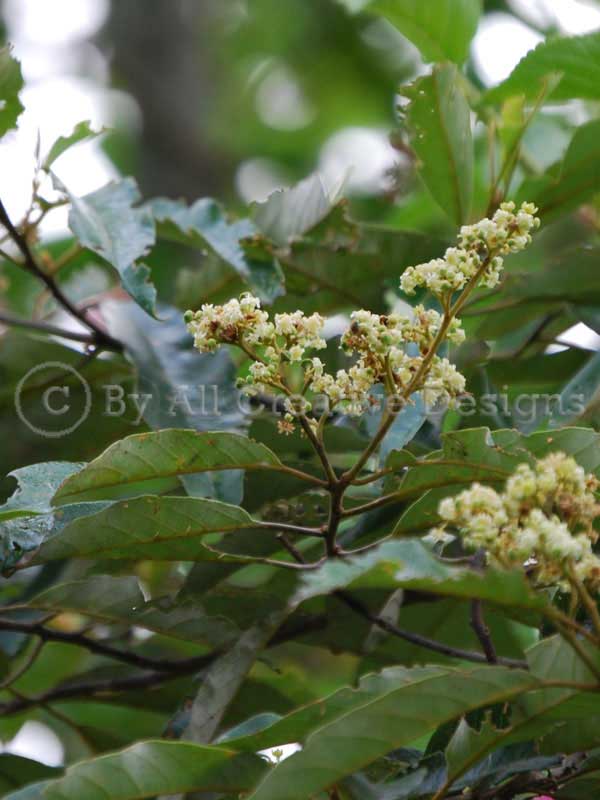
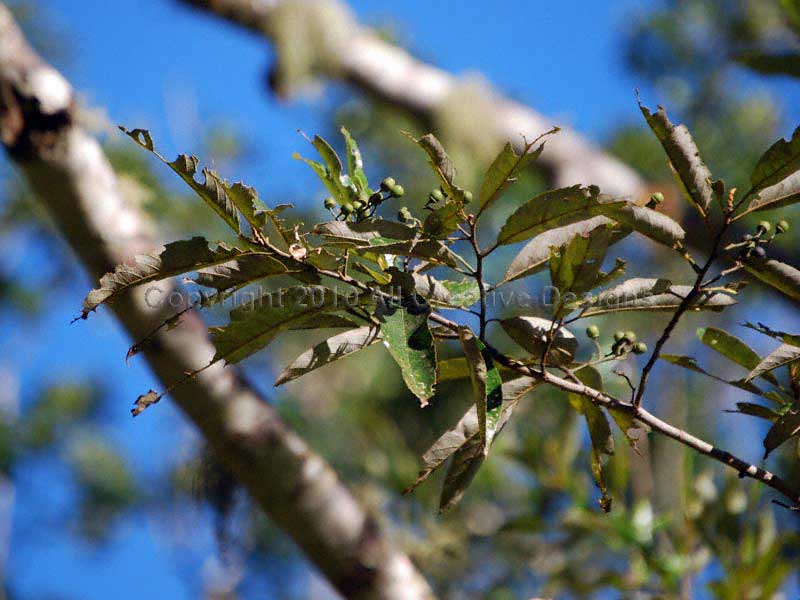
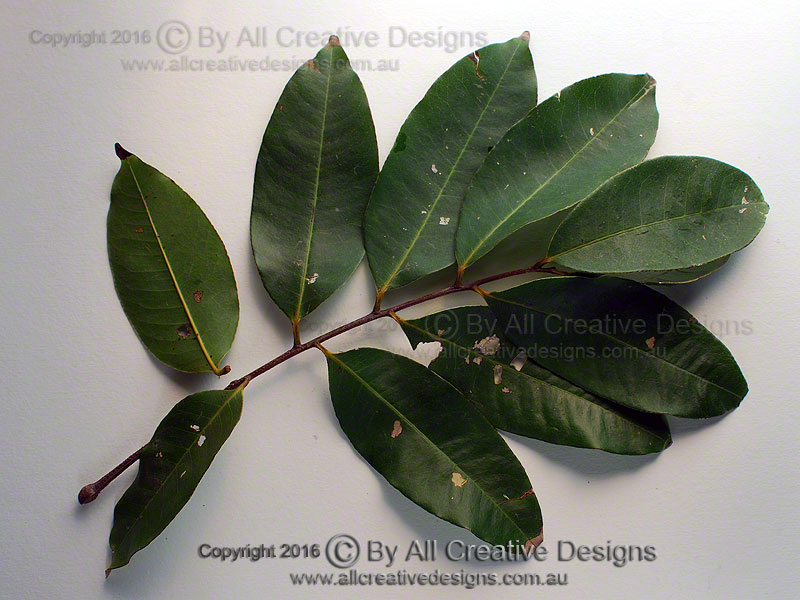
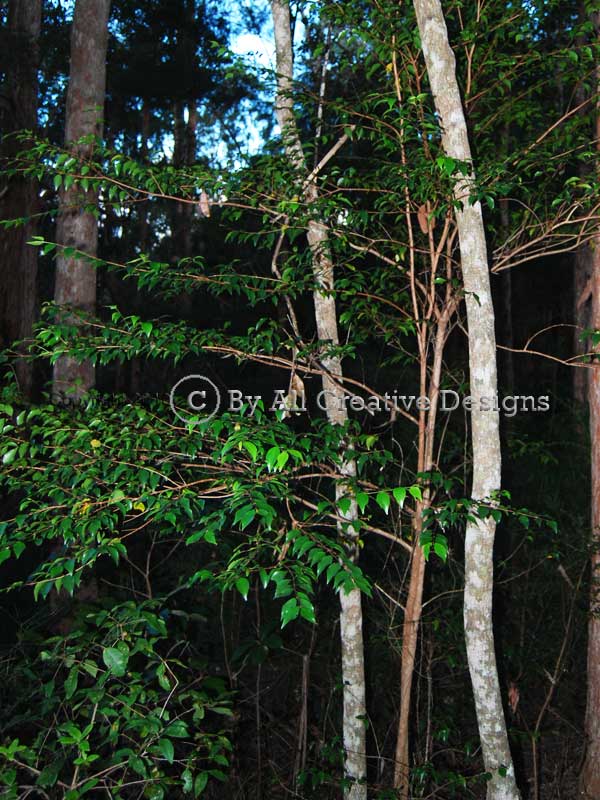
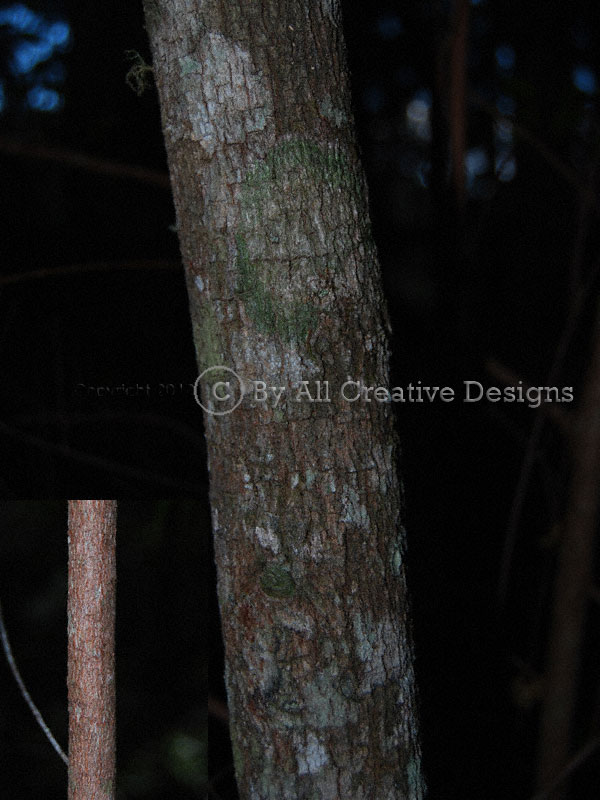
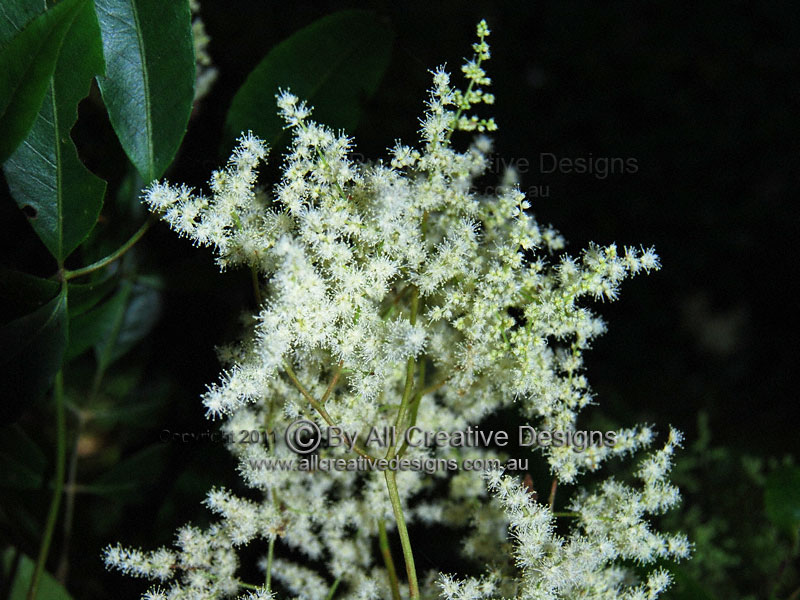
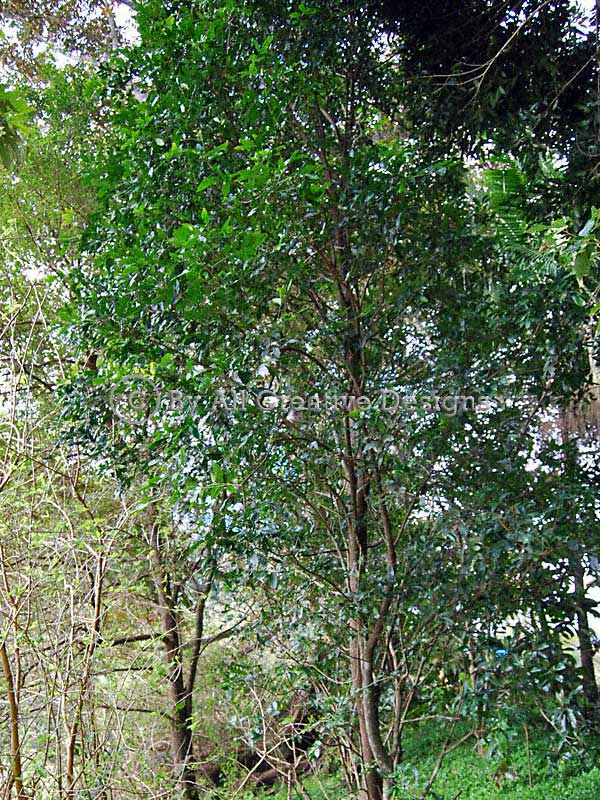
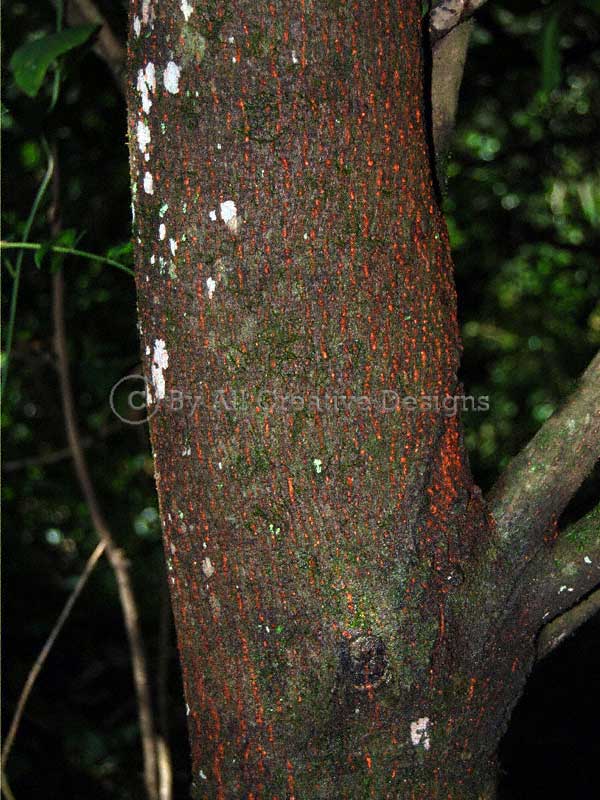
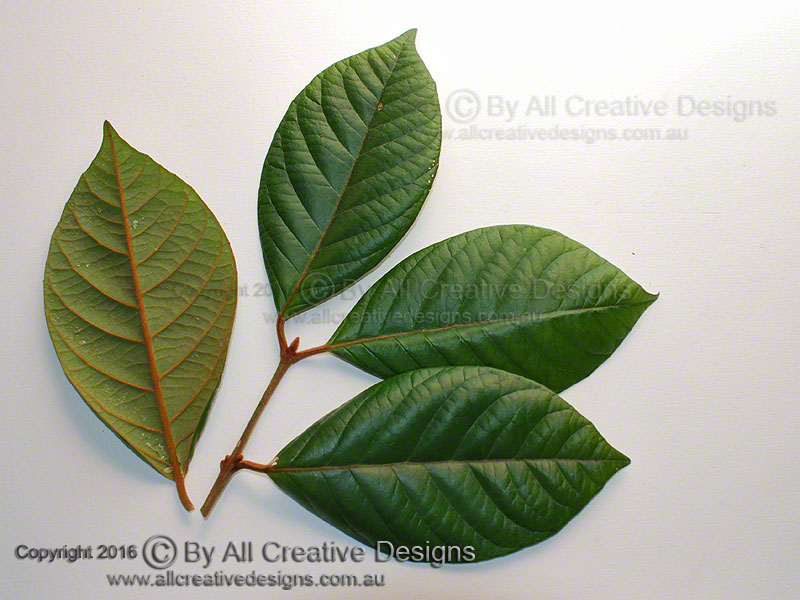
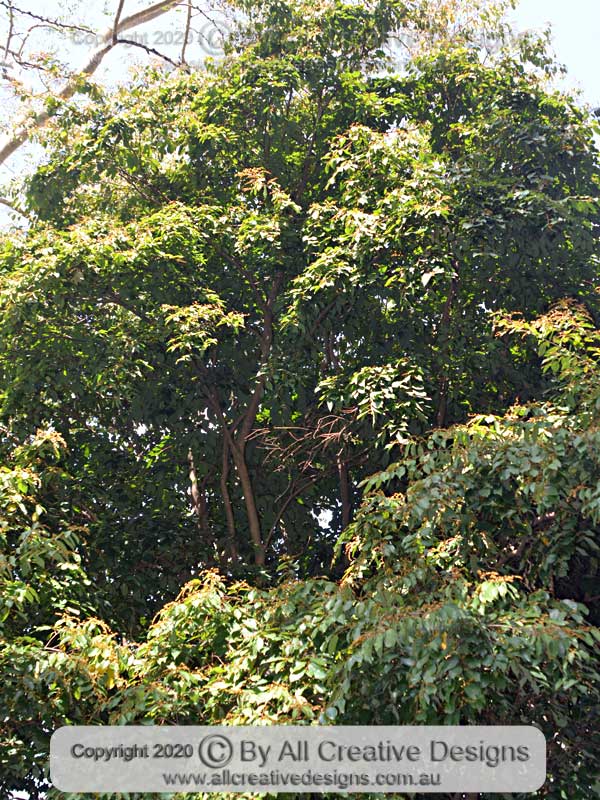
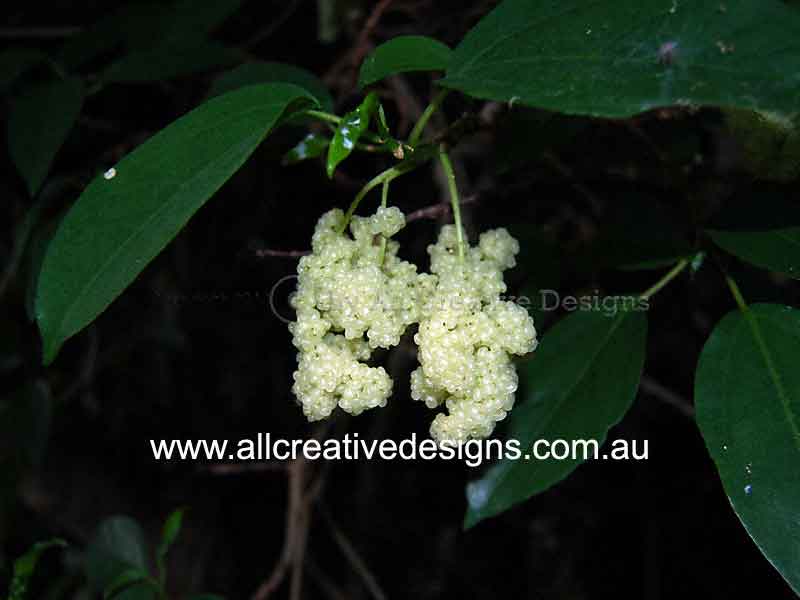
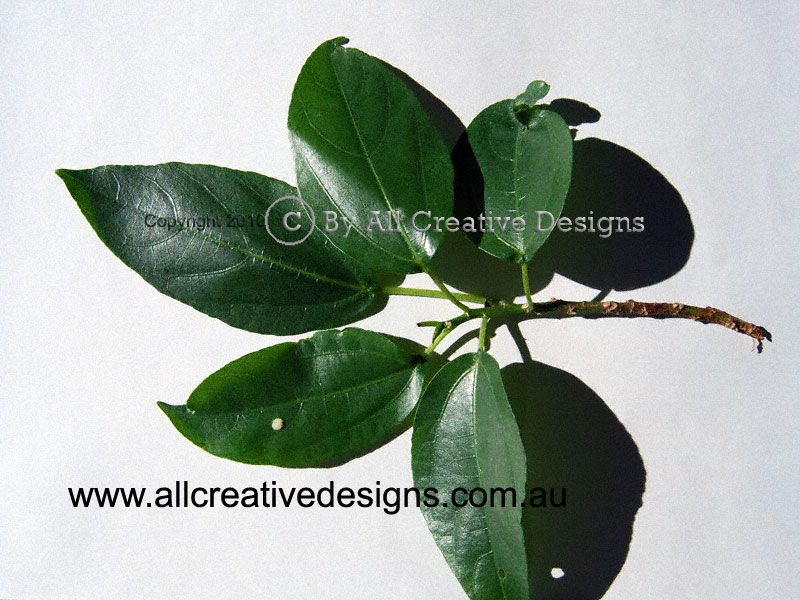
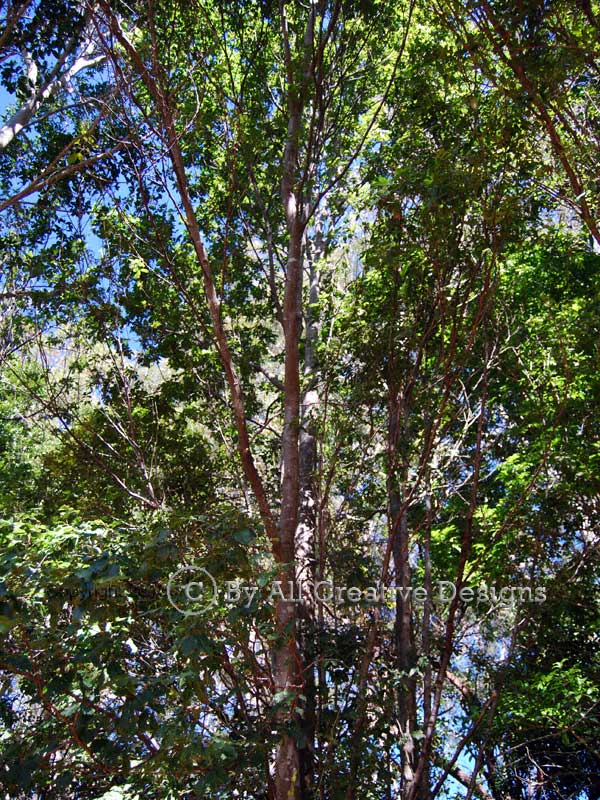
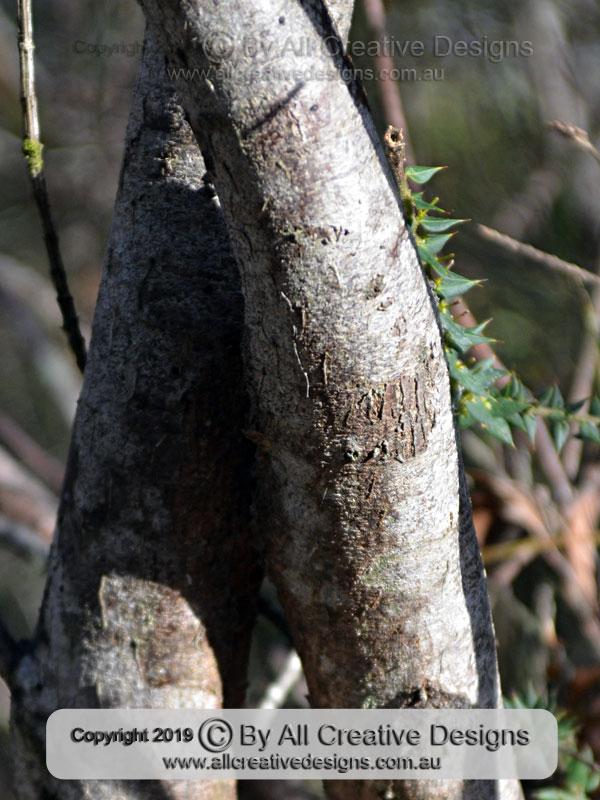
This frequently encountered tree species, found in regrowth and on margins of different rainforest types, has a relative open canopy and reaches 20m in height. Some exceptional specimens growing within subtropical rainforests can be more than 30m tall (Picture 1). Bark is grey in colour with longitudinal fissures. On older trees the trunk is often fluted and bark becomes furrowed and corky at the base (2) Small creamy white flowers appear in spring and are followed by rounded or ovoid shaped fruit turning black when fully mature (Pictures 3 & 4). Simple leaves with an alternate arrangement are; up to 15cm long, oblong to narrow elliptic in shape with entire margins, hairless dark green on top, hairy greyish white beneath and soft in texture. Leaf stalk (petiole) is up to 20mm long and light brown in colour. Mid rib and lateral veins are a yellowish green
(5). The very similar Alphitonia petriei is shown on Page 8. Distribution: South coast of NSW to central Qld.
See Leaf Characteristics Page for explanations of botanical terms used.

(1)

(2)
(3)
(4)

(5)
Green Guide Trees of Australia
How to recognise Australian tree families and genera.
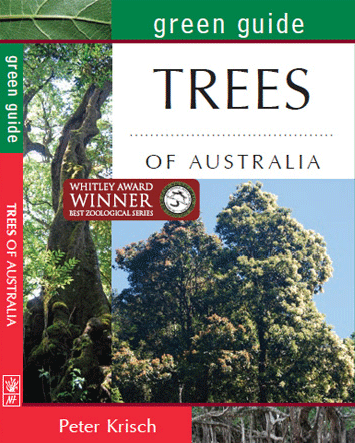
(In Stock) A practical field guide to the identification of native species. More than 200 full colour photographs and detailed descriptions explaining leaf, bark, flower, fruit and other tree characteristics. The guide was written and illustrated by the author of these web pages.
New Holland Publishers: January 2016
Format: Paperback with PVC
Pages: 128 pp.
Size: 13 cm wide x 18 cm high
Price: $19.90
Hand Signed Copies shipped by the Author
CLICK HERE FOR MORE INFORMATION AND CHECK OUTRed-barked Sassafras Cinnamomum virens
Red-barked Sassafras Cinnamomum virens
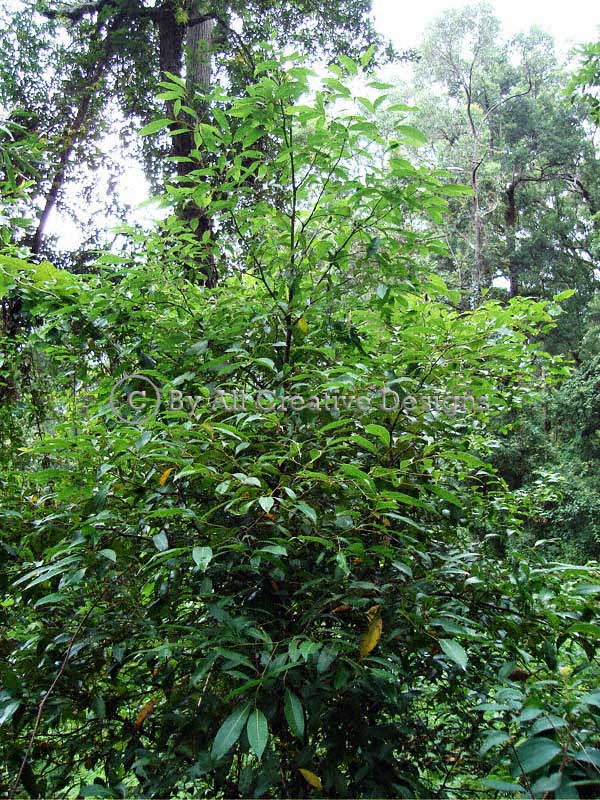
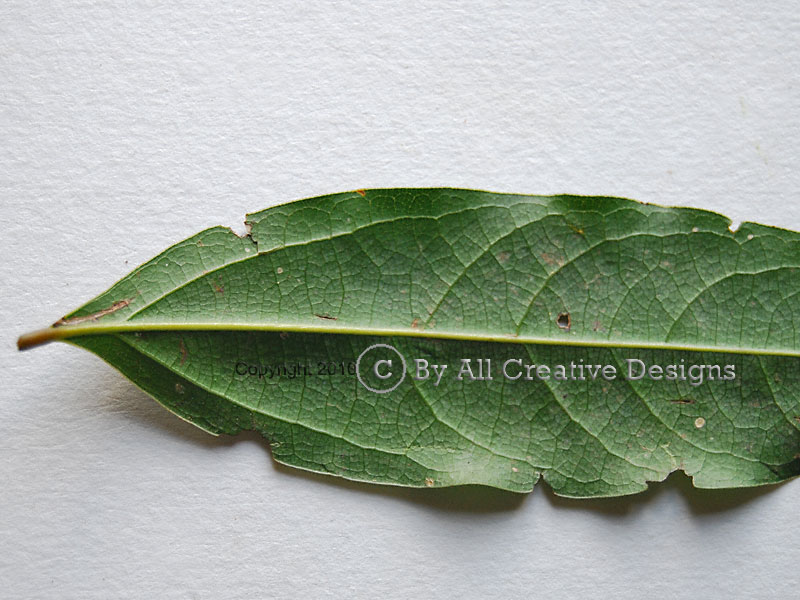
This small to medium sized tree species is a member of the Laurel family (LAURACEAE) known for their spicy scent when leaves are crushed. The Red-barked Sassafras inhabits subtropical and warm temperate rainforests (Photo 1). Bark is reddish brown in colour, firm with fine fissures and some blisters (2). Simple leaves with an opposite arrangement are; up to 13cm long, mostly lanceolate (lance-shaped) or sometimes elliptic with entire margins, dark green and glossy on top, paler and semi glossy beneath, hairless, scented when crushed, firm and stiff in texture. Leaf apex is acute, base shape is cuneate. Leaves are mostly three-veined in the lower part of the lamina, which is a good identification characteristic. Fine reticulate venation is visible under a lens (3, 4 & 5). Distribution: From the central coast of NSW to southern Qld.
(1)
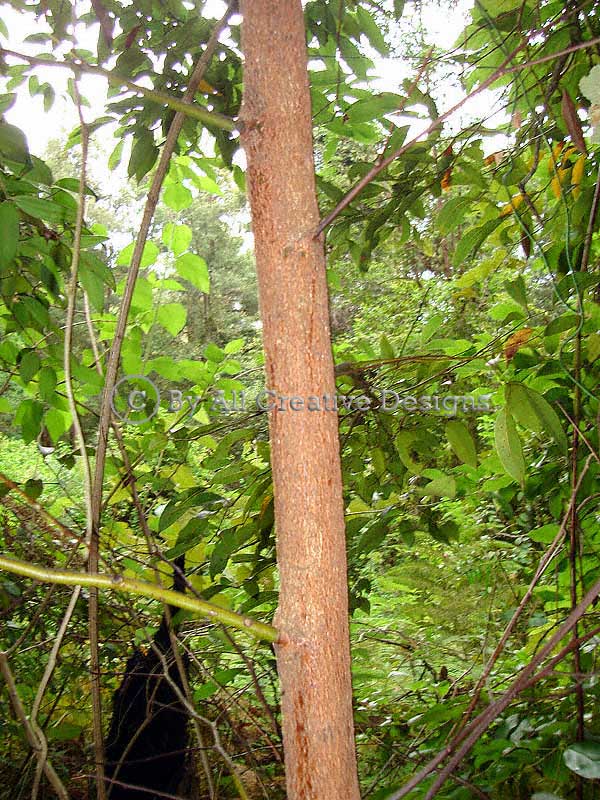
(2)
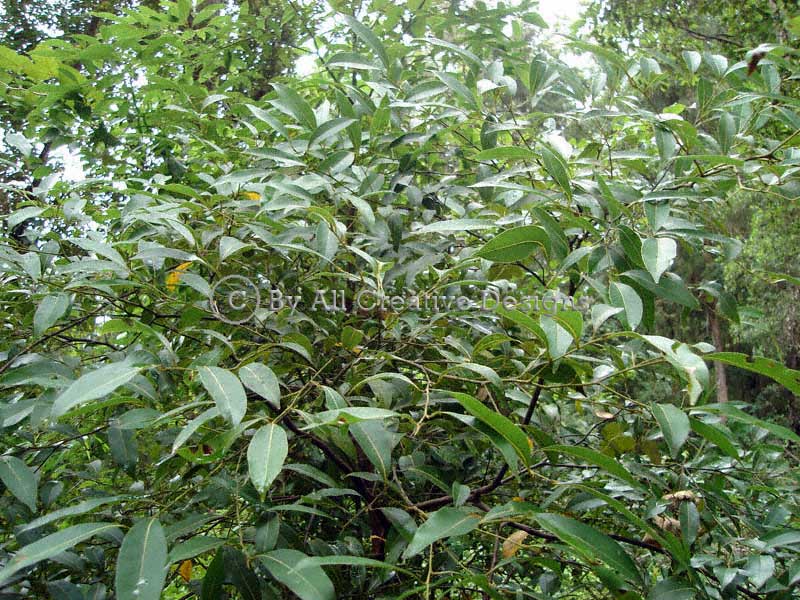
(3)

(4)
(5)
Red Bauple Nut Hicksbeachia pilosa
Red Bauple Nut Hicksbeachia pilosa Other names: Ivory Silky Oak
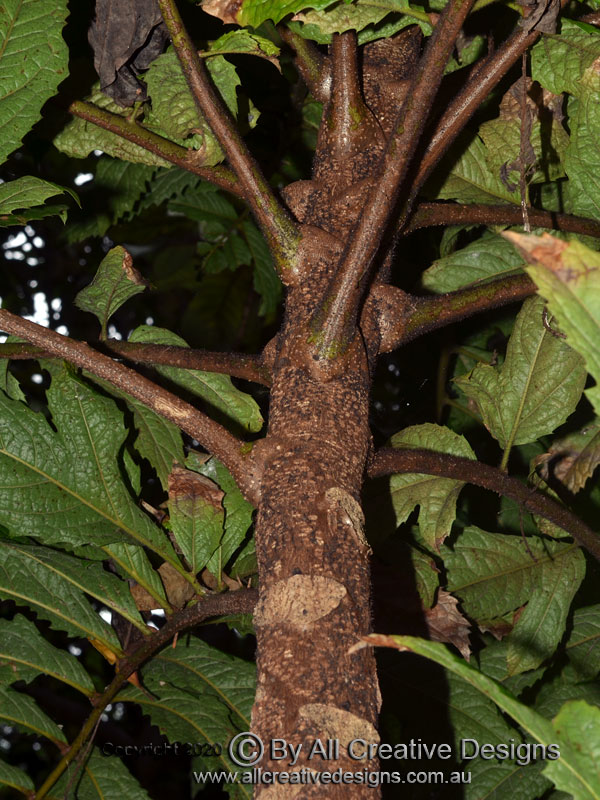
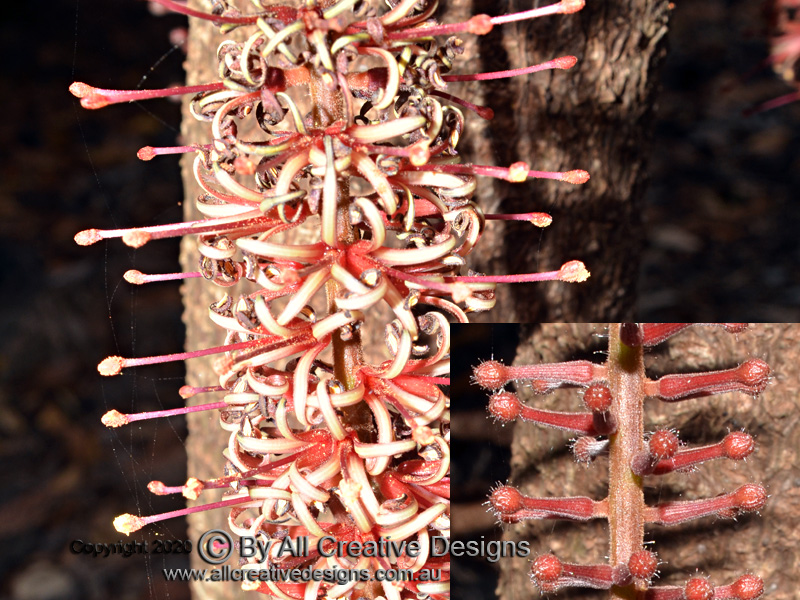
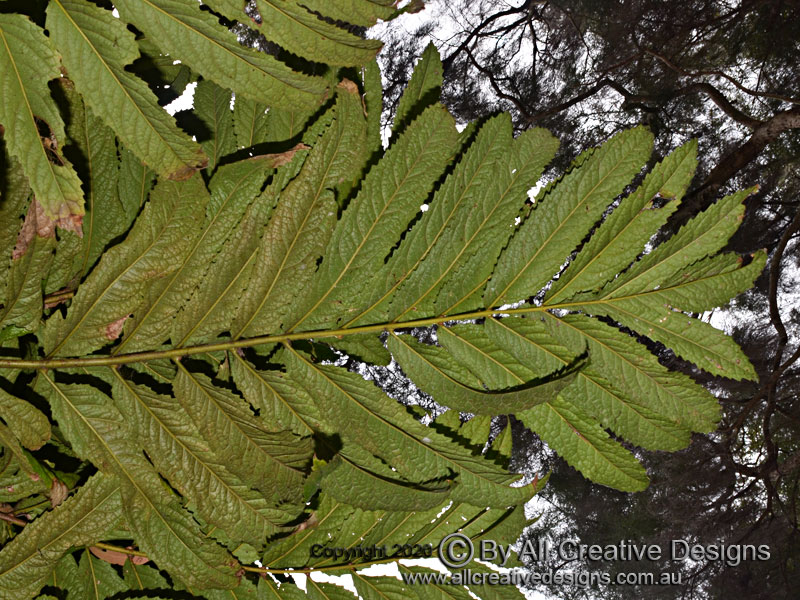
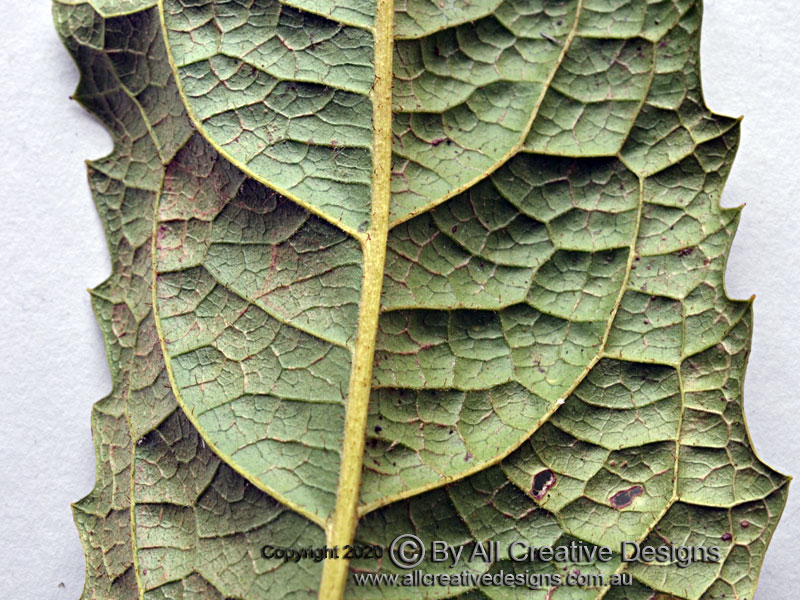
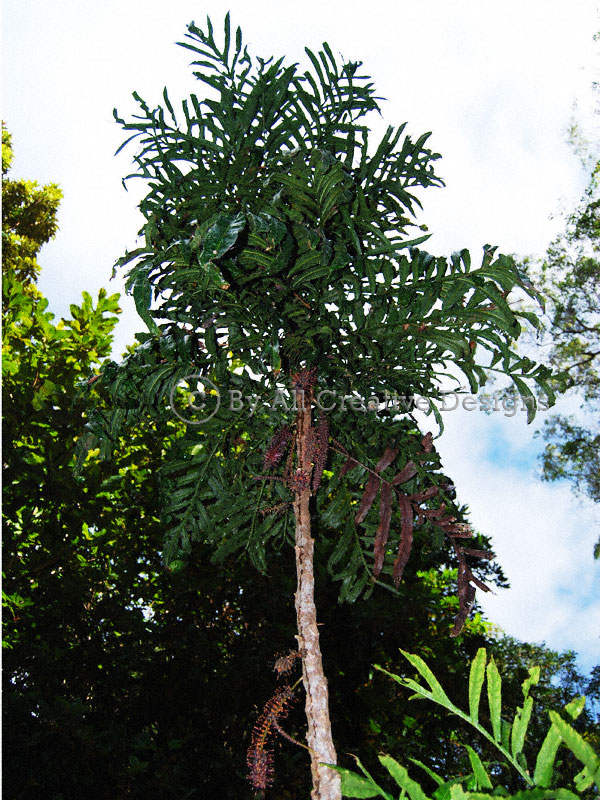
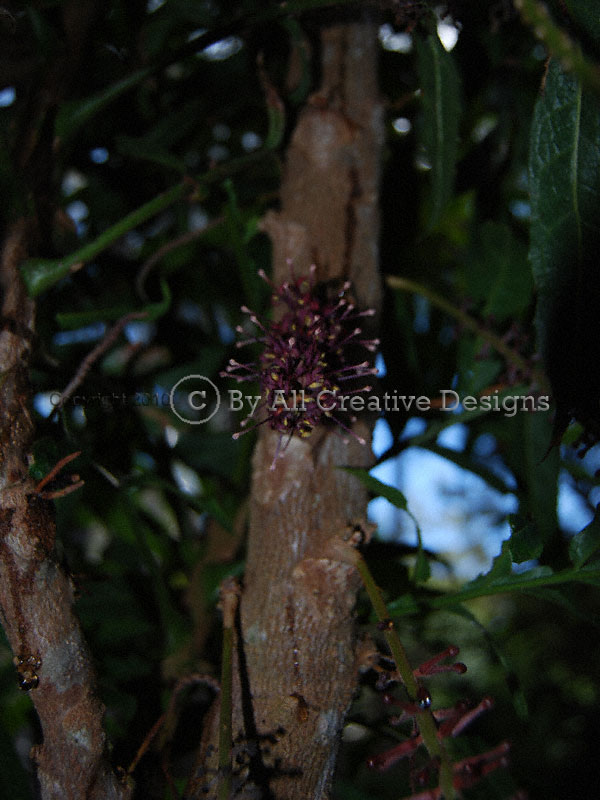
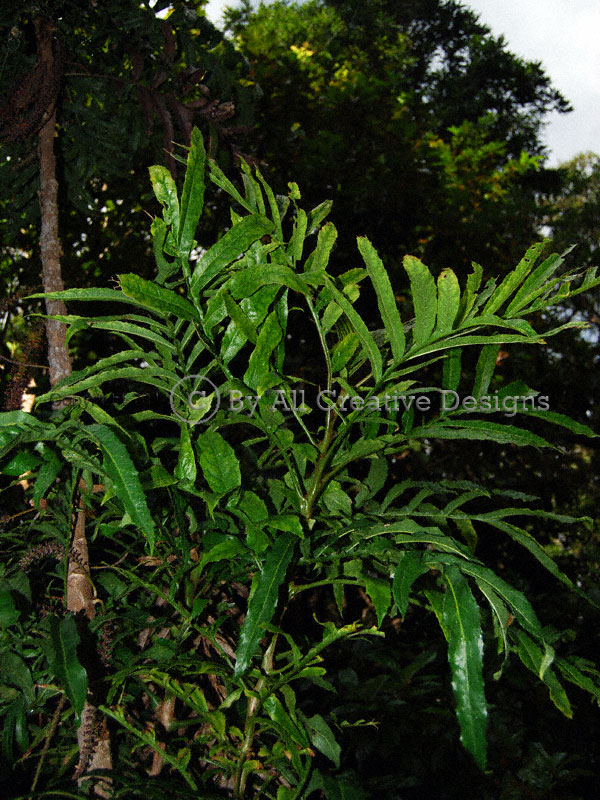
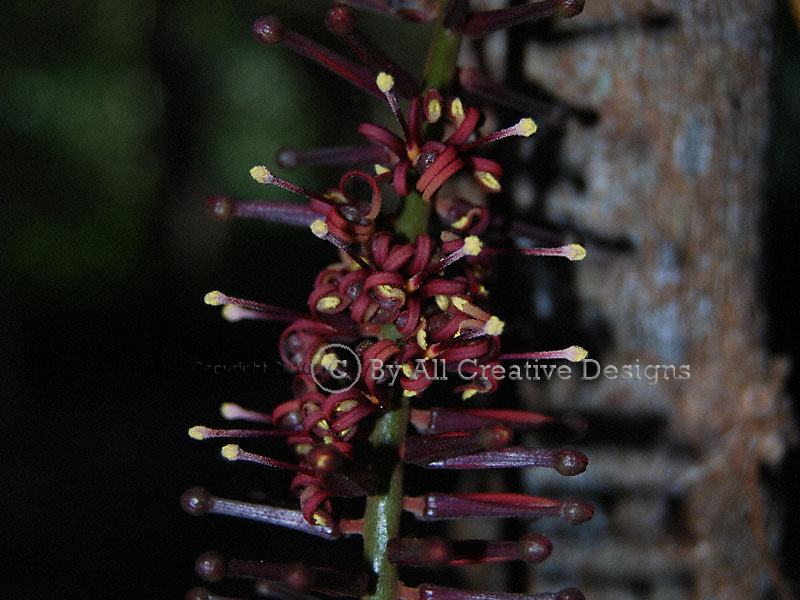
Tropical rainforests are the exclusive native habitat of this elegant small tree that reaches a height of up to 6m. The slender (non-branching or sparsely branching) upright habit and large compound leaves that leave obvious scars on the trunk are identifying features (Images 1 & 2). Bark is firm, brown in colour and on older trunks becomes rough and scaly (2). The drooping (flower) racemes emerge on the trunk (cauliflorous), can be more than 25cm long and bear more than 100 individual flowers. Normally 2 flowers are attached to a single stalk. Before opening, the perianth (floral tube) is 2 to 3cm long, hairy and pink or reddish brown on the outside (Image 3 inset). It splits into 4 re-curving lobes (tepals) that are hairless and cream-coloured on the inside. In the centre, the prominent straight style is a dark pink or purplish colour and hairy towards the base. The pollen presenter at the top of the style is roughly ovoid (egg-shaped). Flowers emit a sweet pungent scent (Image 3). The large pinnate compound leaves reach 1m in length and can feature more than 30 individual leaflets, which are; up to 35cm long, mostly oblong in shape with sharply toothed margins, hairless and dark green on top, pale green and finely brownish hairy on veins beneath, very strong and rigid in texture. The rachis towards the apex of the compound leaf can be winged (4 & 5). Distribution: North-eastern Qld. Note: The genus Hicksbeachia only comprises this species and the very similar H. pinnatifolia (Red Bopple Nut) listed below. See Leaf Characteristics and Flower Identification Page for explanations of botanical terms used.
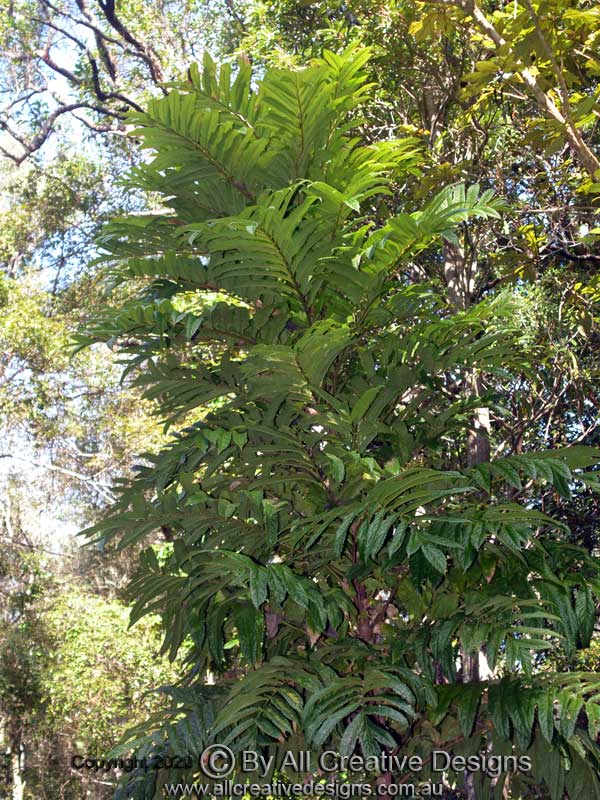
(1)
(2)
(3)
(4)
(5)
Red Boppel Nut Hicksbeachia pinnatifolia
Red Boppel Nut Hicksbeachia pinnatifolia
This beautiful small and relative uncommon tree species has an upright and slender growth habit. It rarely reaches more than 10m in height and inhabits subtropical rainforest as an understorey species (Picture 1). Bark is light brown in colour, firm and finely fissured (2). The distinctive foliage features large compound leaves that are able to reach more than 80cm in length. They show an alternate arrangement and are a characteristic feature in the identification of this tree species (Picture 3). The beautiful drooping flower racemes are up to 40cm long and appear on the trunk (cauliflorous) over late autumn and winter. The perianth (floral tube) is about 2cm long, sparsely hairy and purplish on the outside. The floral tube divides into 4 re-curving segments (lobes) that are hairless and maroon coloured on the inside (4). Leaves are very deeply lobed (pinnatifid), giving the appearance of separate leaflets, with more than 30 lobes possible on the same leaf. Lobes have irregular toothed margins with small spines and are; up to 25cm long with a dark green and glossy upper surface, hairless with a firm and stiff texture (5). Distribution: NSW mid north coast to southern Qld.
(1)
(2)
(3)
(4)
(5)
Red Carabeen Karrabina benthamiana [Geissois benthamii]
Red Carabeen Karrabina benthamiana
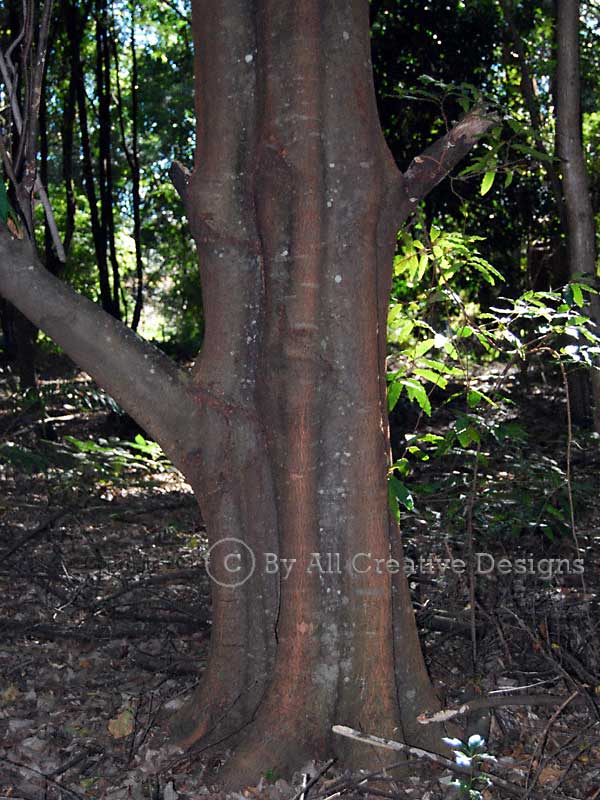
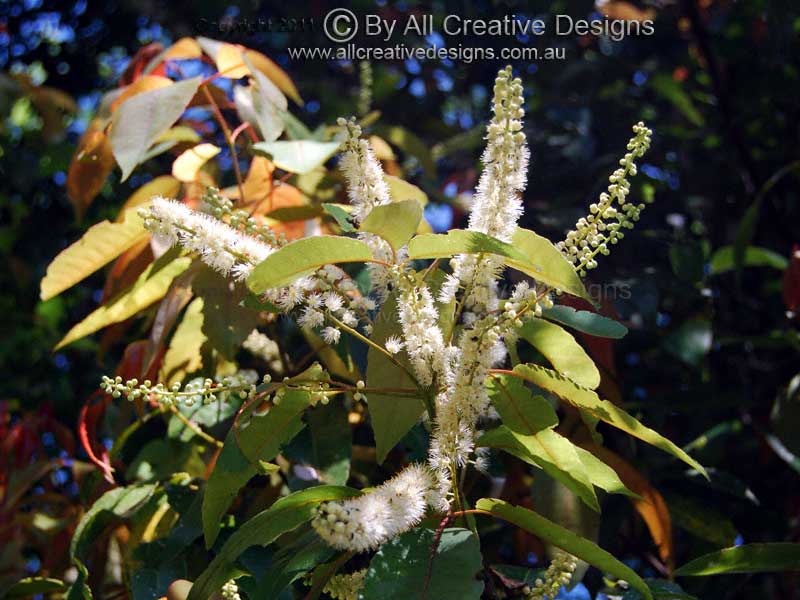
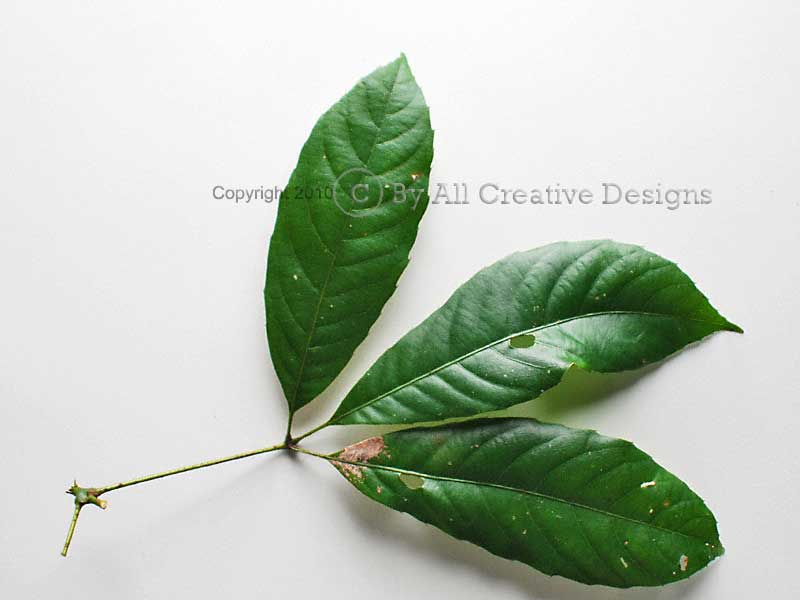
This very attractive native tree reaches a height of up to 40m. It inhabits subtropical and warm temperate rainforests, where it can form the uppermost canopy (Picture 1). Older specimens develop beautifully fluted and buttressed trunks with a fairly smooth, reddish brown bark showing small fissures (2). The long flower racemes are up to 20cm long and hold a large number of stalked white to pale yellow coloured flowers, which blossom in late spring to early summer. New leaf growth flushes in pink-salmon colours turning to a bright red thereafter (3). The fruit is a softly hairy and dry capsule up to 20mm long. It splits along its sides to disperse a number of flattened brown seeds with a small papery wing on one side (4). The large and leafy stipules (on young growth at nodes) are prominent features when identifying the Red Carabeen, which has been recently reclassifiied as Karrabina benthamiana. Trifoliolate compound leaves with an opposite arrangement consist of 3 leaflets, which are; up to 20cm long, elliptic or oblanceolate (reverse lance-shaped) with toothed margins, hairless, glossy and rather firm. Apex is acute or short acuminate, base shape is cuneate. Petiolules (leaflet stalks) are up to 15mm long and the strong petiole (leaf stalk) can reach 10cm or more. Venation is clearly visible showing prominent curved lateral veins (5). Distribution: NSW mid-north coast to southern Qld. See Leaf Characteristics and Flower Identification Page or Bark Characteristics Page for explanations of botanical terms used.

(1)
(2)
(3)

(4)
(5)
Red Cedar Toona ciliata
Red Cedar Toona ciliata [Toona australis]
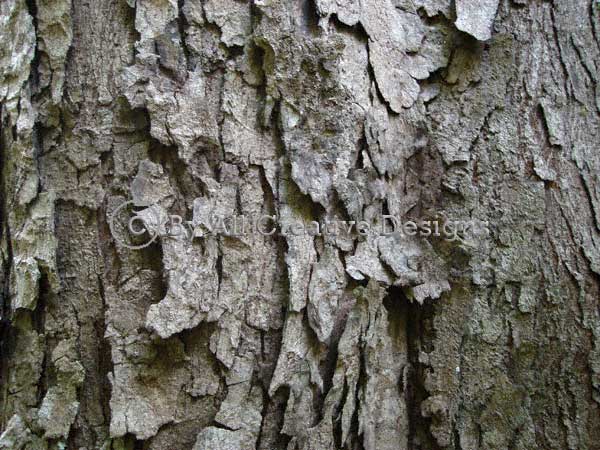
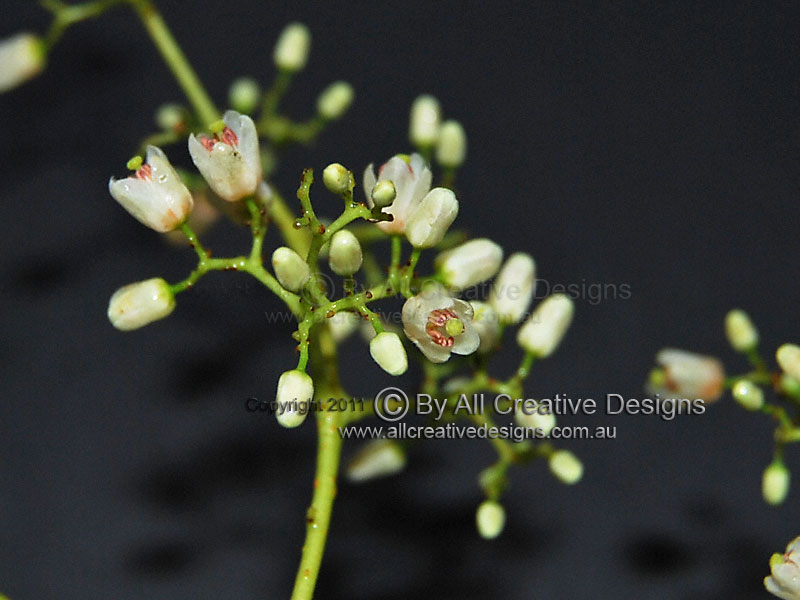
The Red Cedar is a magnificent very large tree species that reaches a height of more than 50m and develops an expansive buttress root system. Best development occurs on nutrient rich soils in subtropical rainforests, whereas trees found in drier types of rainforests are reduced in size. Specimens, as the one shown, are rare these days due to extensive logging for its beautiful timber since the 1830's (Picture 1). Bark on mature trees is a light brown colour with large scales and a rough, flaky texture (2). Small whitish flowers are held on drooping panicles, measure up to 4mm in diameter and bloom over spring (3). The obovoid (pear-shaped) fruit is up to 20mm long and features 5 lobes (chambers) containing tightly packed winged seeds. Fruit turns browner in colour with maturity, but is often attacked by insects at this stage (4). After a short deciduous time over winter, new emerging foliage flushes in red tones. Pinnate compound leaves consist of up to 20 leaflets, which are; up to 14cm long, mostly ovate in shape with entire margins, hairless, smooth and rather soft in texture. Leaflet apex is short acuminate ending in a fine point and base shape is asymmetric. Venation is clearly visible and domatia are present as hairy tufts on lower leaflet surface (5). Distribution: NSW central coast to Qld.

(1)
(2)
(3)

(4)

(5)
Red Kamala Mallotus philippensis
Red Kamala Mallotus philippensis Other names: Orange Kamala
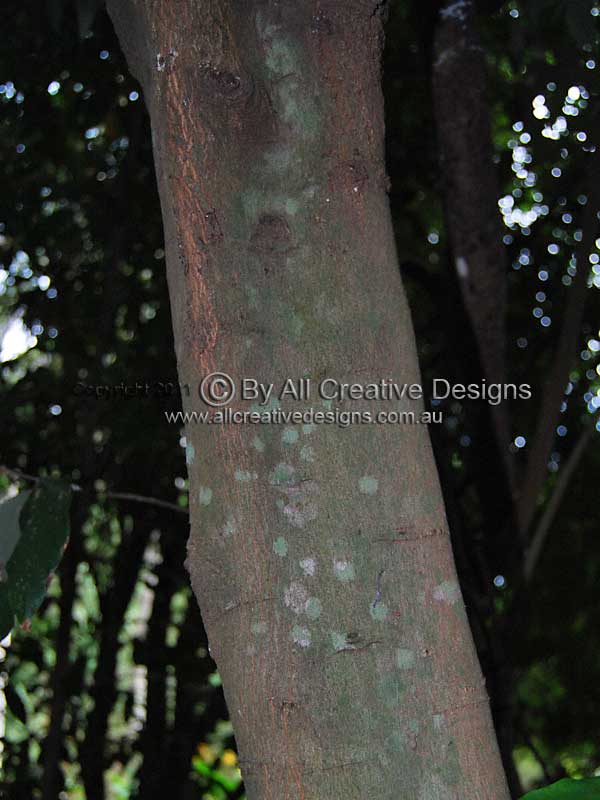
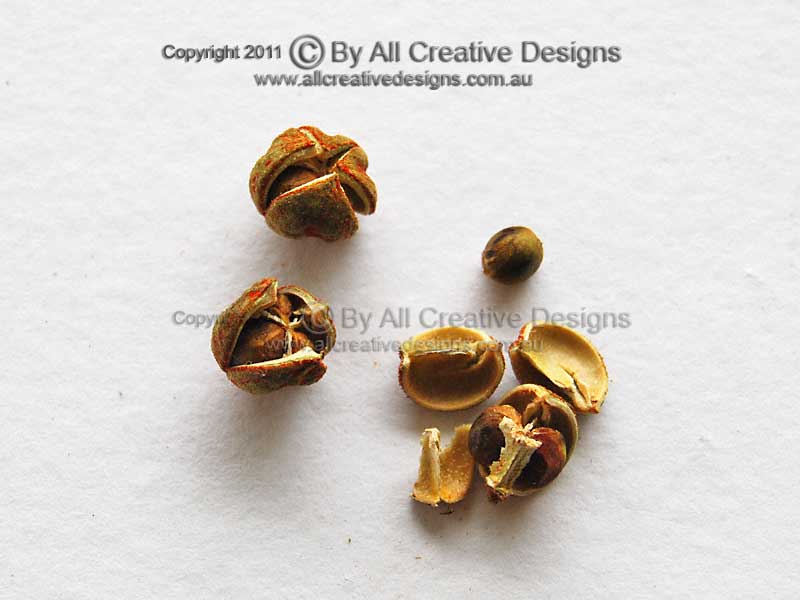
This small understorey tree species is a common occurrence on margins of subtropical and other rainforests types, in regrowth areas and in tall Eucalypt dominated forests. Under favourable conditions the Red Kamala can attain a height of more than 10m and often develops an attractive dense crown (Image 1). Bark on mature specimens is hard with a fairly smooth texture and mostly shades of grey green in colour. Some patches are finely fissured and expose a brown underlying fresh bark (2). Small greenish yellow flowers are held on racemes, which are up to 20cm long, covered in fine brown hair and bloom over spring (3). The fruit is a tough and 3 lobed (chambered) capsule, orange to red in colour, which splits lengthwise to reveal 3 hard and brownish coloured seeds (4). Simple leaves with an alternate arrangement are; up to 22cm long, ovate to broadly lanceolate (lance-shaped) with mostly entire margins, mid-green and hairless on top, greyish green and covered in fine hair below, rather thin and soft in texture. Leaf apex is acute, base shape is rounded. The three prominent veins in the lower half of the leaf are a typical feature for this species. The long petiole (leaf stalk), which is hairy and can be more than 8cm long, is a distinctive feature in identification (5). Distribution: From NSW central coast to Qld. See Flower Characteristics Page and Leaf Characteristics Page for information on terms used.

(1)
(2)

(3)
(4)
fs.jpg)
(5)
Red Olive Berry Elaeodendron australe
Red Olive Berry Elaeodendron australe var australe Other names: Red Olive Plum
The Red Olive Plum or Berry is a native shrub or small tree less than 10m in height. It occurs naturally as an understorey species in different types of rainforests and adjacent wet sclerophyll forest (Picture 1). Bark is firm in texture, a reddish brown in colour and shows shallow vertical fissures and small ridges (2). The fruit (a drupe) is often more globose (globe-shaped) than ovoid (olive-shaped), bright red (or orange) in colour and measures up to 25mm in length. A thin fleshy layer covers the hard-shelled seed (Pictures 3 & 4). Simple leaves with an opposite arrangement are; up to 10cm long, mostly broad elliptic in shape with crenate or more bluntly toothed margins, dark green and glossy on top, duller and light green beneath, smooth, strong and slightly stiff in texture. Leaf apex is acute ending in a rounded point, base shape is cuneate and only the mid vein is prominent (5). Distribution: From NSW south coast to northern Qld.
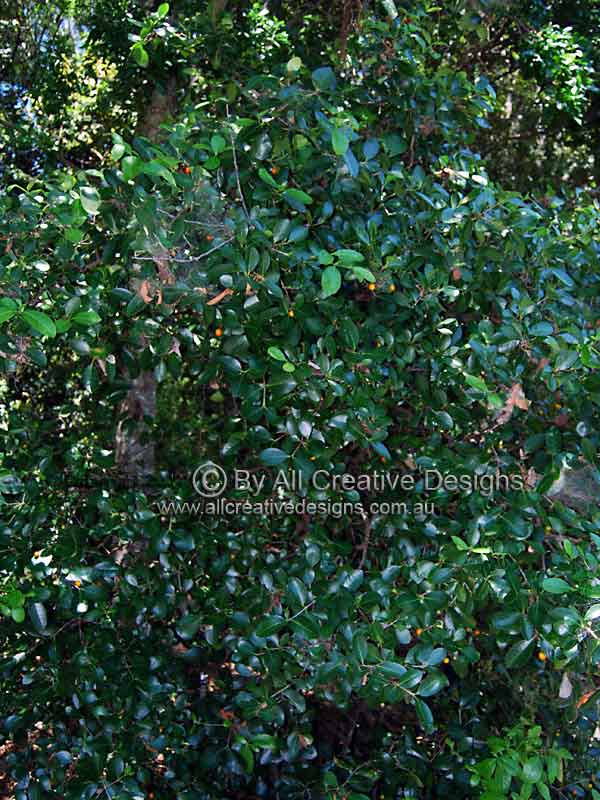
(1)

(2)

(3)
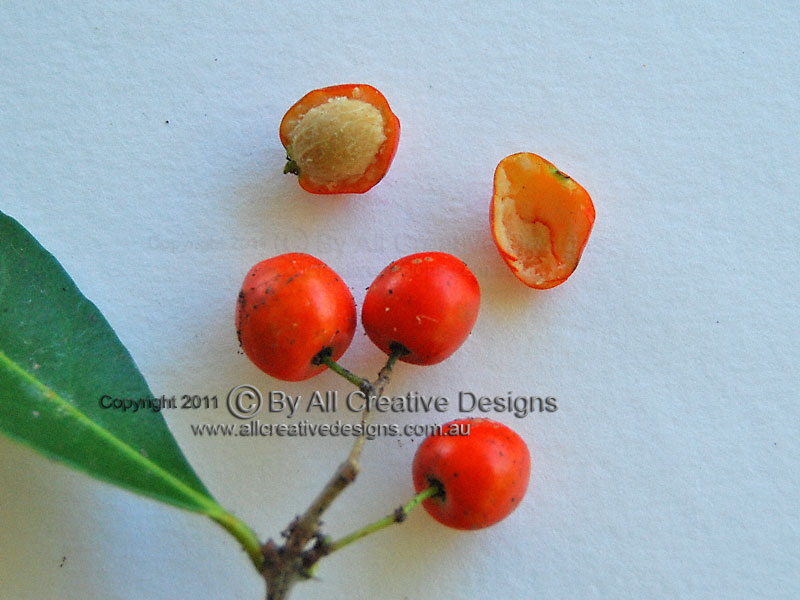
(4)

(5)
See
Leaf -
Flower - Fruit - and Bark Identification Web Pages for explanations of botanical definitions and concepts.
Select images for Full Size View. (Opens new browser window).
Use the Key to Species, which is based on leaf characteristics, to identify native trees and shrubs found on Australia's east coast.
Red Sandalwood Adenanthera pavonina
Red Sandalwood Adenanthera pavonina Other names: Bead Tree, Red Beantree, Coralwood, Circassan Tree, Zumbic Tree, Barricarri and more.
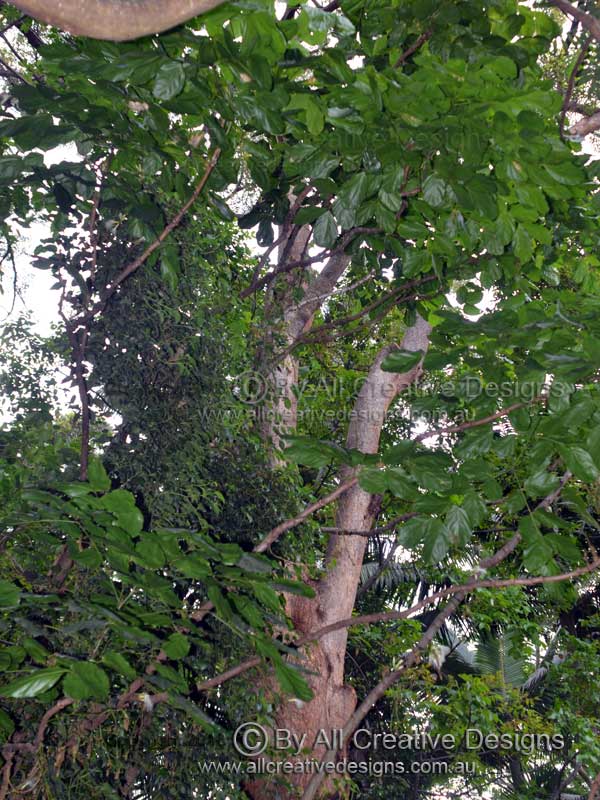
This medium sized tree species is known under a number of different common names, due to its large distribution range across tropical Asia and northern Australia. It can reach a height of more than 20m in its natural habitat of lowland tropical rainforests. Mature trees are deciduous or semi-deciduous for a short time over winter (Picture 1). Bark has a firm and rather smooth texture, but turns rough and flaky around the base of older trees. It is grey with a reddish tinge in colour (2). The fruit is a sickle-shaped pod up to 20cm long, changing from green to black in colour with full maturity. It will split on two sides, then curl and twist when drying, to reveal up to a dozen very hard and bright red coloured seeds. Seeds are very uniform in weight, size and shape making them useful as beads in craft work. Fruit ripens over winter into spring (3 & 4). Large bipinnate compound leaves are up to 40cm long with up to 6 pairs of pinnae, each holding up to 15 individual leaflets. Leaflets are: between 2 to 4cm long, mostly oblong in shape with entire margins, hairless when mature, dark green, dull on top, paler green beneath, thin and soft in texture. Leaflet apex and base shape is rounded. Fine venation is more visible on lower leaflet surface (3 & 5). Distribution: Northern tropical Qld, WA & NT and Asia.
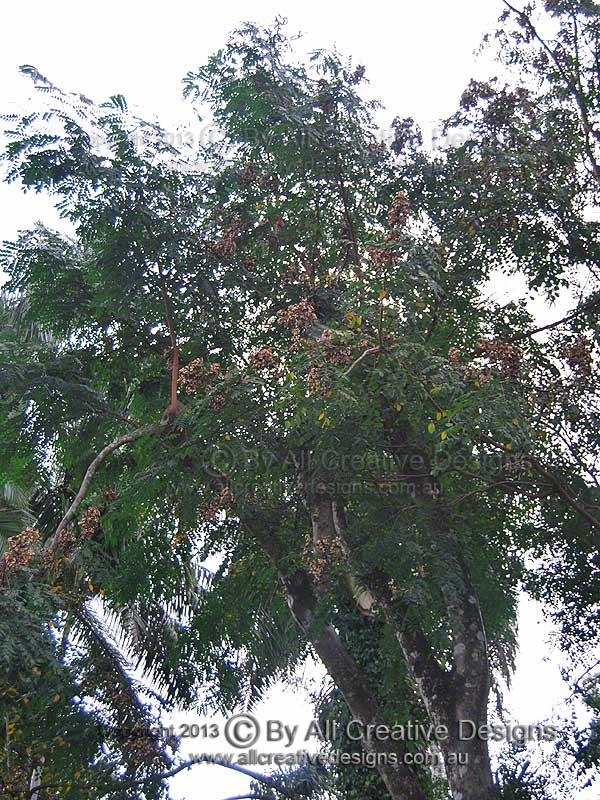
(1)
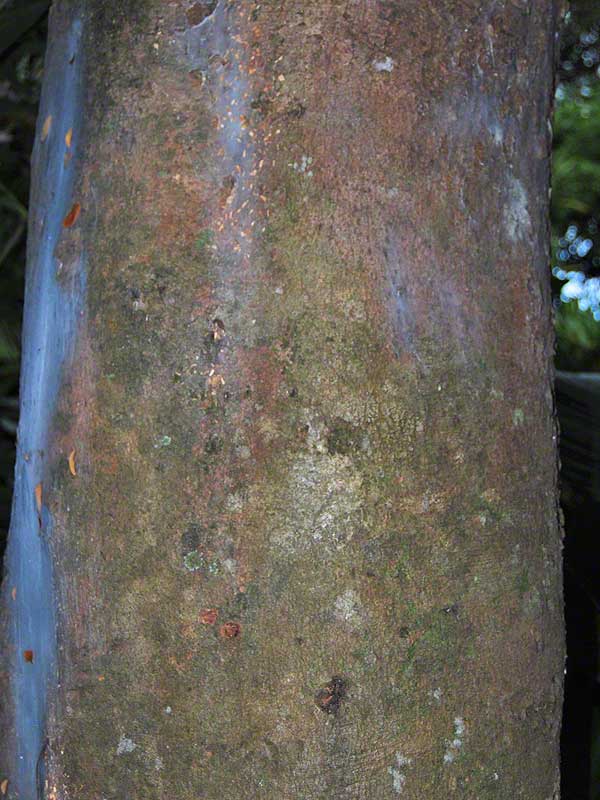
(2)
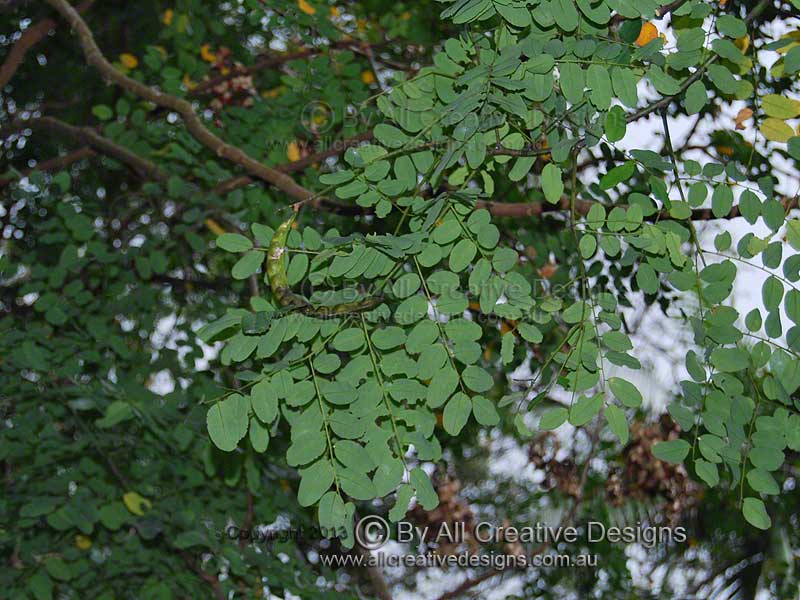
(3)

(4)

(5)
Red Tulip Oak Argyrodendron peralatum
Red Tulip Oak Argyrodendron peralatum Other names: Red Crowsfoot
This stately tree can reach a height of up to 50m in its habitat of tropical rainforests, where it often forms the uppermost canopy. The column like trunk on mature trees is often branchless to half or more of its height (Picture 1). The large wing-like buttress roots that develop on older specimens are a good initial identification feature (2). Bark texture is scalier and a more reddish brown in colour compared to that of its close relative the Brown Tulip Oak or White Booyong (Argyrodendron trifoliolatum) (3). Compound leaves feature three leaflets (trifoliolate) which are; up to 18cm long, mostly elliptic in shape with entire margins, mid green, semi-glossy on top, whitish or silver coloured beneath, (good identification feature), rather thin but strong in texture. Leaflet apex is short acuminate, base shape is cuneate. Centre vein is prominently raised and can be covered in rusty scales on lower leaflet surface, up to 30 pairs of fine laterals veins are showing. The strong petiole (leaf stalk) is up to 10cm long. Distribution: Tropical east coast of Qld. See also: Black Booyong (Argyrodendron actinophyllum) on Page 1 and White Booyong (Argyrodendron trifoliolatum) Page 12.
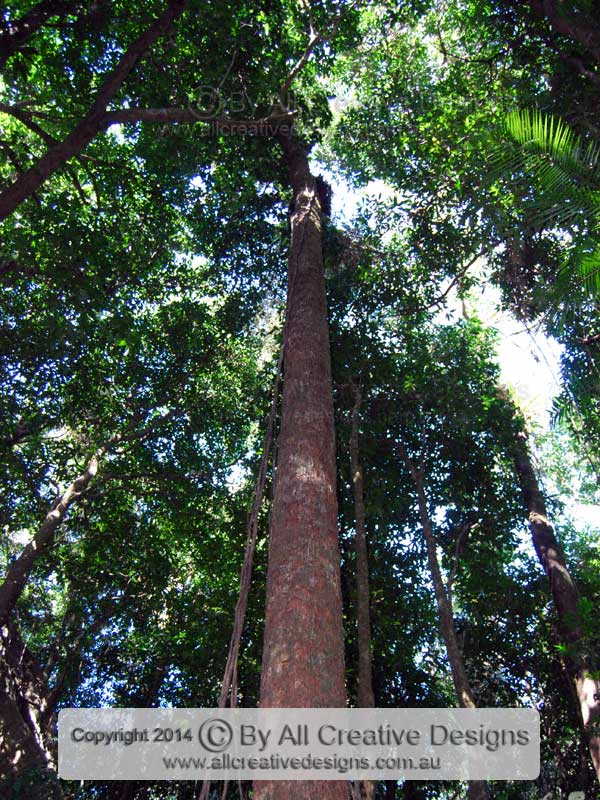
(1)

(2)

(3)

(4)

(5)
Descriptions and all images copyright ©2023 by www.allcreativedesigns.com.au world wide rights reserved.
Click or Tap Images for Full Size View (Opens new browser window)
Ribbonwood Euroschinus falcatus
Ribbonwood Euroschinus falcatus Other names: Pink Poplar, Chinaman's Cedar, Maiden's Blush, Cudgerie
Due to its extensive distribution range, this attractive tree is known under a number of common names, confusingly the names Maiden's Blush and Cudgerie are also used for other unrelated species. Under ideal conditions the Ribbonwood reaches a height of more than 25m and with age forms a relative dense canopy with bright green foliage. It is a common species found in many different habitats ranging from mountainous regions at elevations above 1000m to the shoreline (1). Bark is brown in colour (grey patches are caused by lichen) and becomes rough, furrowed and scaly at the base of trunks of older trees. A fruity scent is emitted when younger branches are rubbed (2). In some years prolific flowering over spring and summer makes this species a standout feature with large conspicuous multi-branching panicles appearing towards the end of young branches. Each panicle bears large numbers of small cream coloured flowers that open successively over a period of time. Flowers with 5 ovate petals measure about 5 to 6mm across when fully opened. Male flowers (shown) feature 10 stamens with white filaments topped by large anthers (in relation to the size of the flower) that are bright yellowish-orange in colour (3). The fruit is a fleshy drupe that turns black at full maturity and contains a brown coloured flattened seed (4). Pinnate compound leaves consist of up to ten leaflets, which are; up to 10cm long, mostly ovate in shape with entire margins, hairless, dark green, smooth and faintly mango-like scented when crushed. Leaflet base shape is asymmetric. Conspicuous domatia (inset 5) appear as bristly tufts along the centre vein on the underside of leaflets. This and other specific characters such as smell make it relative easy to identify this tree species (5). Distribution: Two variations are recognised; E. falcatus var.falcatus from southern NSW to northern Qld and E. falcatus var. angustifolius north from central Qld.
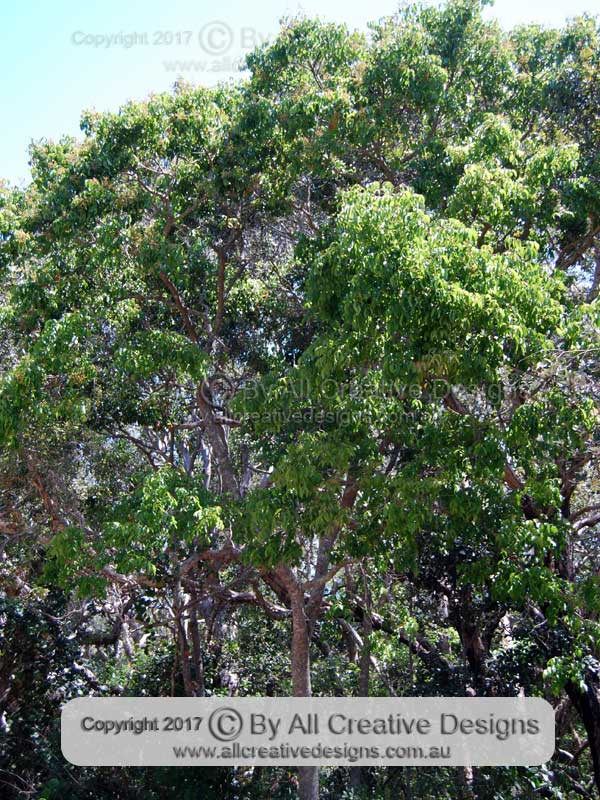
(1)

(2)
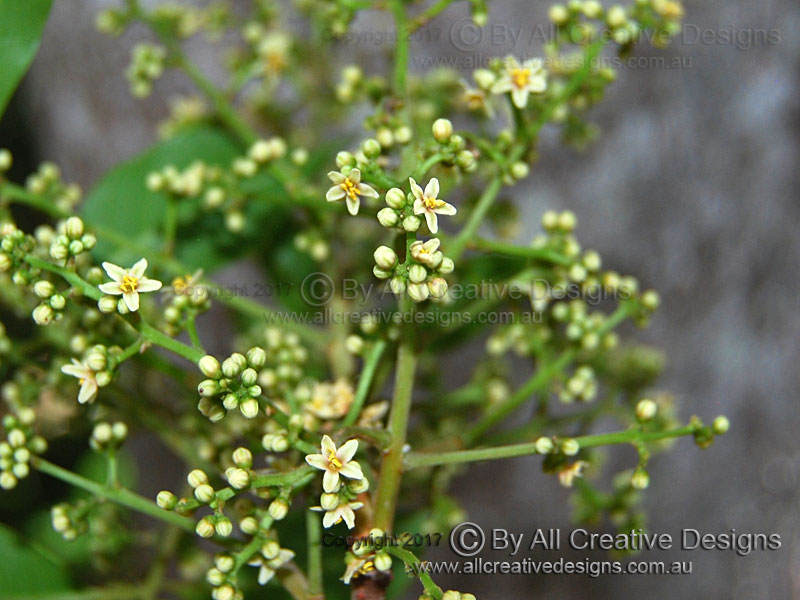
(3)

(4)

(5)
Ringwood Anetholea anisata
Ringwood Anetholea anisata [Syzygium anisatum, Backhousia anisata] Other names: Aniseed Myrtle, Aniseed Tree
This beautiful tree species can attain a height of up to 40m and naturally occurs along water courses, but is rare these days due to clearing of subtropical rainforests. The specimen shown is regularly affected by flooding (Photo 1). Bark is a weathered grey with shallow furrows on older specimens, compared to the reddish brown bark with a softer texture on younger trees (2 & 3). Vibrant green and uniform foliage is a prominent feature when identifying this species (4). Simple leaves with an opposite arrangement are; up to 11cm long, elliptic or lanceolate (lance-shaped) with very wavy margins, hairless, rather thin but firm in texture. Leaf apex is long acuminate, base shape is cuneate. Mid vein is pronounced on lower leaf surface and numerous straight laterals are faintly visible. Petioles (leaf stalks) and young stems are coloured red. Identify leaves by the pleasant aniseed odour emitted when crushed (Photos 4 & 5). Distribution: Rare, small natural range on the mid-north coast of NSW.
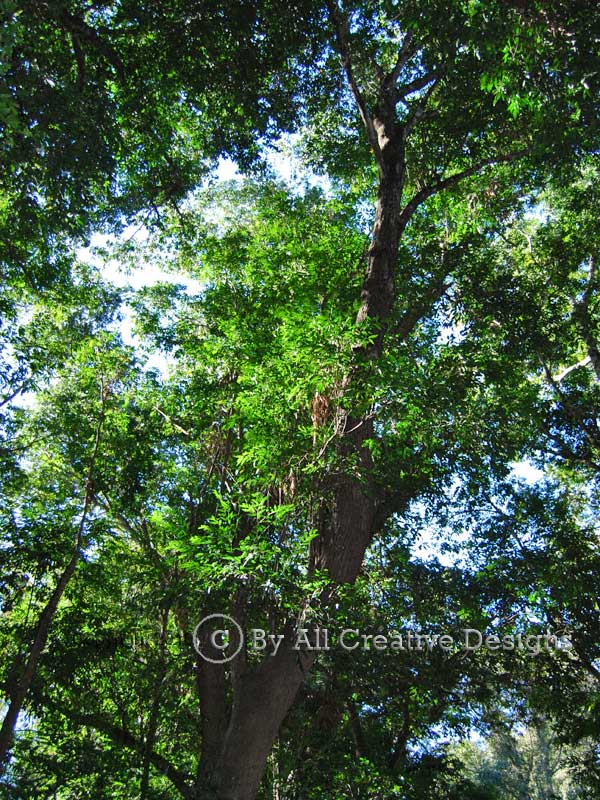
(1)
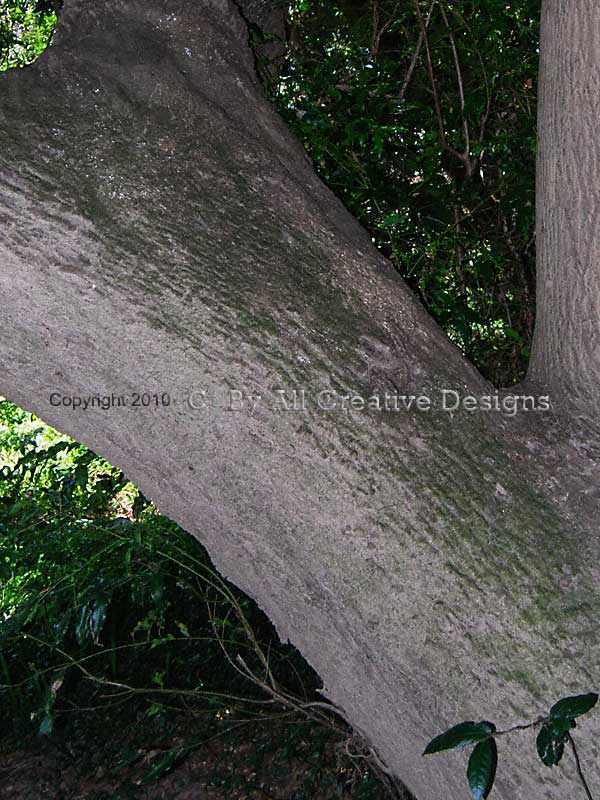
(2)

(3)

(4)
fs.jpg)
(5)
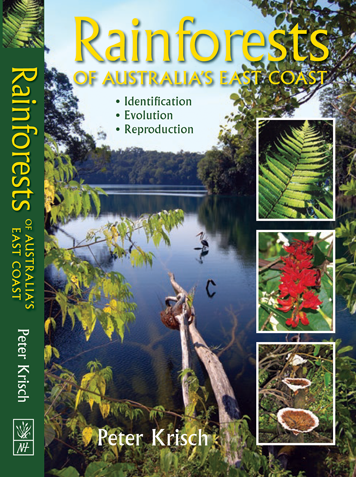
Rainforests of Australia's East Coast, HAND SIGNED BOOKS; (Out of Stock) A practical and informative field guide to the identification of native rainforest species. More than 800 colour photographs, informative graphics, maps and detailed description of more than 300 species.
This book is a valuable information source for bushwalkers, students, gardeners and anyone with an interest in Australia’s native flora.
The book was written and illustrated by the author of the tree identification web pages.
New Holland Publishers: May 2019
ISBN: 9781925546293
Format: Paperback with PVC
Pages: 304 pp.
Size: 23 cm high x 15 cm wide
Full Colour Photography
Rainforests: Identification - Evolution - Reproduction
Dedicated photography of rainforest species including; mosses, mushrooms, lichens, slime moulds, ferns, conifers, flowering trees, climbing plants, orchids and palms enable the reader to identify commonly encountered species.
CLICK HERE FOR MORE INFORMATION
River Bottlebrush Callistemon sieberi
River Bottlebrush Callistemon sieberi [Callistemon paludosus]
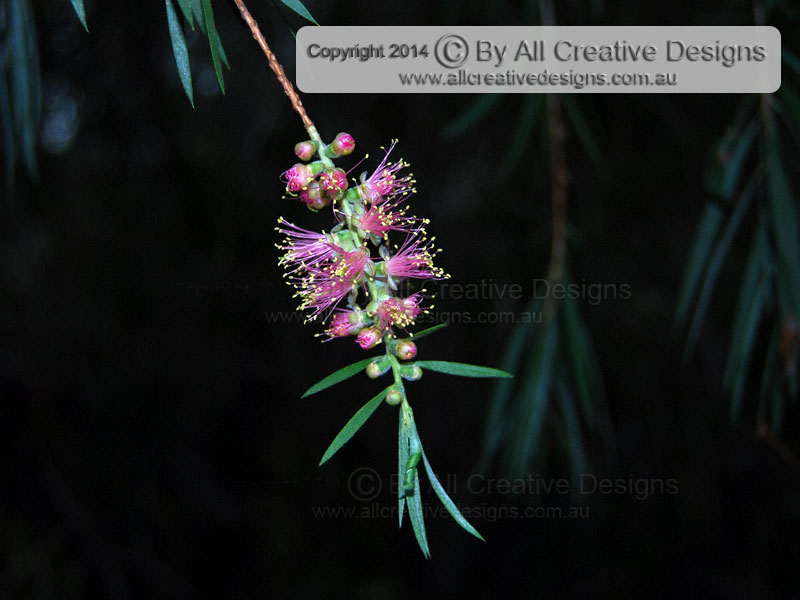
The common name implies that this native shrub or small tree prefers a moist habitat along stream banks. It is also found within open forests, where mature specimens can reach a height of up to 8m and often develop a weeping foliage. This species has a wide distribution range and is a common occurrence on both sides of the Great Dividing Range, along Australia's east coast (Picture 1). Bark on the trunk of mature trees is rough, deeply furrowed and hard in texture. It is a light brown colour at first and then weathers to grey (2). Small flower spikes are inconspicuous when compared to other Callistemon species, but are an unusual and attractive pale pink colour. Individual flowers feature a bundle of pink or sometimes cream coloured filaments less than 1cm long, which are topped by bright yellow anthers. Tiny petals are rounded in shape and a transparent, whitish green colour. The green calyx (base), is covered in very fine hair (no flower stalks). The long flowering period lasts from late spring to autumn (3). The fruit is a small cup-shaped capsule measuring less than 5mm across and features a wide and flat rim at the apex. Old capsules will remain on branches for years (4). Simple mature leaves with an alternate arrangement are; up to 9cm long, mostly narrow elliptic in shape (widest around the middle) with entire margins, dull grey green on both surfaces, hairless, strong and rigid in texture. Leaf apex shape narrows very gradually into a hard, sharp tip, base shape is cuneate. Venation with exception of the midrib is very faint (5). Distribution: Vic., NSW & Qld.

(1)
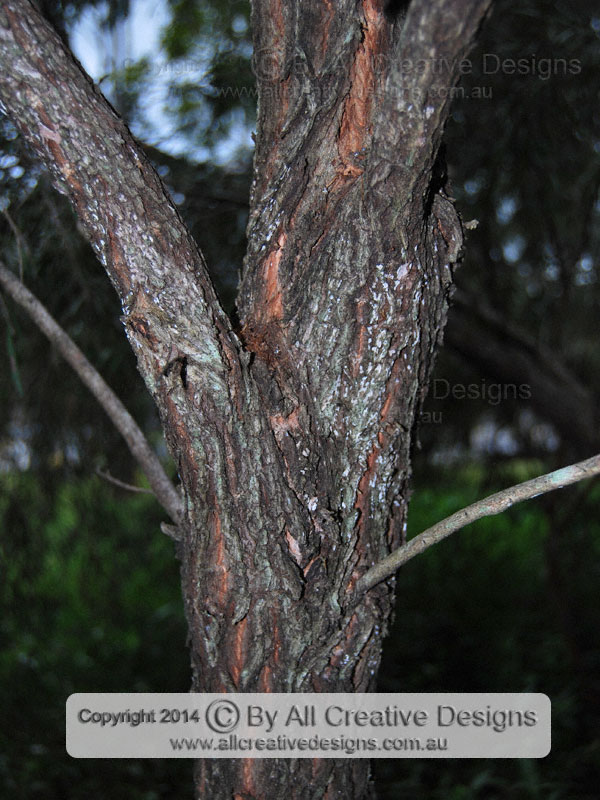
(2)
(3)

(4)

(5)
River She-oak Casuarina cunninghamiana
River She-oak Casuarina cunninghamiana
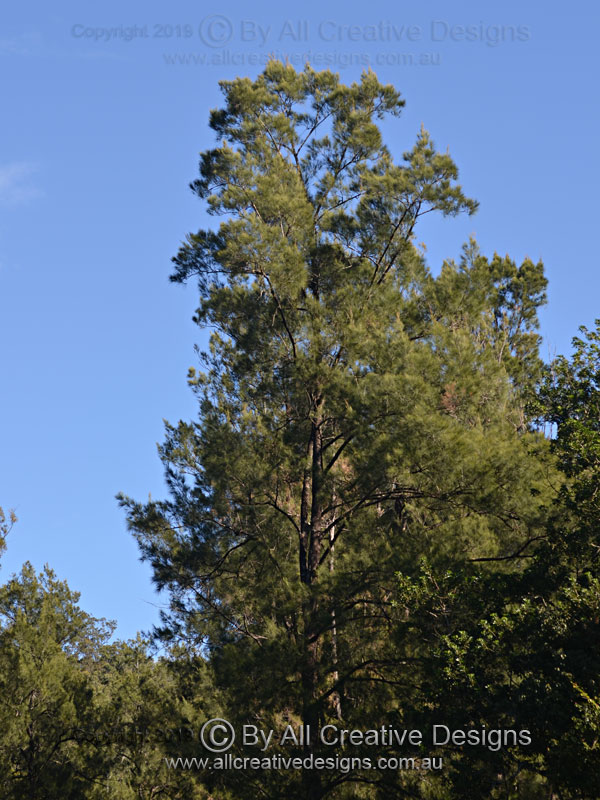
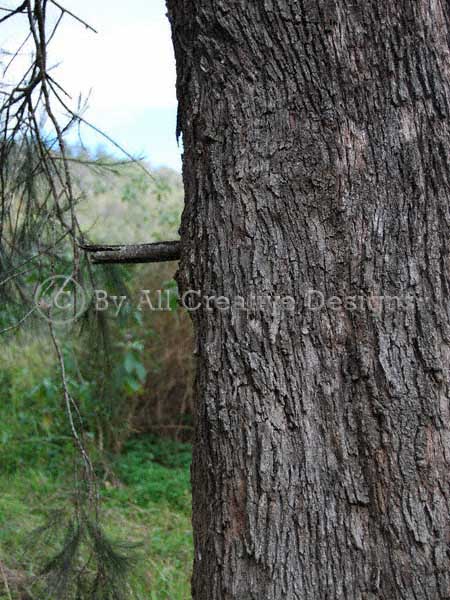
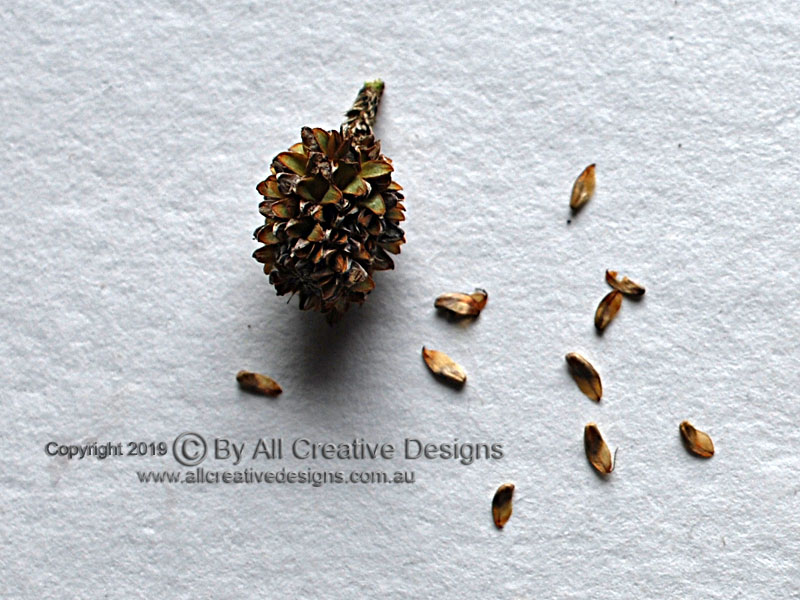
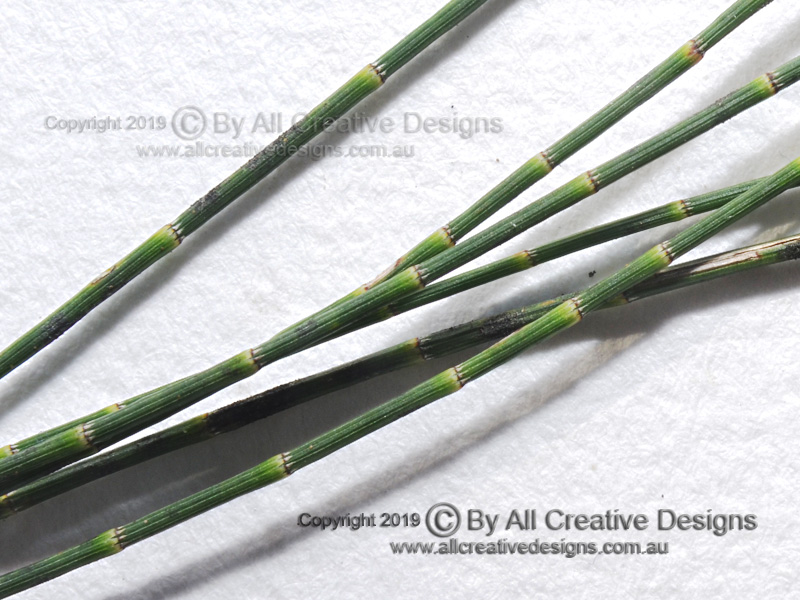
This medium to tall tree can attain a height of 40m and is commonly found on the banks of freshwater courses. It inhabits coastal environments, the tablelands of the Great Dividing range and drier inland locations (Picture 1). Bark is dark grey, sometimes more brown in colour and has a tough hard texture (2). This species is dioecious, producing male and female flowers on separate trees. The barrel-shaped or more rounded 'cones', shown before opening, are borne on outer branchlets and reach up to 12mm in diameter (3). At full maturity the 'cone' disperses the fruit, a samara, consisting of a seed enclosed in a translucent papery wing (4). Branchlets are up to 30cm long with tiny scale-like leaves up to 5mm long appearing in whorls of 8 - 10 at internodes, spaced less than 1cm apart (5). Distribution: From southern NSW to northern Qld. 2 subspecies cunninghamiana (shown) and subsp. miodon mainly occurring in NT. This species is protected in NSW.
(1)
(2)
fs.jpg)
(3)
(4)
(5)
Rose Butternut Blepharocarya involucrigera
Rose Butternut Blepharocarya involucrigera Other names: North Queensland Bollygum
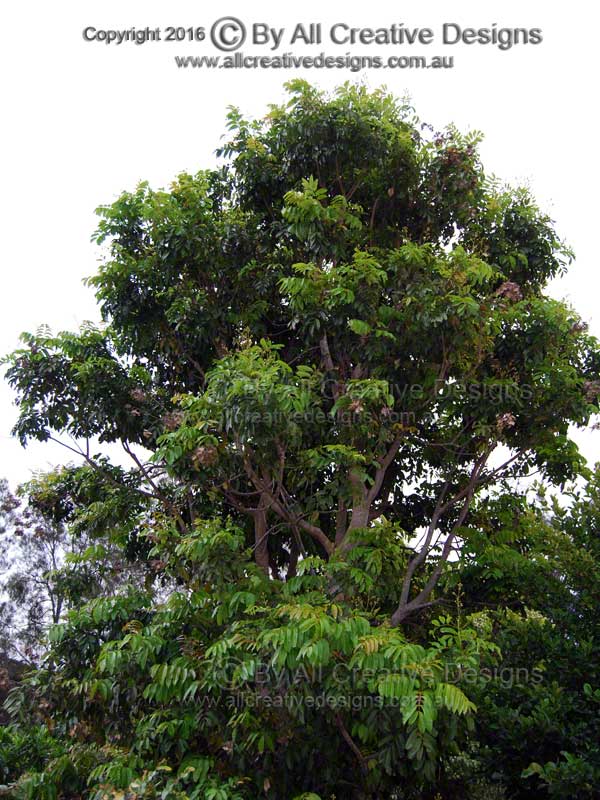
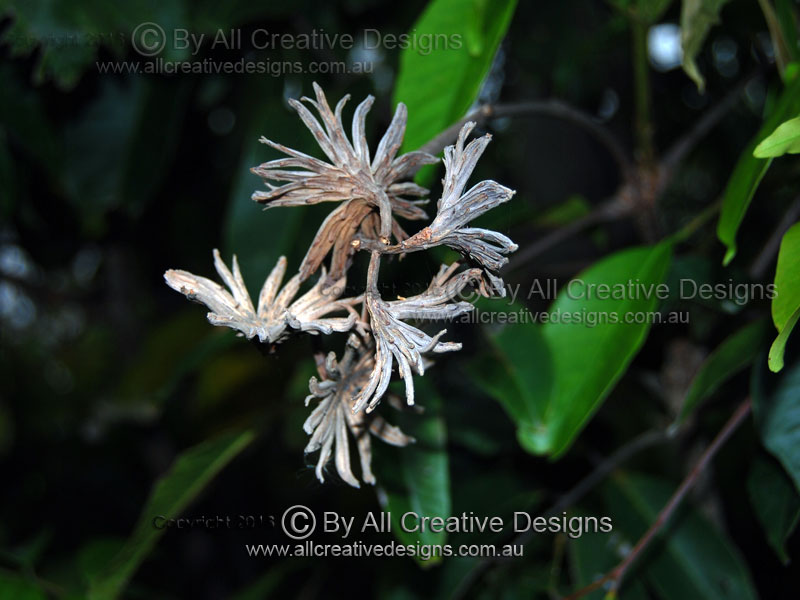
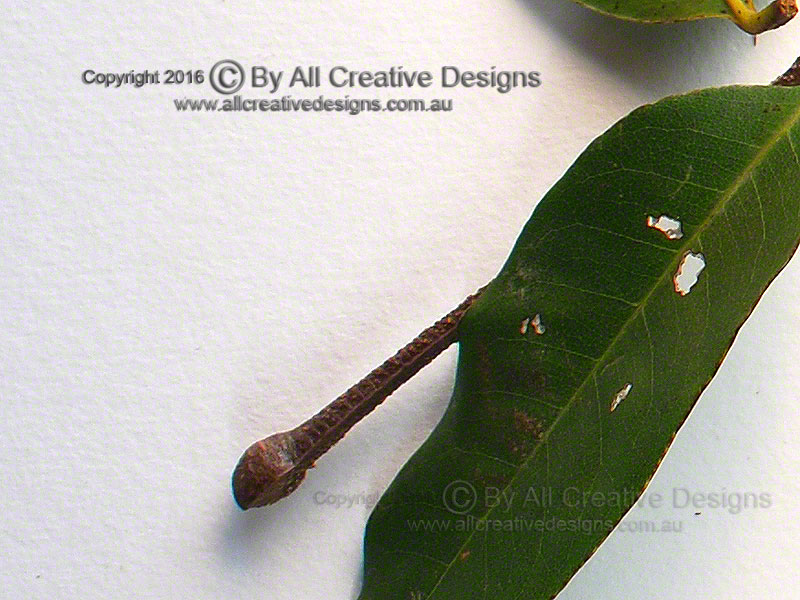
Under ideal conditions this species can develop into a tall tree reaching 40m in height, with mature trees developing a dense and rounded canopy (Photo 1). Bark is grey with pink or reddish hues and has a firm, finely rough texture (2). The unusual fruit is enclosed by a number of bracts referred to as an involucre. After opening these bracts become woody and remain on the tree for some time or can be found on the forest floor, which makes them a good identification feature (3). The petiole and to a lesser degree the rachis have a flattened underside and are covered in small blisters (lenticels) (4). The pinnate compound leaf features up to 12 leaflets, which are; up to 15cm long, elliptic to ovate in shape with entire margins, hairless, dark green when mature, paler green beneath, rather thick and strong in texture. The petiolules (leaflet stalks) are yellow in colour and grooved on the upper surface. Mid rib on lower surface is strongly raised and yellowish. Distribution: Tropical North Qld. Note: when touched this species is reported to cause allergic reactions to some people.
(1)

(2)
(3)
(4)
(5)
Rose Myrtle Archirhodomyrtus beckleri
Rose Myrtle Archirhodomyrtus beckleri
This attractive shrub or small tree inhabits subtropical rainforest as an understorey species. It is often taller and reaches a height of up to 10m in adjacent tall forests (Picture 1). Bark changes from a fairly smooth texture and a light brown colour on immature specimens
(inset picture 2) to a rough, scalier texture and a darker grey brown colour on mature trees (2). The distinctive foliage of the Rose Myrtle is very glossy and arranged in a very orderly fashion (3). Beautifully scented flowers with pure white petals and pink stamens are held on individual stalks or appear in small groups of three. They arise from axillary buds and appear over spring (4). Simple opposite arranged leaves are; between 2 to 5cm long, varied in shape from broad elliptic to obovate (reverse egg-shaped) with entire margins, dark green and very glossy on top, paler but also glossy beneath, hairless, thin and soft with a polished like texture. Apex is long acuminate ending in a blunt point, base shape is cuneate to rounded. The three-veined pattern starting from the base of the leaf is broadly raised on the upper surface, which is a good identification feature. On the lower leaf surface only the mid vein is clearly visible. Leaves are very pleasantly scented when crushed (5). Distribution: NSW mid-north coast to central Qld.
(1)
(2)

(3)

(4)

(5)
To locate trees by botanical name or to find related species go to:Species List Botanical, which also shows all family names.
Rose-leaved Marara Ackama paniculata
Rose-leaved Marara Ackama paniculata [Calduvia paniculosa] Other names: Soft Corkwood
The Rose-leaved Marara can grow to 30m or more and inhabits different types of rainforests. It is often a pioneer species in regenerating forest areas (Picture 1). The bark has distinct variations from the shallow fissured example to the deeply fissured, more irregular texture shown in the inset, both are very soft and corky (Picture 2). Masses of small white flowers are borne on large terminal panicles and turn reddish brown with age (3). The fruit is a tiny rounded and hairy capsule that measures up to 3mm in diameter. It is brown in colour and contains numerous very fine seeds (4). Mature pinnate compound leaves with an opposite arrangement feature up to 7 leaflets, which are; very varied, 12 to more than 20cm long, mostly elliptic in shape with finely toothed, crenate or nearly entire margins, nearly hairless to very hairy under shady conditions, light to dark green in colour (depending on sun exposure) and rather soft in texture. Leaflet apex is acute, base shape is cuneate. Other identification characteristics are stipule scars, present at leaf nodes on branchlets, and clearly visible domatia along mid-vein on lower leaflet surface. Under good sunlight conditions new growth can flush in pink tones (5). Distribution: NSW central coast to tropical Qld.
See Flower Identification and Leaf Identification Page for information on terms used.

(1)

(2)
(3)

(4)

(5)
Rosewood Dysoxylum fraserianum
Rosewood Dysoxylum fraserianum Other names: Rose Mahogany
This tall native tree species is well known for its beautiful timber and can reach a height of up to 40m in its natural habitat of subtropical rainforests (Picture 1). Older specimens feature a scaly, reddish brown bark (2). Pinnate compound leaves with an alternate arrangement consist of 4 to 10 leaflets (mostly 8), which are; up to 12cm long, mainly lanceolate (lance-shaped) with entire margins, hairless, dark green, glossy on top, paler green beneath and smooth in texture. Large domatia along the mid vein on the underside of the leaflet are a prominent characteristic to assist in identification of this tree species (3, 4, & 5). Distribution: NSW south coast to southern Qld.
(1)
(2)
fs.jpg)
(3)

(4)
fs.jpg)
(5)
Rusty Carabeen Aceratium ferrugineum
Rusty Carabeen Aceratium ferrugineum
The Rusty Carabeen has a limited distribution range within upland tropical rainforests and under ideal conditions can reach a height of 30m. This very ornamental tree has the potential to be used in landscaping within subtropical climate zones and will produce flowers / fruit at a young age (1). Bark on younger stems is grey in colour, hard and rough in texture due to fine fissures (2). The fleshy fibrous fruit turns red at full maturity and is covered in fine white hair. It is ellipsoid (oval) or more ovoid (egg-shaped) and up to 5cm long (3 & 4). Simple leaves with an opposite arrangement are; up to 16cm long, obovate (reverse egg-shaped) with entire margins, dark green, glossy, hairless on top (when mature, except for mid rib ), paler green and rusty (brown) hairy beneath and firm in texture. Conspicuous venation is densely covered in rusty brown hair and raised on lower leaf surface. Impressed lateral veins on the upper surface add rigidity to the lamina. Leafstalks, less than 2cm long, young branches and new growth are all rusty hairy (5). Distribution: Restricted and endemic to north Qld.

(1)

(2)

(3)

(4)
(5)
Rusty Cleistanthus Cleistanthus semiopacus
Rusty Cleistanthus Cleistanthus semiopacus
This relatively common tall shrub or small tree prefers to inhabit tropical and drier monsoonal rainforests in the proximity to the coast, and less likely can also be found in upland regions. Under ideal conditions it is densely foliated and can reach a height of 15m (Image 1). Bark is light grey or more pale brown. At the base of older trunks, bark becomes tessellated (scaly) and small vertical fissures (cracks) are usual (2). The image shows female flowers, which are sessile (without a stalk) and emerge in clusters along a rusty hairy raceme. The white and glabrous (hairless) flower style divides into 3 ‘stems’ at the base, which are forked at the apex. The prominent ovary and calyx (basal flower cup) are densely hairy. Fertilised flowers produce a 3-lobed orange-coloured capsule (not shown) (3). The attractive foliage consists of simple leaves with an alternate arrangement. Leaves are; up to 13cm long, ovate (egg-shaped) with entire margins, hairless when mature, dark green on top, paler beneath and firm in texture. Young branchlets and growing buds are covered in rusty hair. The curved petiole (leaf stalk) is normally less than 10mm long. Venation is clearly visible on the lower leaf surface, with lateral veins forming loops (4 & 5). Distribution: Endemic to tropical north-eastern Qld and Cape York peninsula.
(1)
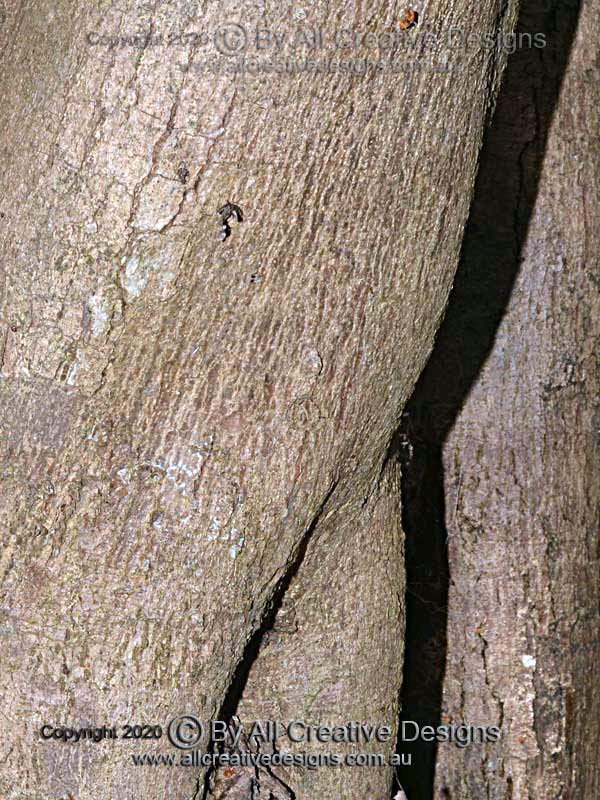
(2)

(3)

(4)

(5)
Rusty Pittosporum Pittosporum ferrugineum
Rusty Pittosporum Pittosporum ferrugineum
This densely foliated shrub or small tree reaches less than 10m in height. The single and often crooked trunk is up to 30cm in diameter. It is naturally found as an understorey species on the margins and
within upland and lowland tropical rainforests (Photo 1). Bark is cream grey in colour and fairly rough in texture with small ridges and flaky patches covering the surface (2). The fruit is a capsule splitting on two
sides to disperse up to a dozen seeds, each covered in a very sticky and bright red coloured aril. The fruit, up to 12 mm long, is irregular rounded or more pear-shaped with a small nipple at the
apex and turns yellow or orange at full maturity (3 & 4). Simple leaves are arranged in a whorl of 4 or 5 when emerging, turning to an opposite or sometimes alternate arrangement as they mature. Leaves are; up to 12cm long, varied in shape from elliptic to obovate (reverse egg-shaped) with broadly undulating margins, mostly hairless, dark green, dull on top, paler green, short rusty hairy beneath and soft in texture. Leaf apex is acute ending in a rounded tip, base shape is cuneate. Mid rib and lateral veins are raised on the lower leaf surface and covered in woolly, rusty hair as are the petiole and young stems (4 & 5). Distribution: Tropical Qld (shown) and NT, but has been spreading to subtropical locations along the coast in more recent times.
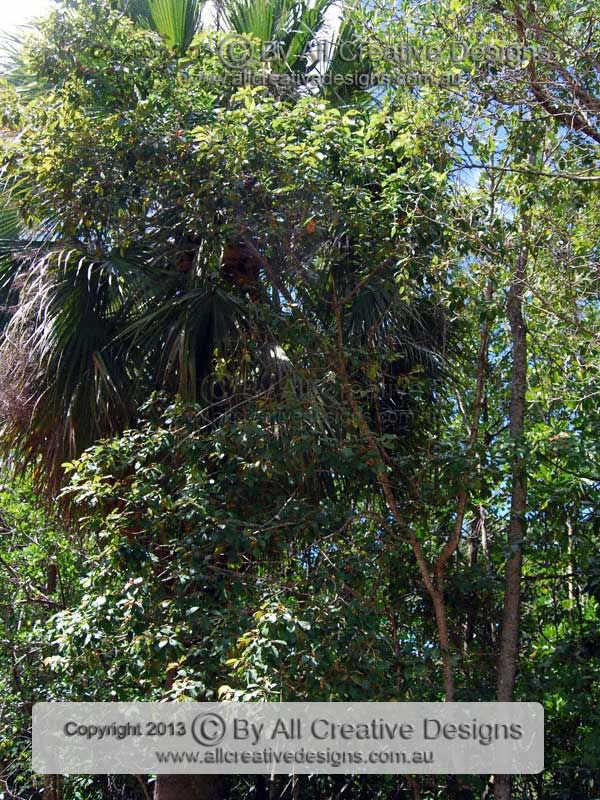
(1)

(2)
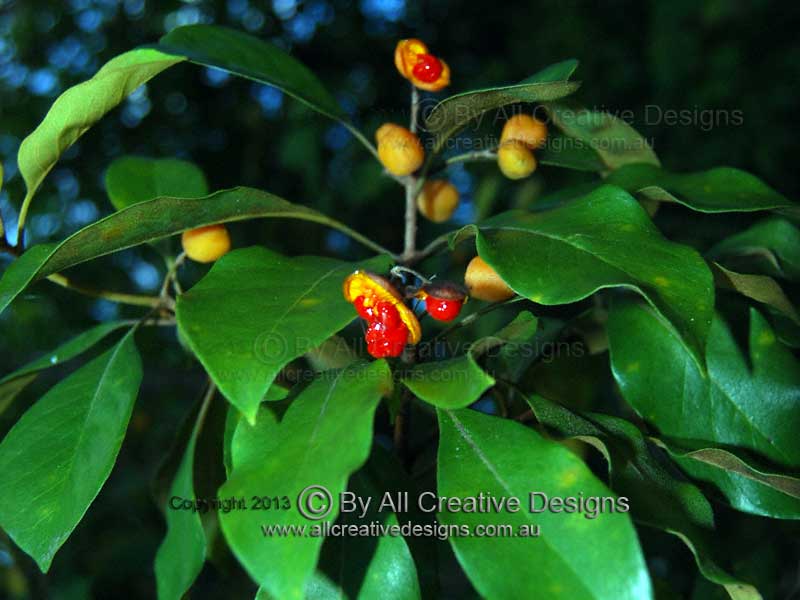
(3)
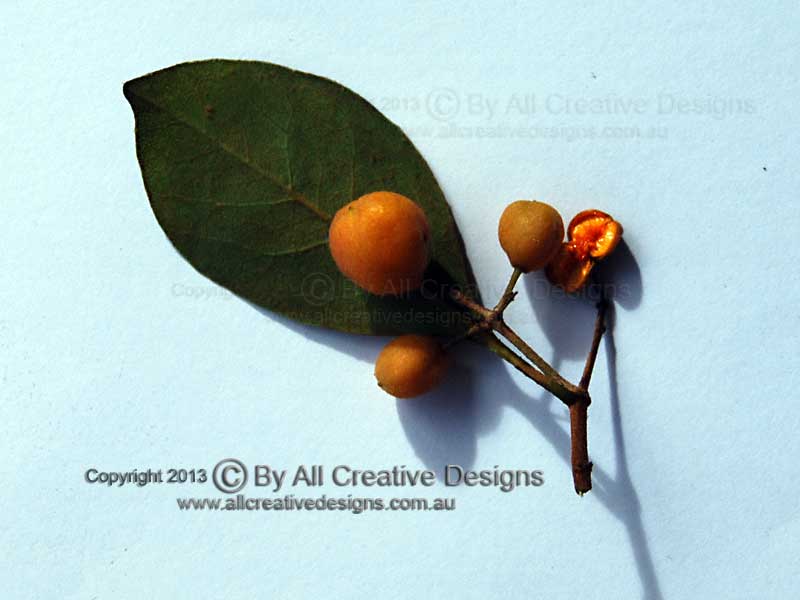
(4)
(5)
Rusty Plum Niemeyera whitei
Rusty Plum Niemeyera whitei
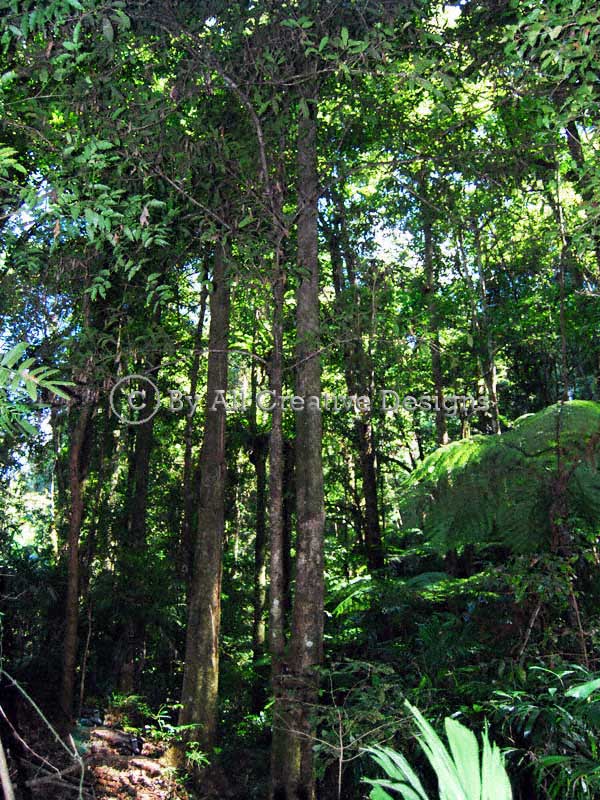
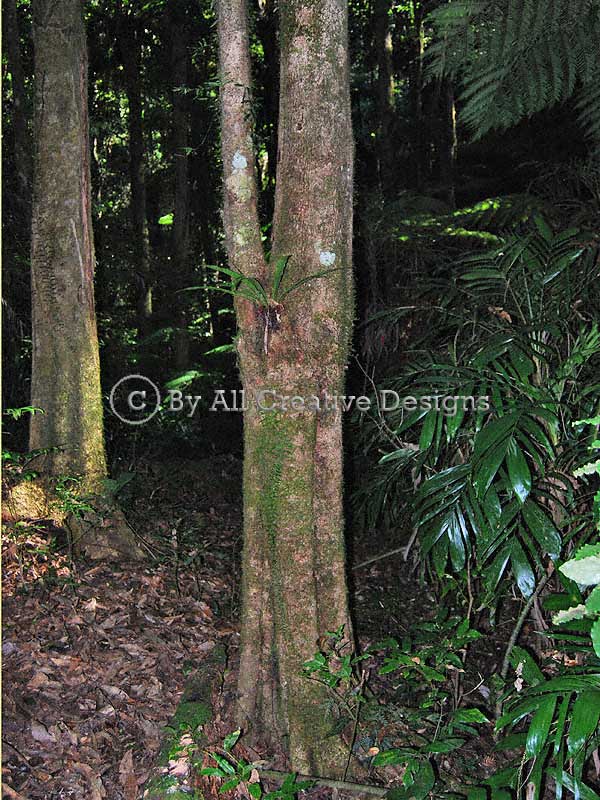
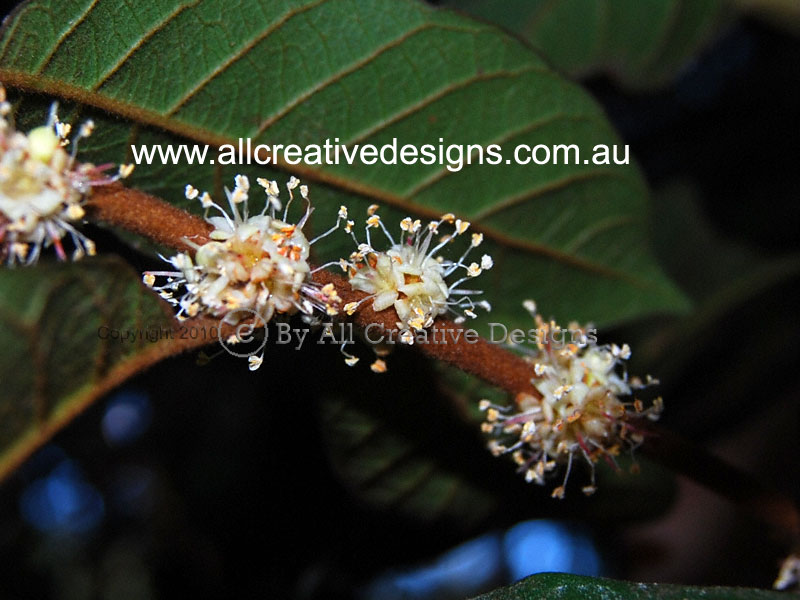
Due to its small natural distribution range and extensive clearing of subtropical and warm temperate rainforests, the Rusty Plum Niemeyera whitei has become a relatively rare native tree species. The largest specimens can be found in undisturbed subtropical rainforests, where it can attain a height of more than 25m (Photo 1). Older trees develop a fluted trunk. The greyish bark is furrowed and scaly with a soft corky texture (2). Tight clusters of up to 15 flowers are borne along younger branches. The whitish cream coloured flowers reach a diameter of up to 5mm when fully opened and are seated in a brown hairy calyx. Flowers feature a long tapering style and 5 stamens with distinctive anthers (3). The fruit (a berry) turns black at full maturity and can reach more than 6cm in diameter. A fleshy (succulent) layer surrounds the globular seed, which is up to 5cm in diameter, brown in colour and shows a typical elliptical scar (4). Simple leaves with an alternate arrangement are; up to 20cm long, elliptic to oblanceolate (reverse lance-shaped) or oblong with entire margins, dark green, hairless and semi glossy on top, paler and hairy below, thick and rather leathery. Apex is short acuminate, base shape is cuneate. Mid vein and laterals are raised and covered in fine rusty brown hair on lower leaf surface. Petiole (leaf stalk) is up to 10mm long and densely hairy, as are young branches (5). Distribution: NSW mid-north coast to southern Qld.
(1)
(2)
(3)
(4)
(5)
Rusty Pods Hovea longifolia
Rusty Pods Hovea longifolia
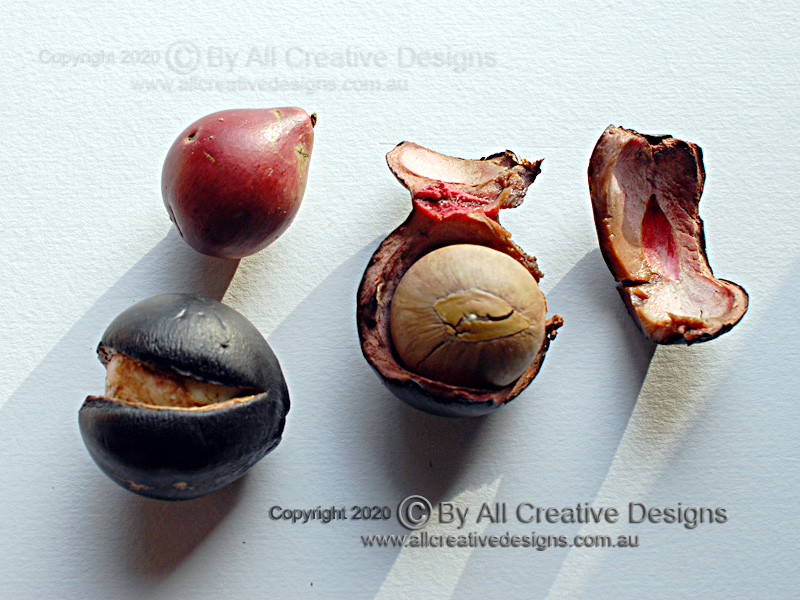
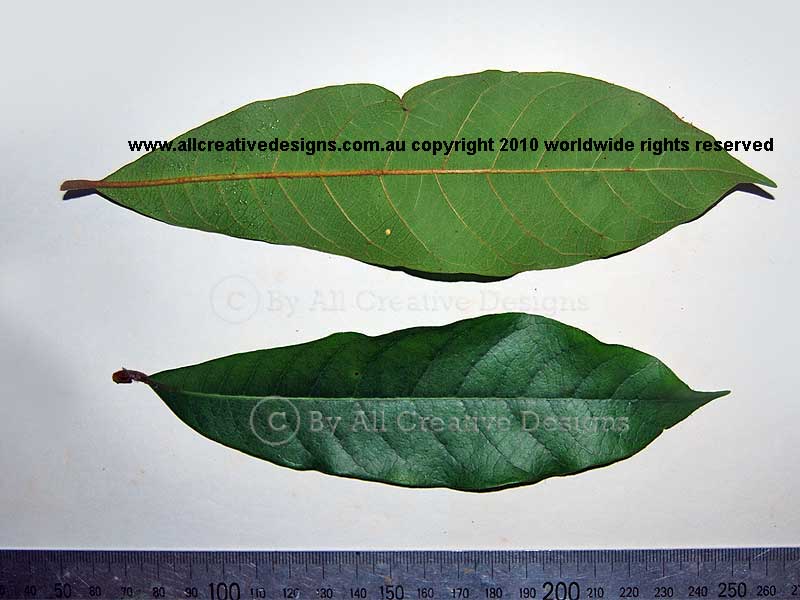
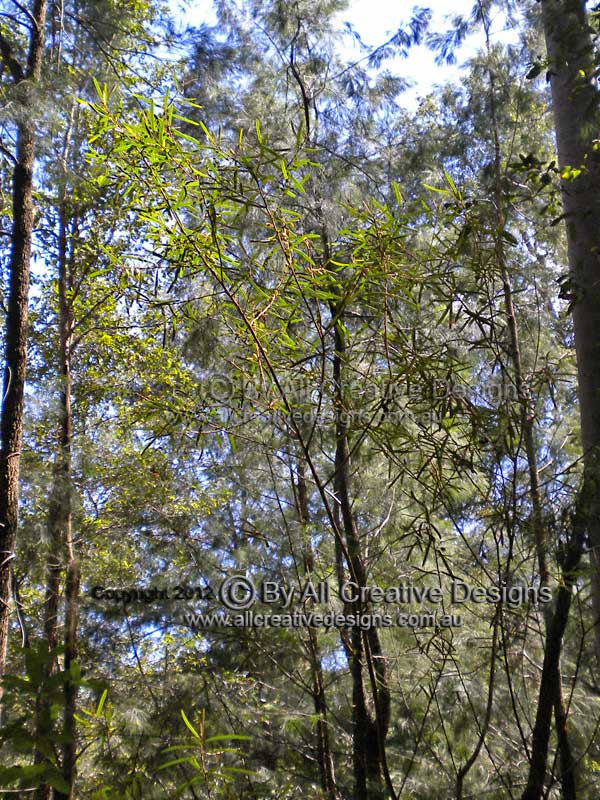
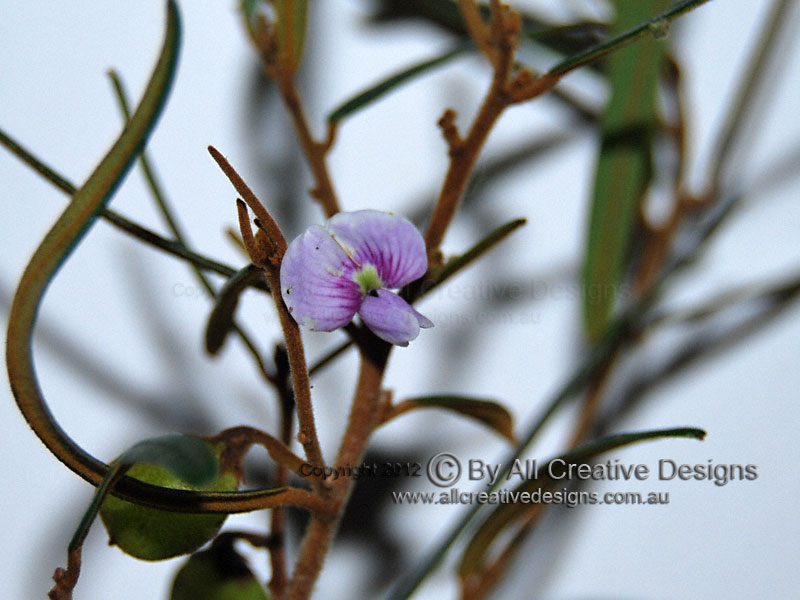
Moist gullies, close to rainforest margins, are the preferred habitat for this upright shrub reaching a height of 3m (Photo 1). New bark is light-brown turning darker with age and has a firm texture (2). The flower (characteristic for the pea/bean family, FABACEAE) is pale mauve in colour and shows darker veins towards the centre. One or two flowers emerge from axillary buds along branches and measure up to 12mm in diameter (3). The fruit is an ovoid shaped pod up to 12mm long, which is covered in fine brown hair, as are the old calyx, stems and young branches. The pod contains (mostly) two small bean shaped seeds that are yellowish green in colour (4). Simple leaves with an alternate arrangement are; up to 7cm long (sometimes longer), oblong in shape with entire in-rolled margins, very narrow, not more than 6mm wide, dark green, glossy, hairless on upper surface, pale green, short woolly hairy beneath, strong and rather stiff in texture. Leaf apex shape is rounded, base is obtuse. Mid vein on upper surface is sunken, as are the fine net veins. The raised mid vein on lower leaf surface is covered in rusty brown hair (5). Distribution range: Eastern side of the Great Divide from Vic, NSW & Qld. Note: This species has a range of recognised variations.
(1)

(2)
(3)

(4)
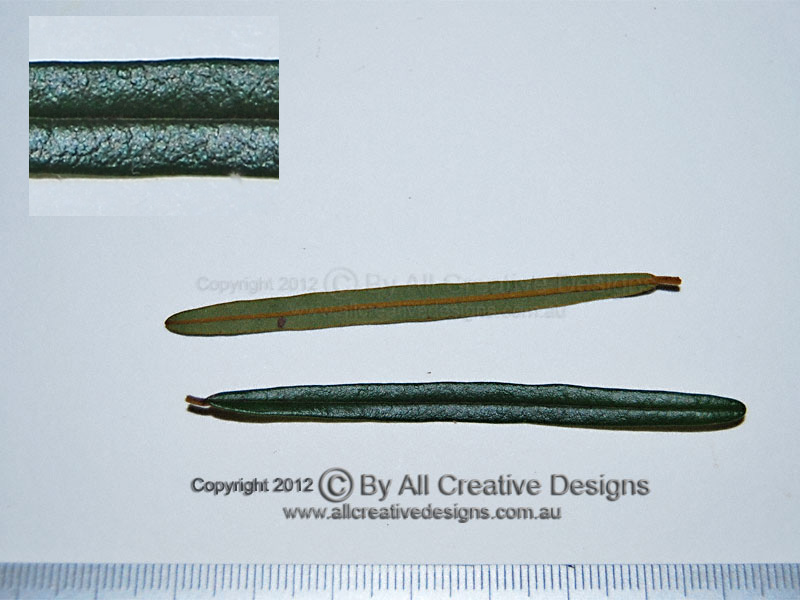
(5)
Salmon Bean Archidendron vaillantii
Salmon Bean Archidendron vaillantii
This small to medium sized tree reaches a height of 15 to 20m in its natural habitat of tropical lowland and upland rainforests. The Salmon Bean prefers to grow beneath taller trees and is reported to be deciduous over late winter. Species belonging to this genus are known for their beautiful flowers dominated by bundles of long stamens and for producing bright coloured seed pods (1). Bark on the trunk is greyish brown and marked by fine horizontal fissures and small blisters. Conspicuous scars and bumps are left in places where leaves have detached (2). Beautiful but short-lasting flowers are borne on panicles that appear on the trunk and along branches. The floral tube splits into pointed lobes at the apex to expose a multitude of white to cream coloured filaments. They are up to 40mm long and crowned by small yellow anthers (3). The attractive foliage is made up of large bipinnate (twice divided) compound leaves that feature 2 to 6 pinnae (branches) with normally 8 leaflets each. Leaflets are; up to 18cm long, mostly ovate (egg-shaped) with entire margins, hairless, smooth, dark green and glossy on top, paler green also glossy beneath and relatively thin but firm in texture (4 & 5). Distribution: North Qld. Note: This species is very similar to the smaller shrub-sized Scarlet Bean (Archidendron lucyi), listed below on this page.
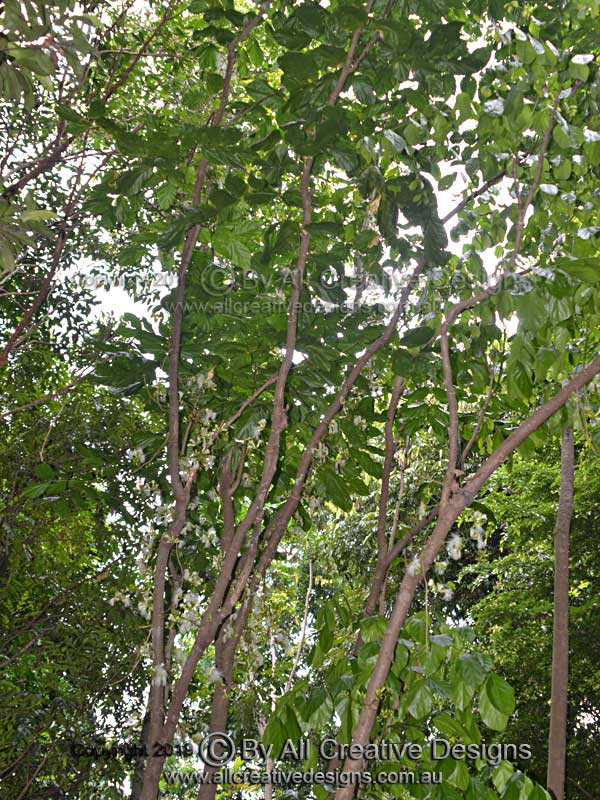
(1)
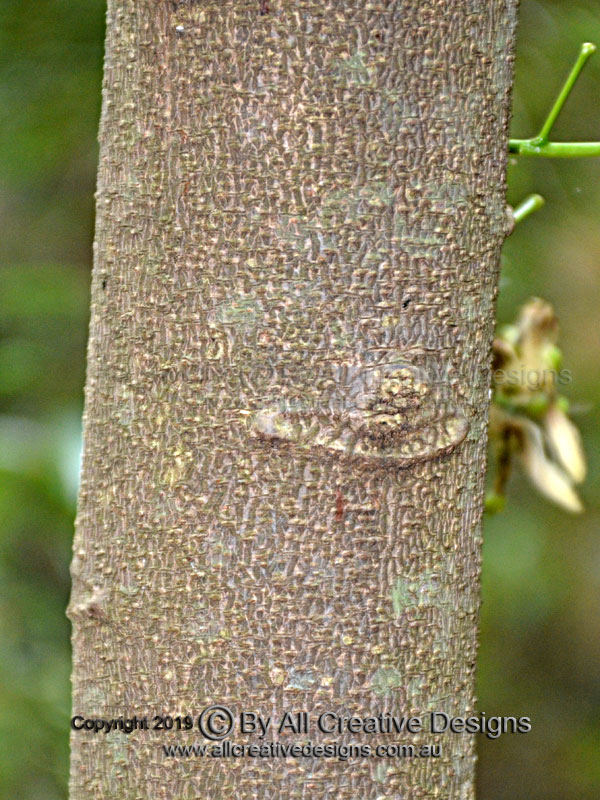
(2)
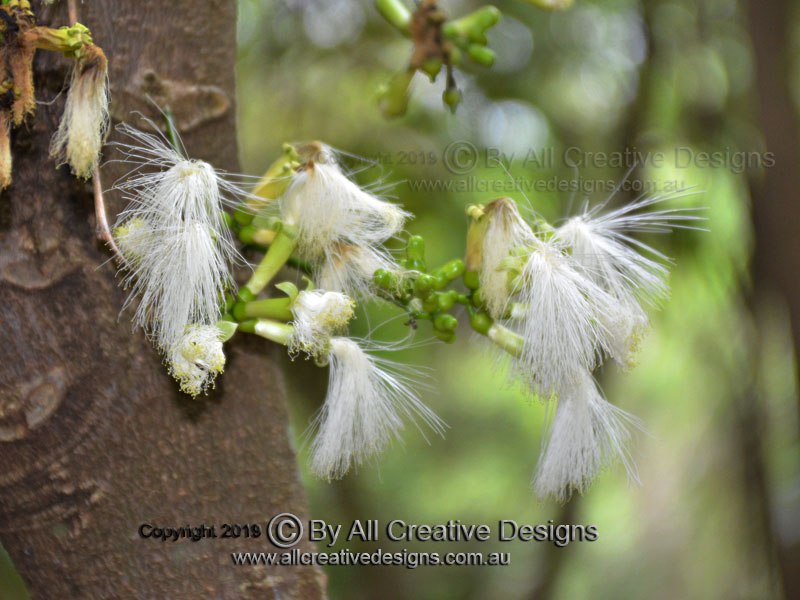
(3)
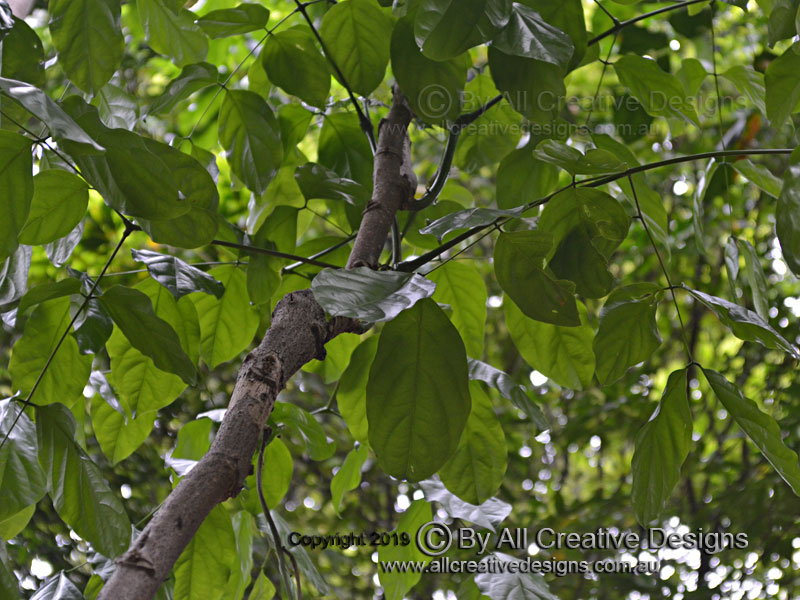
(4)
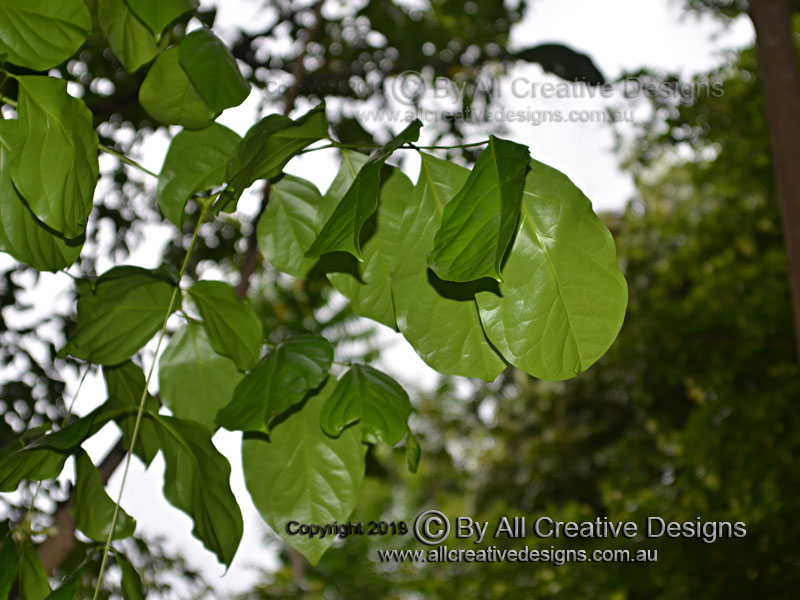
(5)
Sandfly Zieria Zieria smithii
Sandfly Zieria Zieria smithii
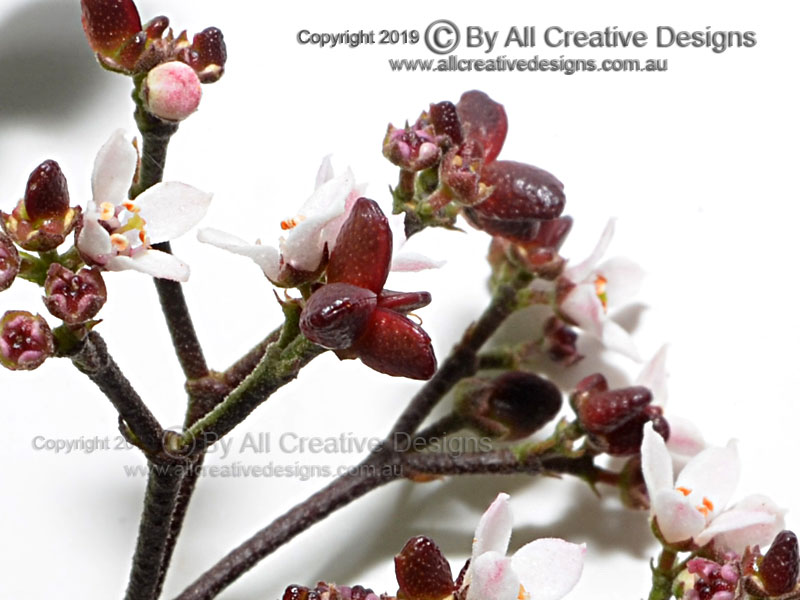
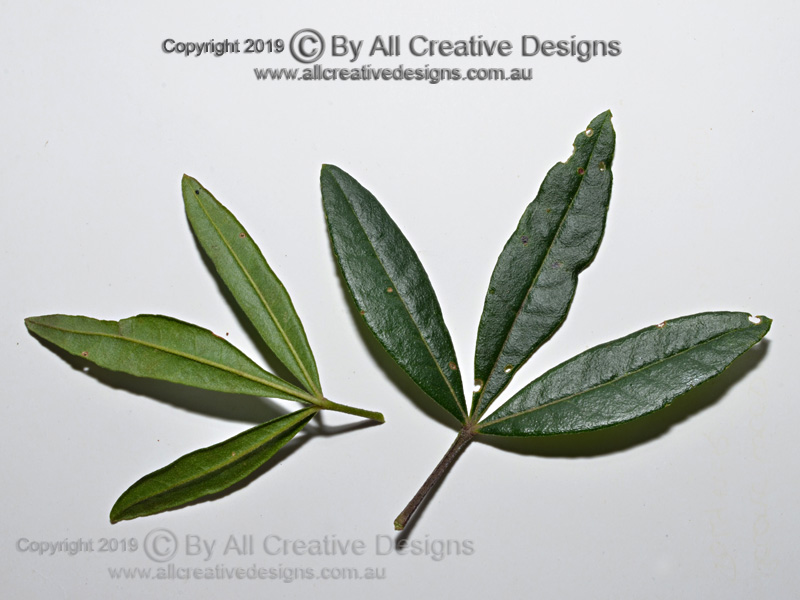
This very adaptable shrub is found in different environments that range from drier habitats in coastal locations to the margins of upland tropical and other forms of rainforests. It is identified by its distinctive trifoliolate (with 3 leaflets) compound leaves that emit a strong odour when crushed. Depending on conditions, it can be a compact and upright shrub up to 2m tall or straggly and less than 1m high in exposed sites (Image 1). Bark is brown coloured, firm and covered in small ridges and blisters on older stems (2). Flowers are borne on small panicles that are mostly less than 5cm long (sometimes up to 8cm). Individual flowers are 4-numerous, i.e. feature 4 calyx lobes (sepals), 4 white and finely hairy petals, 4 stamens with hairy filaments and prominent, partly orange-coloured anthers. A straight style, crowned by a 4-lobed stigma is visible in the centre. Flowers measure 6 to 8mm in diameter when fully opened (3). The fruit, a dry capsule when mature (unripe fruit is shown), normally consists of 4 (sometimes only 1 to 3) follicle-like segments that are jointed at the base. Each segment splits along one side to disperse one or two seeds. Panicles can bear flower buds and ripening fruit at the same time (4). Compound leaves feature 3 leaflets, which are; up to 5cm long, elliptical, oblong or lance-shaped with entire in-rolled margins, dark green, mostly hairless and covered in tiny glands on the upper surface, paler green and hairy (on centre vein) below, strongly scented when crushed. The primary leaf stalk (petiole) is up to 2.5cm long, hairy and broadly grooved on top. Distribution: From Vic. to northern Qld (also in Tas.). See also Tall Zieria (Z. arborescens) on Page 11. The genus Zieria includes more than 50 species native to Australia.
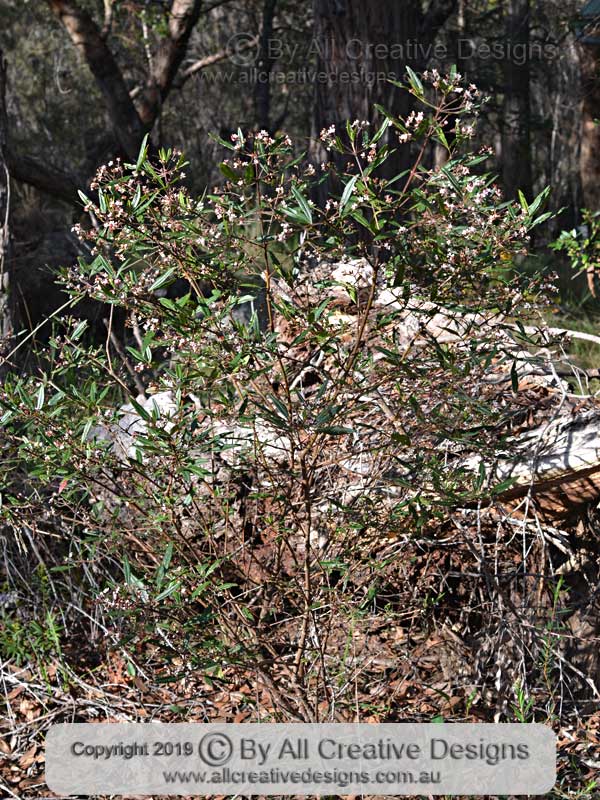
(1)
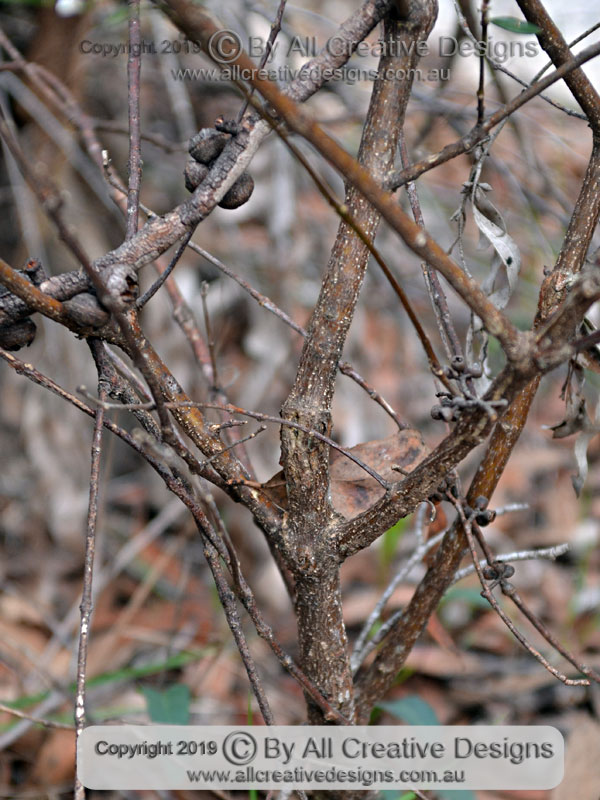
(2)

(3)
(4)
(5)
See
Leaf -
Flower - Fruit - and Bark Identification Web Pages for explanations of botanical definitions and concepts.
Select images for Full Size View. (Opens new browser window).
Use the Key to Species, which is based on leaf characteristics, to identify native trees and shrubs found on Australia's east coast.
Sassafras Doryphora sassafras
Sassafras Doryphora sassafras
This common tree is often encountered as an under-storey species within different types of rainforests. In these habitats it is rarely more than 10m tall, but under favourable conditions it has the potential to reach 25m in height
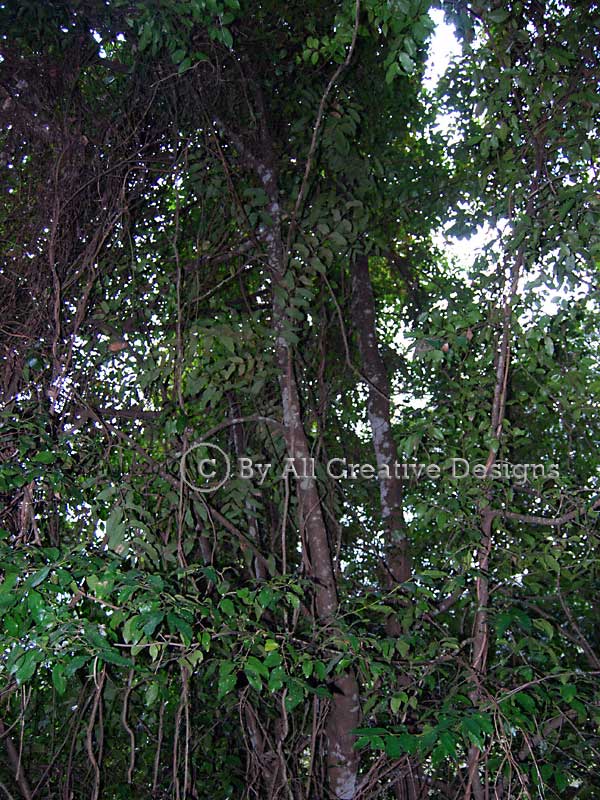
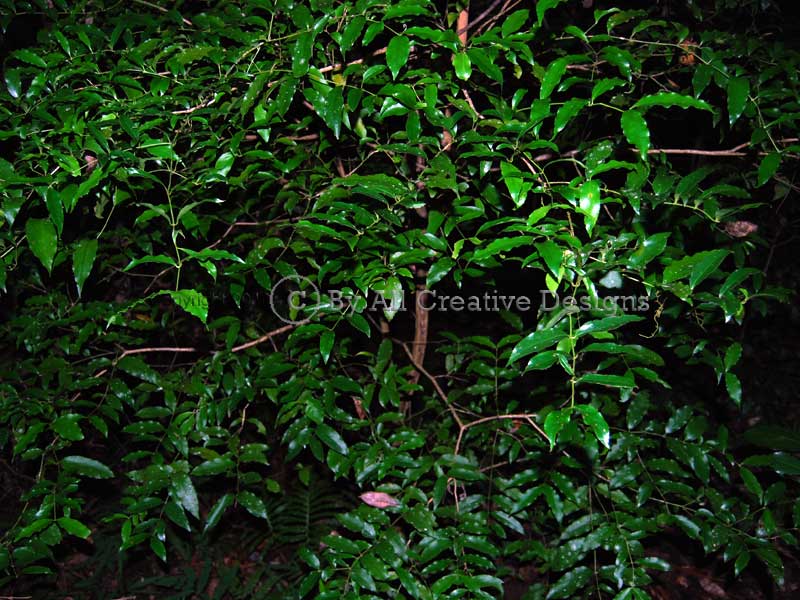
(Photo 1). Bark has a rather hard texture with a granular surface and is light brown in colour (2). The glossy and scented foliage is a distinctive feature in identification of this species (3). Up to 3 whitish flowers are supported by a common stalk (peduncle) and reach about 2cm in diameter when fully opened (4). Simple leaves with an opposite arrangement are; up to 10cm long, mostly elliptic in shape with toothed and wavy margins, hairless, glossy on their upper surface, scented when crushed, firm and rather leathery in texture. Lower leaf surface is a paler green and moderately shiny. Reticulate venation is quite prominent (5). Distribution: from the NSW south coast to central Qld.
(1)

(2)
(3)
(4)
(5)
Satinwood Nematolepis squamea
Satinwood Nematolepis squamea ssp. squamea
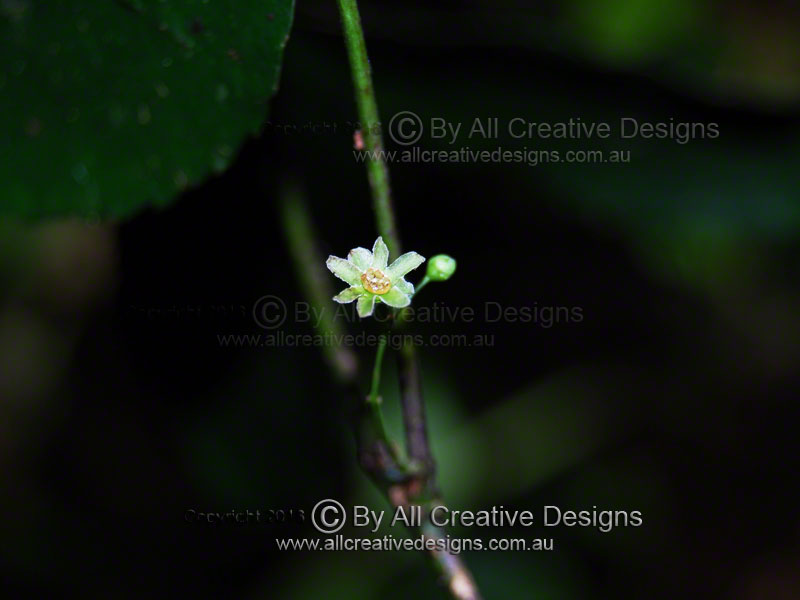
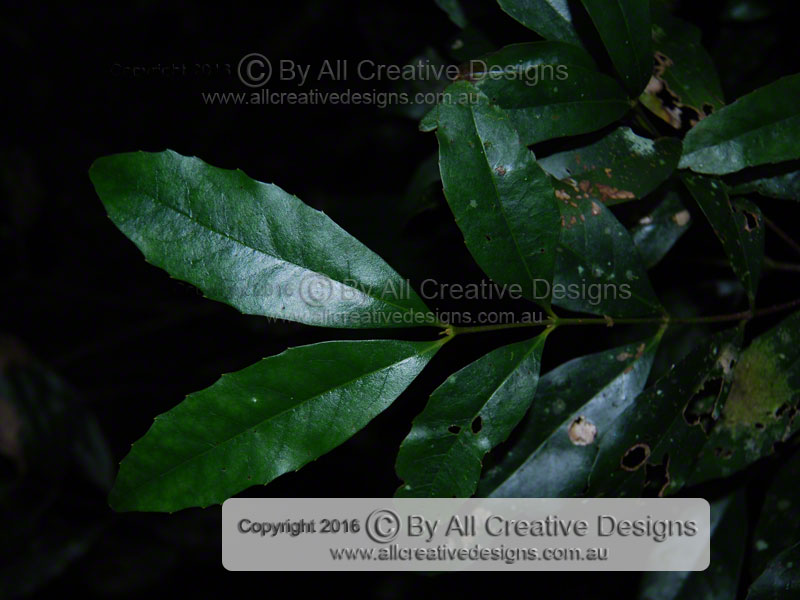
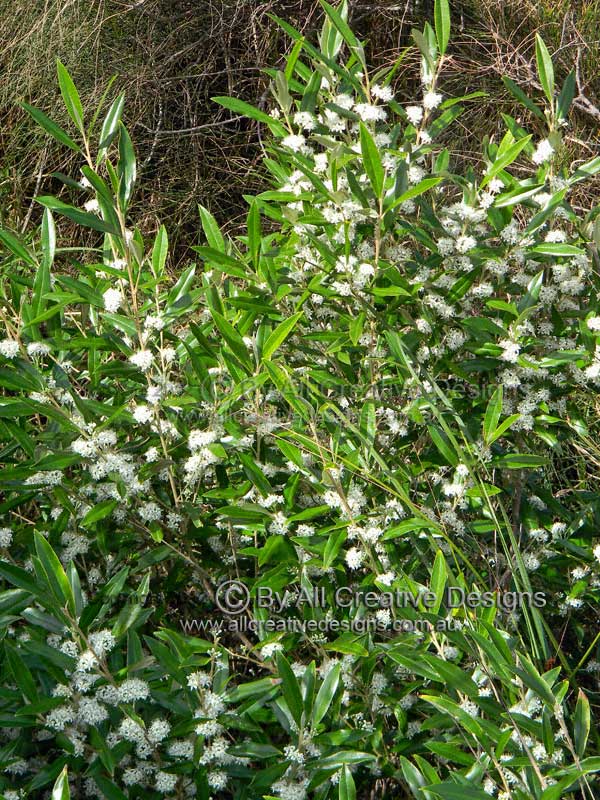
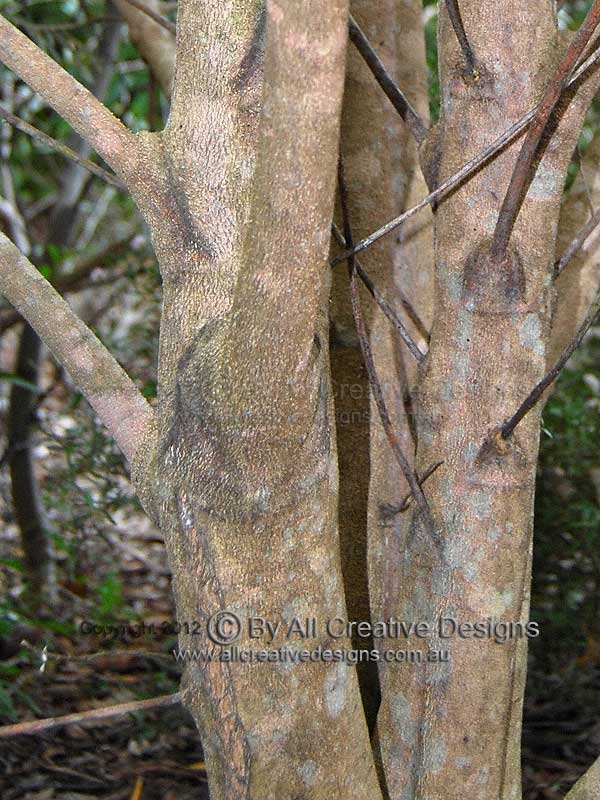
This hardy and adaptable shrub or small tree can reach a height of up to 10m. It is found in a wide range of different forest types, including rainforests and locations in close proximity to the coast. The specimen shown is the subspecies N. squamea ssp. squamea occurring in NSW (Photo 1). Bark on the often multi-stemmed trunk is grey/brown in colour with a firm and finely rough texture due to blisters and small ridges (2). Flowering takes place over late winter into spring with crowded panicles of individual flowers appearing along the length of branches. Flowers measure less than 1cm across when fully opened and feature 5 white petals and prominent stamens topped by yellow anthers (3 & 4). Simple leaves with an alternate arrangement are; up to 10cm long, mostly long elliptic in shape with entire margins, dark green on top, silver-white beneath and rather soft in texture. Leaf
apex shape is acute, base shape is cuneate. Mid vein is sunken on top and strongly raised below, otherwise venation is invisible. Petiole (leaf stalk) is less than 1cm long and covered in small silvery scales (5). Distribution: Tas., Vic., NSW & Qld; as different subspecies.
(1)
(2)

(3)
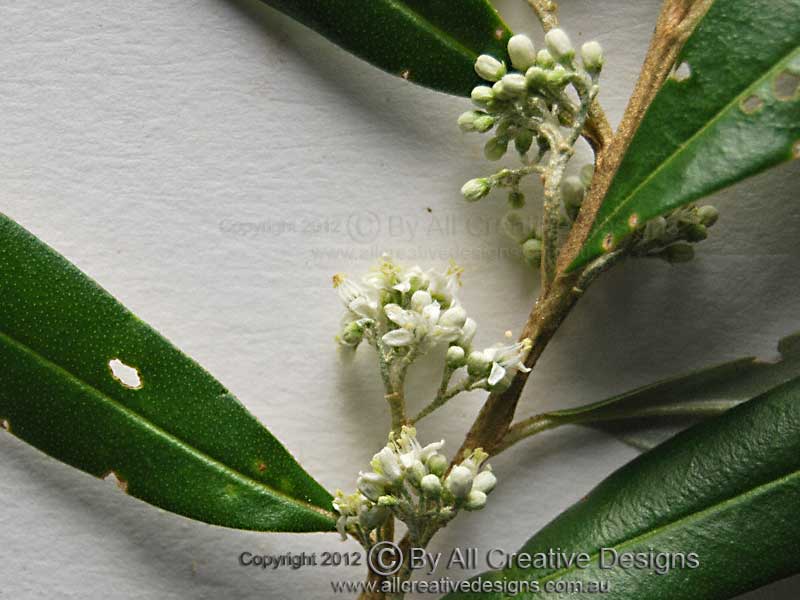
(4)

(5)
Saw-tooth Banksia Banksia serrata
Saw-tooth Banksia Banksia serrata Other names: Old man Banksia, Saw Banksia
The common name refers to the sharp and regularly spaced teeth along the (serrated) leaf margins. In exposed coastal locations, it is likely to be a tall spreading shrub or small tree, whereas in open forests the Saw-tooth Banksia produces a more upright trunk and is able to reach a height of 15m (1). The distinctive bark is a greyish brown in colour, lumpy and soft corky in texture (2). The large cylindrical flower heads are up to 20cm long and produce masses of cream to pale green coloured flowers with prominent curved styles (3). The dry fruit (a follicle) becomes woody at maturity and splits horizontally to disperse normally two winged seeds. Follicles are grey in colour, thick-walled and up to 35mm wide (4). Simple leaves are borne in a crowded whorl arrangement at end of branches. Leaves are; up to 20cm long, narrow oblong in shape with toothed margins, hairless (when mature), dark green on top, pale green beneath, thick, strong and rigid in texture (5). Distribution: Vic., NSW and southern Qld. See also: Coastal Banksia (B. integrifolia) Page 2 and Green Banksia (B. robur) Page 6.
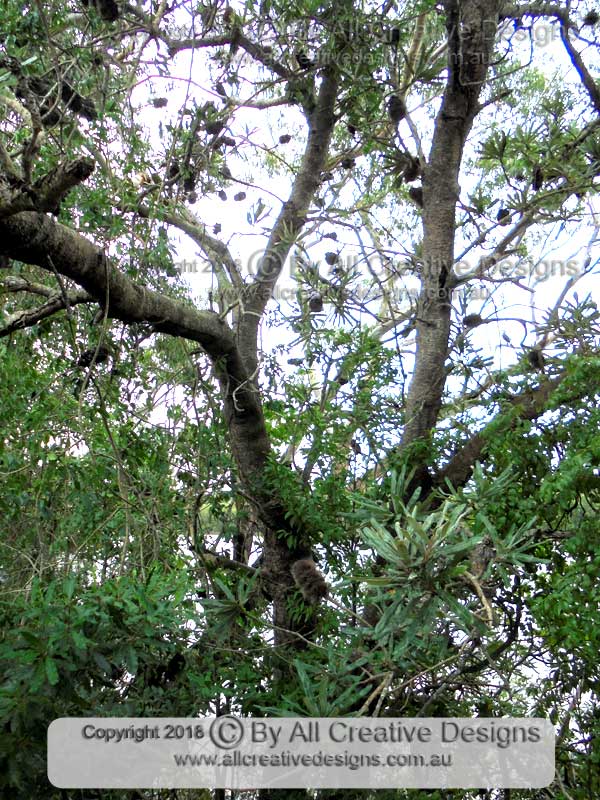
(1)

(2)

(3)
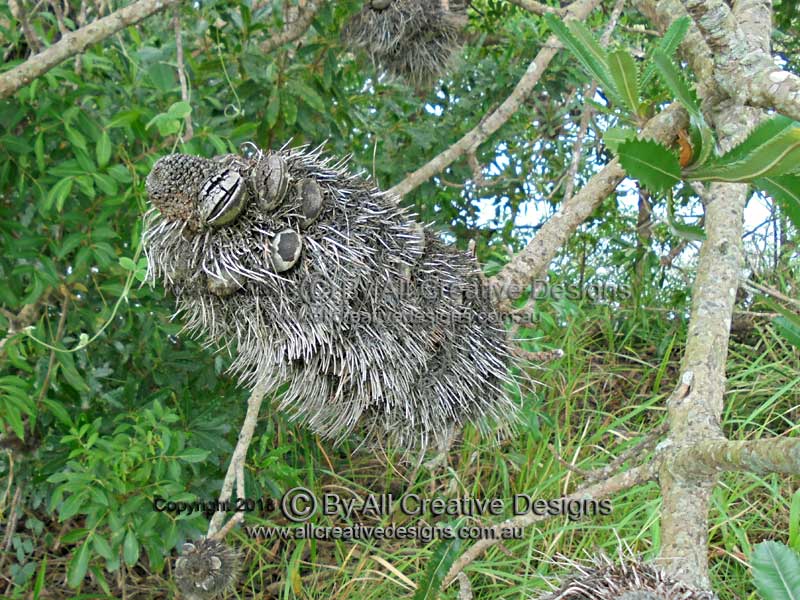
(4)
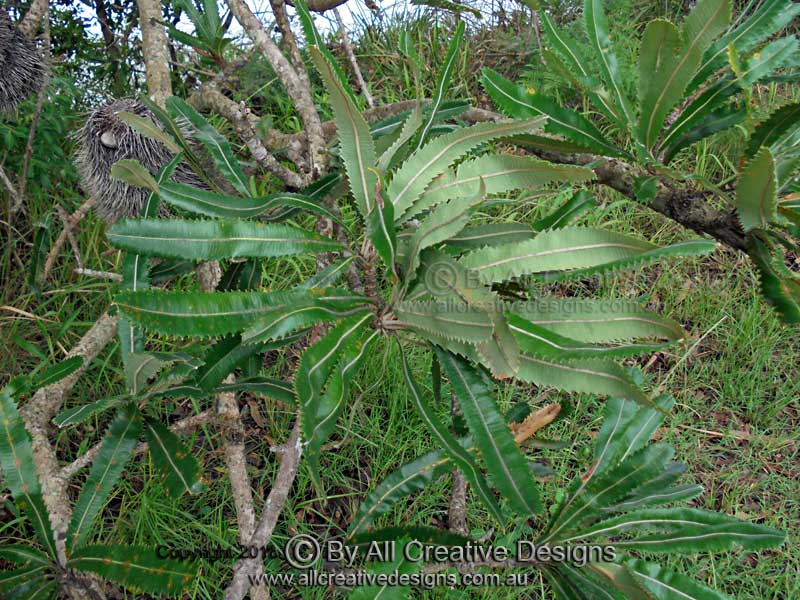
(5)
Descriptions and all images copyright ©2023 by www.allcreativedesigns.com.au world wide rights reserved.
Click or Tap Images for Full Size View (opens new browser window)
Scaly Myrtle Gossia hillii
Scaly Myrtle Gossia hillii
The Scaly Myrtle prefers to grow as an understorey species beneath taller trees within dryer forms of subtropical rainforests and also inhabits upland tropical rainforests. It is a small tree, up to 10m tall with an often crooked multi-branching trunk and attractive dense glossy foliage (Photo 1). Bark is brown, rough with small fissures and thinly scaly on the trunk of older trees (2). The scented flowers appear solitary (individually) or are borne in small groups, (3 or 4) supported by a primary stalk. They measure up to 12mm in diameter when fully opened and feature 5 pure white petals up to 5mm long. The sepals (calyx lobes) are hairy, up to 2mm long and pointed at the apex. Numerous stamens are white and 3 to 4mm long, (stamens are still at a developing stage in the image) (3). The succulent fruit, a berry, reaches a diameter of about 10mm and turns black when fully ripe (immature fruit is shown). The persisting sepals are present at the top of the fruit (4). Simple leaves with an opposite arrangement are: up to 6cm long, elliptical with entire margins, hairless, dark green, smooth and very glossy on top, paler green and duller beneath. Leaf apex is acute or short acuminate and terminates in a rounded tip. Mid rib is broad and raised on upper leaf surface (5). Distribution: Northern NSW to north Qld.
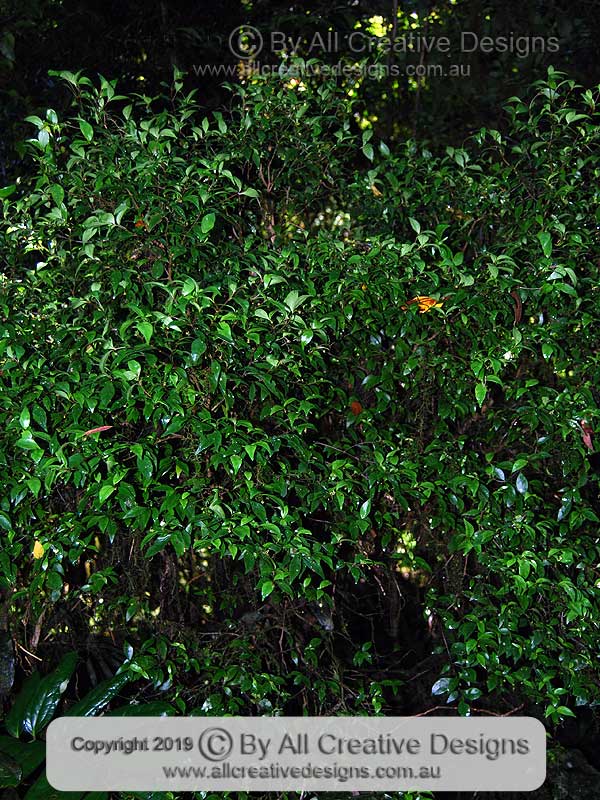
(1)
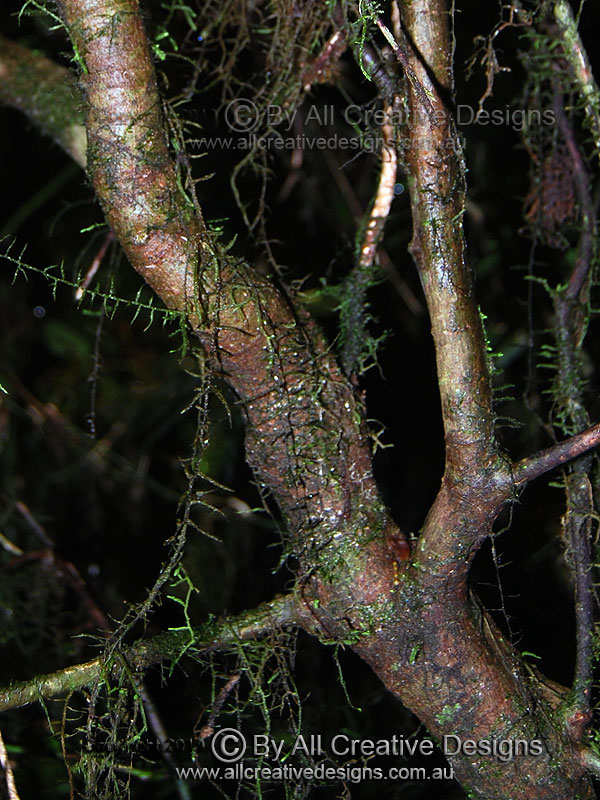
(2)
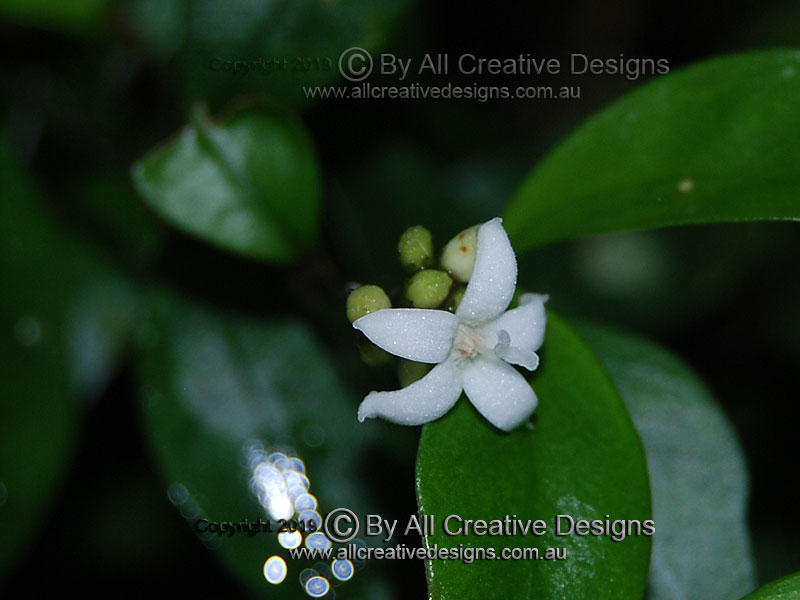
(3)

(4)
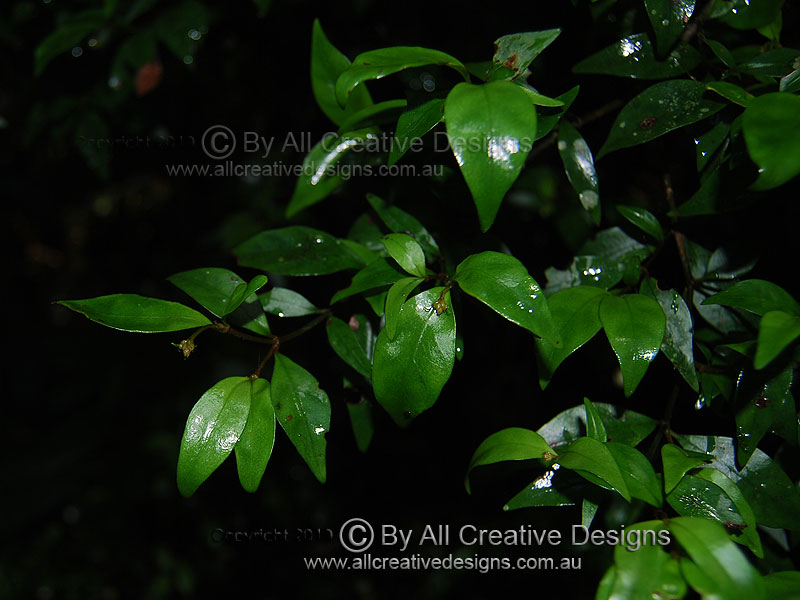
(5)
Scarlet Bean Archidendron lucyi
Scarlet Bean Archidendron lucyi
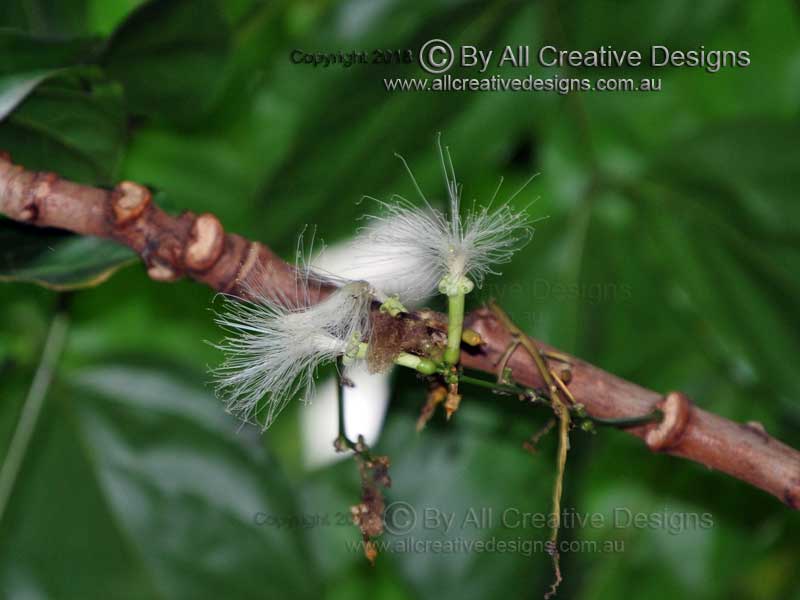
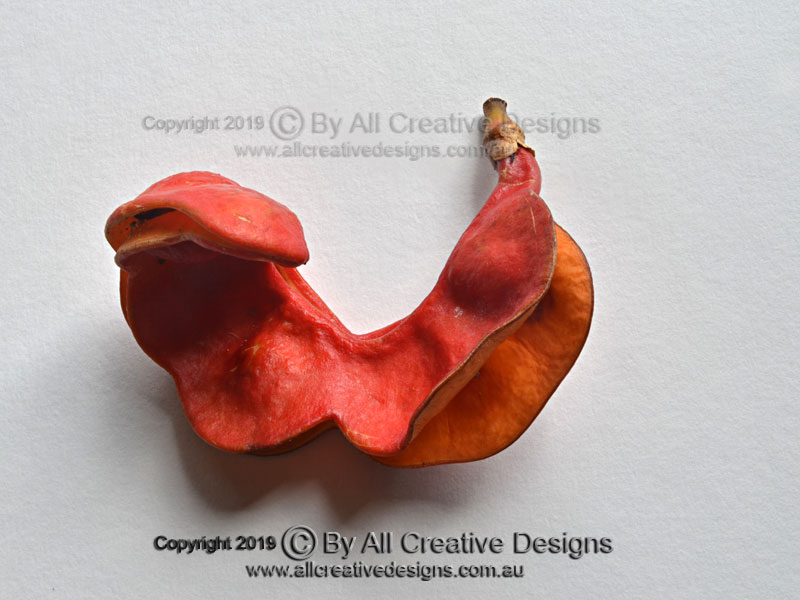
This beautiful tall shrub or small tree is found under the dense canopy of tropical lowland (coastal) rainforests. The specimen in the image is partly overgrown by a Giant Pepper Vine (Piper hederaceum) (Picture 1). The bark on older trees is greyish brown in colour with a rough texture, marked by lenticels (blisters) and horizontal ridges (2). The striking flowers are scented and dominated by numerous white stamens up to 50mm long (3). Pods reach a length of 10 to 12cm and split along the sides to release oval-shaped, flattened and dark blue or black-coloured seeds (4). The large bipinnate (twice divided) compound leaf mostly features 2 or 4 pinnae (branches), each normally bearing 6 large leaflets. The petiole (primary leaf stalk) shows a gland at the apex. Leaflets are; up to 20cm long; broad elliptic, ovate or obovate (reverse egg-shaped) with entire margins, hairless, smooth, glossy on both surfaces and firm in texture (5). Distribution: North-eastern Qld. Note: This species is an attractive ornamental small tree for shady, frost-free environments. See also: Pink Laceflower A. grandiflorum (Page 8), White Laceflower A. hendersonii (Page 12) and the Salmon Bean A. vaillantii above on this page.
(1)

(2)
(3)
(4)

(5)
Scented Acronychia Acronychia littoralis
Scented Acronychia Acronychia littoralis
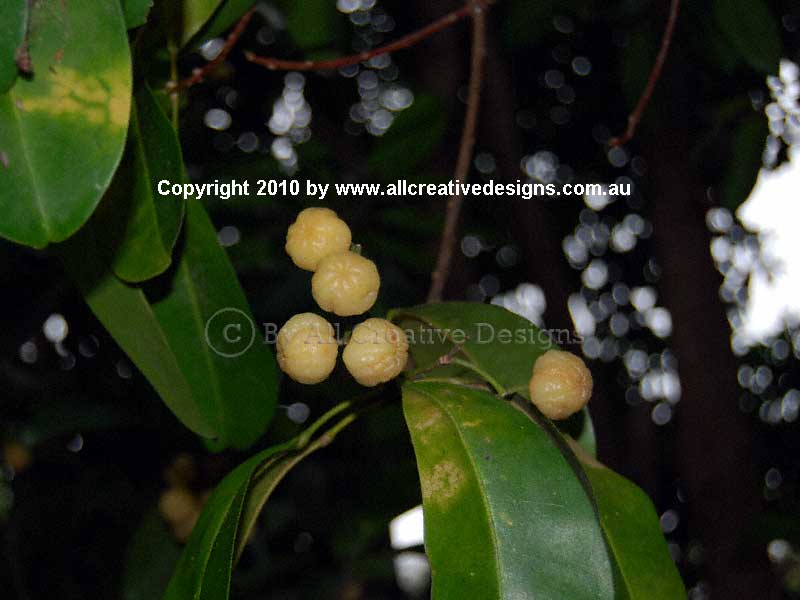
Due to extensive clearing of littoral (close to the beach) subtropical rainforests the habitat of this small understorey tree species is severely restricted. Mature specimens are less than 10m tall and develop a dense canopy (Photo 1). Bark is grey brown in colour, fairly smooth in texture with fine fissures (Photos 2 & 3). The fleshy fruit (a drupe) is globose in shape; up to 20mm across, cream to yellow in colour and contains a single seed (4). Simple (1-foliate) leaves with an opposite arrangement are; up to 15cm long, mostly obovate (reverse egg-shaped) with entire margins, fairly glossy on both surfaces, hairless with a firm and fleshy texture. Leaves feature a rounded and notched (emarginate) apex and a cuneate (wedge-shaped) base. Leaves are scented when crushed (5). Distribution: From the mid-north coast of NSW to southern Qld.

(1)

(2)

(3)
(4)

(5)
Scented Daphne Phaleria clerodendron
Scented Daphne Phaleria clerodendron Other names: Scented Phaleria
Depending on conditions, such as soils and competition for available sunlight, this elegant species can be a tall shrub or small tree. Due to habitat destruction it has become increasingly rare in its natural environment of tropical rainforests (1). Bark is brown in colour, rough, hard and fissured on the trunks of older trees (2). Tight groups of flowers not only emerge from young branches, but also appear along older branches (ramiflorous) and on the trunk (cauliflorous). Flowers are supported by a primary stalk and as the common name suggests, the handsome flowers are fragrant. The pure white perianth (floral tube) reaches a length of about 3cm and splits into 4 or 5 well-defined and re-curving lobes at the apex. The prominent stamens consist of white filaments crowned by yellowish anthers (3). The reddish coloured fruit (a drupe) is irregular globe-shaped and reaches a diameter of up to 5cm. A layer of whitish pulp surrounds one or two seeds that are covered in a hard brown shell (endocarp) (4). Simple leaves with an opposite arrangement are; up to 20cm long, broadly elliptic or ovate (egg-shaped) with entire margins, hairless, dark green, glossy on top, paler green beneath, relatively thick, smooth and soft in texture. Leaf apex shape is acuminate; base is mostly rounded (5). Distribution: North Qld. Note: a beautiful ornamental plant, available at (online) nurseries.

(1)
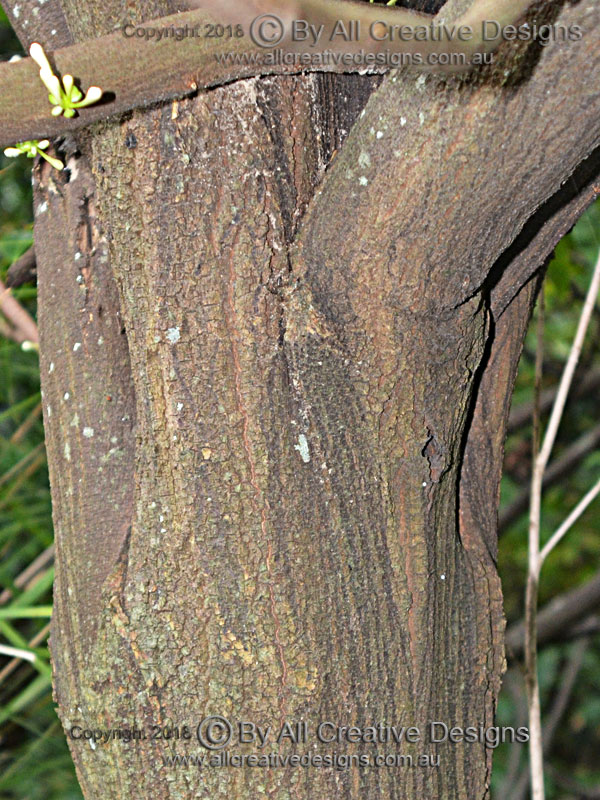
(2)
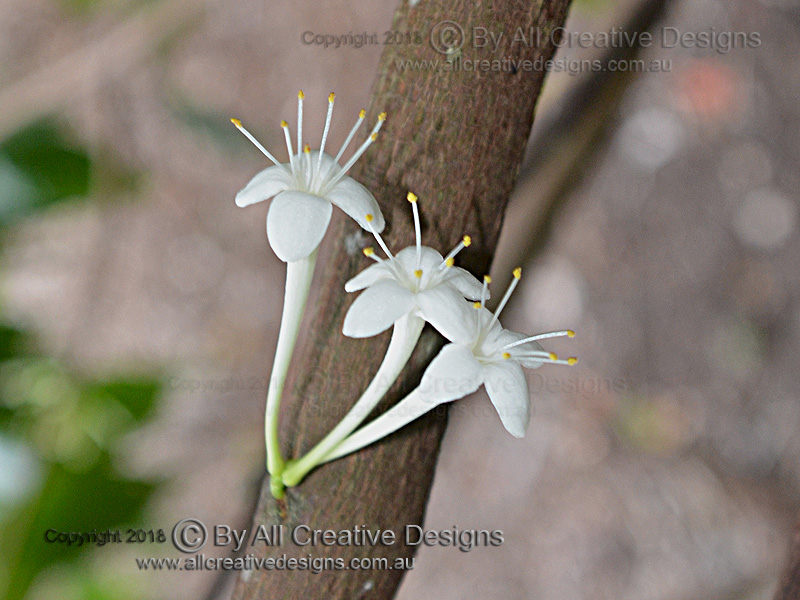
(3)

(4)

(5)
Scentless Rosewood Synoum glandulosum
Scentless Rosewood Synoum glandulosum
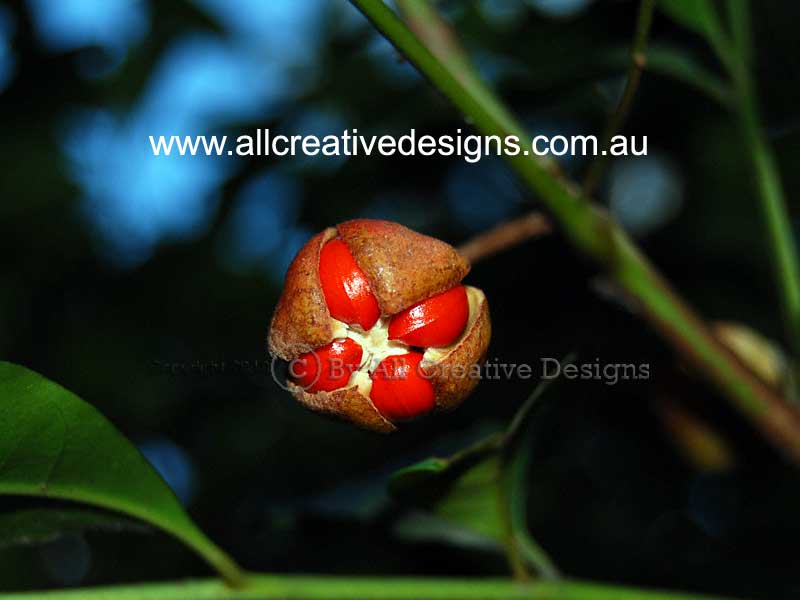
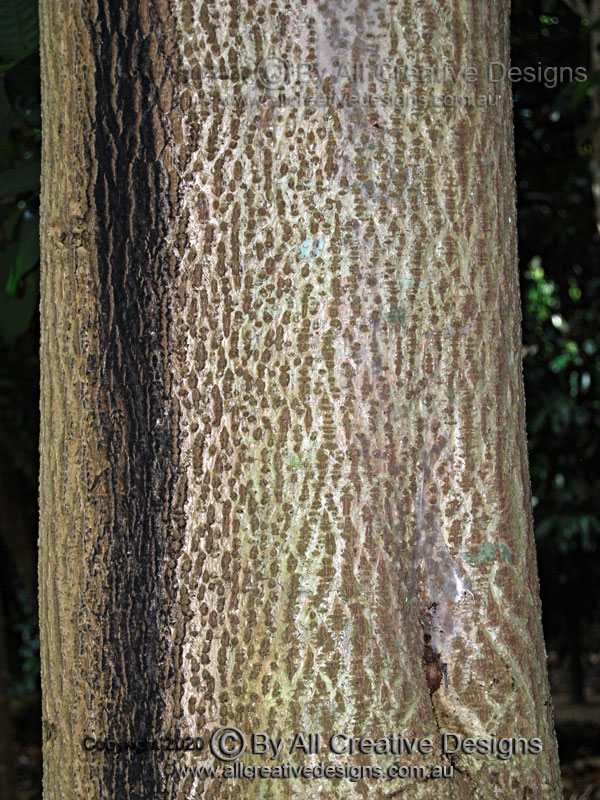
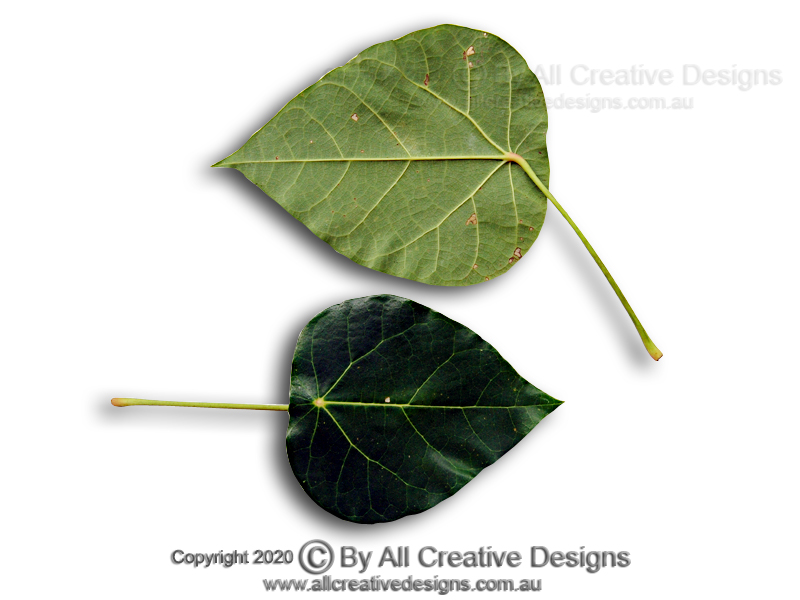
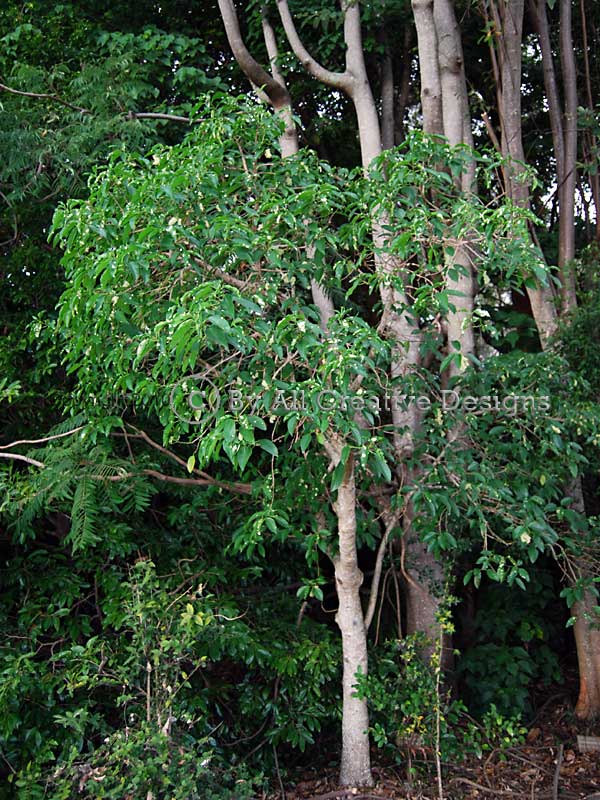
This common species is found as an understorey species in different types of rainforests and adjacent wet tall forests. The Scentless Rosewood Synoum glandulosum reaches a height of up to 15m. The common name refers to the similarity of its timber to that of the Rosewood Dysoxylum fraserianum, but without being scented (Photo 1). Bark on more mature specimens is rough and furrowed in texture, and grey brown in colour (2). The globose shaped fruit (a capsule) matures in late winter to spring and features 3 lobes containing 3 to 5 seeds, which are partly covered by a bright red aril. It measures up to 18mm in diameter and turns a yellow-orange when ripe (3). Pinnate compound leaves consists of up to 9 leaflets, which are; up to 12cm long, mainly oblanceolate (reverse lance-shaped) with entire margins, mid-green and rather dull on top, paler beneath, hairless, thin and soft in texture. Leaflet apex is acute, base shape is attenuate (4). The strongly raised mid vein has clearly visible hairy domatia along its length helping in identification of this species (5). Distribution: Common from the NSW south coast to Qld. See Leaf Characteristics Page for explanations of botanical definitions used.
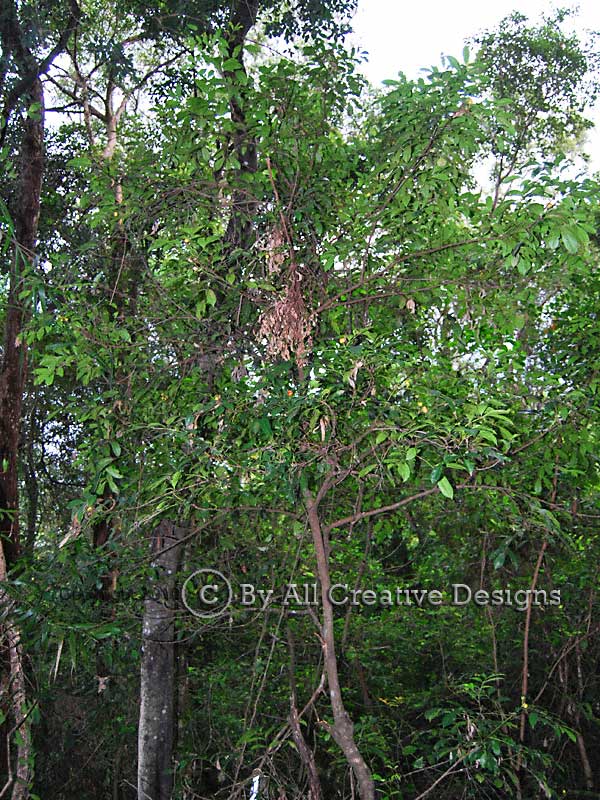
(1)
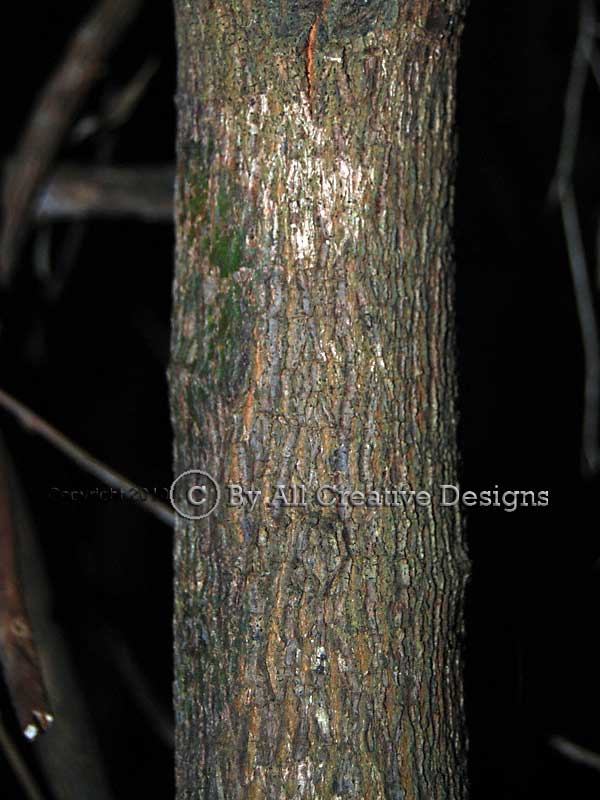
(2)
(3)

(4)

(5)
Sea Hearse Hernandia nymphaeifolia
Sea Hearse Hernandia nymphaeifolia Other names: Lantern Tree, Hernandia
As the common name suggests, this tree inhabits various environments close to the seashore which include tropical and monsoonal rainforests. It has the potential to reach a height of 20m and is identified by its large broadly egg-shaped leaves and unusual fruit (Image 1). Bark on the trunk is cream to pale brown coloured, rough with vertical (irregular) lines of darker brown protrusion. Older trees often develop intertwining buttress roots (2). The +/- depressed globe-shaped outer casing that loosely surrounds the fruit has a fleshy/wax-like consistency and features a rounded opening at the apex. It reaches a diameter of 35mm and changes from white to pink or red at full maturity. The mature fruit is black, urn-shaped with a broad rounded protrusion at the apex and up to 25mm long. The ribbed outer surface of the fruit is of leathery consistency. The rounded seed (shown top left) is cream/pale brown coloured and up to 15mm in diameter. The outer casing is called a cupule, a type of involucre, which is a persistent and enlarged part of the inflorescence (flower) that initially surrounded the ovary producing the fruit (3 & 4). Simple leaves with an alternate arrangement are; up to 30cm long, broadly ovate (egg-shaped) with entire margins, hairless, thick and strong. The rigid petiole (leafstalk) is up to 18cm long and attached inside the lamina (leaf blade) margin, a feature called peltate. Venation is very conspicuous and raised on lower leaf surface (5). Distribution: Tropical north eastern Qld and NT. See also Grease Nut Tree Hernandia bivalvis Page 6.

(1)
(2)

(3)

(4)
(5)
To locate trees by botanical name or to find related species go to: Species List Botanical, which also shows all family names.
Shiny-leaved Stinging Tree Dendrocnide photinophylla
Shiny-leaved Stinging Tree Dendrocnide photinophylla
This medium sized tree species, reaching a height of up to 20m, grows in a range of different rainforest types and features very glossy foliage (Photo 1). Bark on younger specimens is light grey and changes to a more light brown colour with maturity. Texture is rather soft and fairly smooth with some horizontal ridges and bumps (2). Dense clusters of tiny brown fruits are situated at the end of the very swollen, white and fleshy stalks (3). Simple leaves with an alternate arrangement are; up to 15cm long, ovate (egg-shaped) with varied margins from nearly entire to toothed and even crenate. Leaves are fairly thin, soft and feature small stinging hair, mainly on the petiole (leaf stalk) and main veins. Leaf apex is acute, base shape is rounded (5). Distribution: NSW central coast to southern Qld. Note: Effect of stinging hair is fairly mild compared to that of the Giant Stinging Tree Dendrocnide excelsa (Page 4).
(1)

(2)
(3)
(4)

(5)
Short-leaved Beetroot Ellatostachys xylocarpa
Short-leaved Beetroot Ellatostachys xylocarpa Other names: White Tamarind
The Short-leaved Beetroot or White Tamarind is a small to medium sized native tree species found in drier types of rainforests (Photo 1). Bark on the lower trunk is hard, rather smooth with minute longitudinal fissures and dark green to nearly black in colour (2). The three (sometimes 4) valved fruit (a capsule) turns a yellow orange when fully ripe. It measures up to 2cm across and contains 3 or 4 black seeds (3). Pinnate compound leaves feature up to 6 leaflets, which are; up to 8cm long, mostly elliptic in shape with mainly irregular toothed margins, mid green fairly dull to satin glossy on top, slightly paler beneath, firm and strong in texture. Young stems, petiole, petiolule and veins on lower leaf surface are all covered in fine, white hair. Leaflet apex is acute; base shape rounded. Venation is very prominent on both surfaces. Large and numerous domatia, present as swellings on lower leaflet surface, are a good identification characteristic (Photos 4 & 5). Distribution: Upper mid-north coast of NSW to central Qld.
(1)

(2)

(3)

(4)

(5)
Shrubby She-oak Allocasuarina rupicola
Shrubby She-oak Allocasuarina rupicola Other names: Rock She-oak
The genus of Allocasuarina consists of nearly 60 species (shrubs and trees) that are endemic to Australia, with the majority being shrubs less than 5m tall. While it is relatively easy to recognise the genus, identification of individual species is rather difficult and manly relies on the shape of fruiting ‘cones’ and the number of teeth-like leaves. The Shrubby She-oak (shown) is growing in heath land on rocky (granite) terrain at an altitude above 800m. It is a slender shrub with upright branches that reaches a height of 3m (Image 1). On older stems, bark is firm and relatively smooth with areas covered in fine fissures and small ridges; colour is brown and obscured by grey crust forming lichen (2). The fruiting structure is referred to as a ‘cone’, but differs to cones produced by conifers in that She-oaks (Allocasuarina and Casuarina species) bear flowers. The Shrubby She-oak bears either male or female flowers on separate plants, i.e. is dioecious. The female shrub produces cones that are cylindrical in shape, up to 20mm long and 10mm in diameter. They are supported by a stalk (peduncle) up to 10mm long (3). The (pine) needle-like branchlets reach a length of 18cm and a diameter of less than 1mm. Articles, the portions of the branchlet between whorls of leaves, are up to 1cm long (4). Mostly 8 (sometimes only 7) teeth-like leaves, emerging in a whorl formation, are triangular in shape and about 5mm long (5). Distribution: North eastern NSW and south eastern Qld.

(1)
(2)
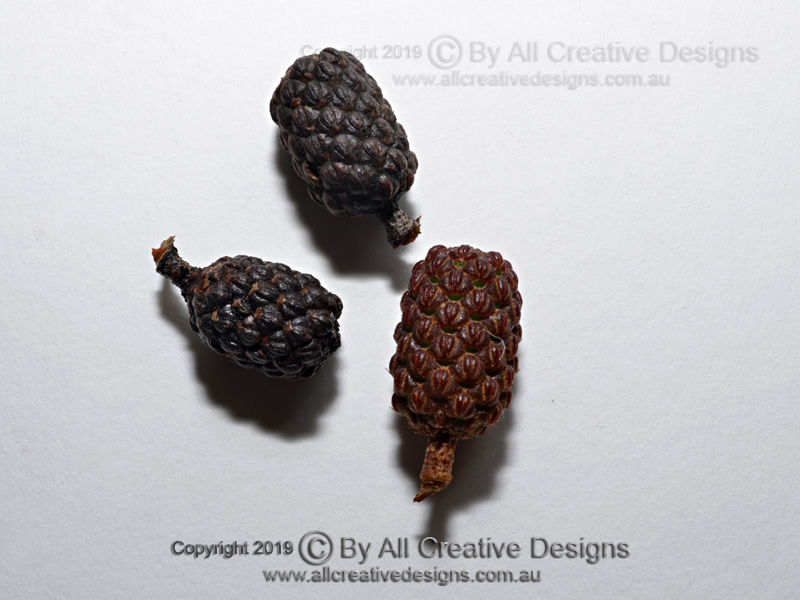
(3)
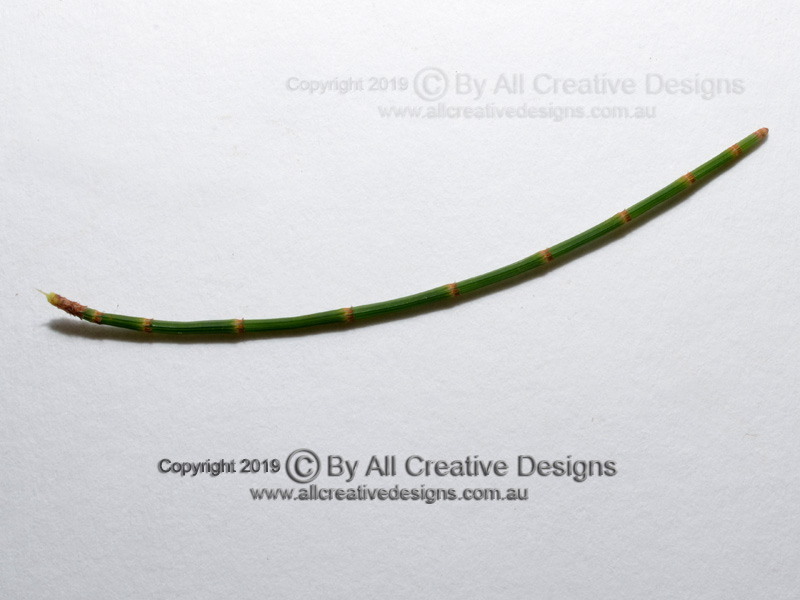
(4)

(5)
Silky Lomatia Lomatia fraseri
Silky Lomatia Lomatia fraseri Other names: Tree Lomatia, Forest Lomatia
This species prefers habitats at higher altitudes and under ideal conditions will reach a height of 8m. It inhabits the margins of cool- and warm temperate rainforests and other wet tall forests (Photo 1). Bark is brown in colour with a firm and finely rough texture (2). The fruit is a woody follicle up to 3cm long, which changes colour from green to black at full maturity. It splits at one side only to release numerous winged seeds. The distinctive remnant flower style at the apex of the follicle is a typical feature for members of the Protea Family (PROTEACEAE) (3 & 4). The simple leaves with an alternate arrangement are; up to 12cm long, elliptic or lanceolate (lance-shaped) with very varied margins from nearly entire to shallow or deeply serrated and also deeply lobed (pinnatisect), dark green, hairless above, silky hairy beneath (first greenish white changing to rusty brown with age), strong and stiff in texture. The yellowish brown coloured petiole is up to 25mm long. Distribution: Vic., NSW and southern Qld (Springbrook Plateau). See Leaf Characteristics Page for explanations of botanical definitions used.

(1)
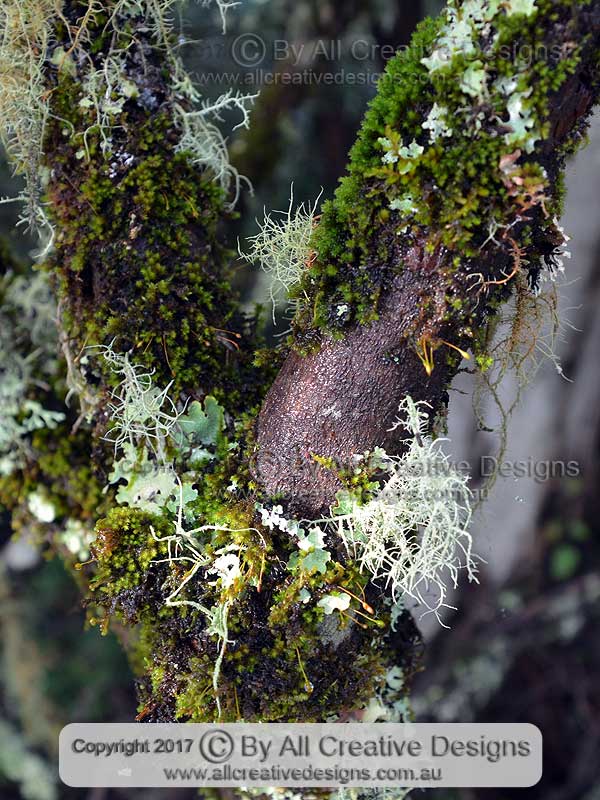
(2)
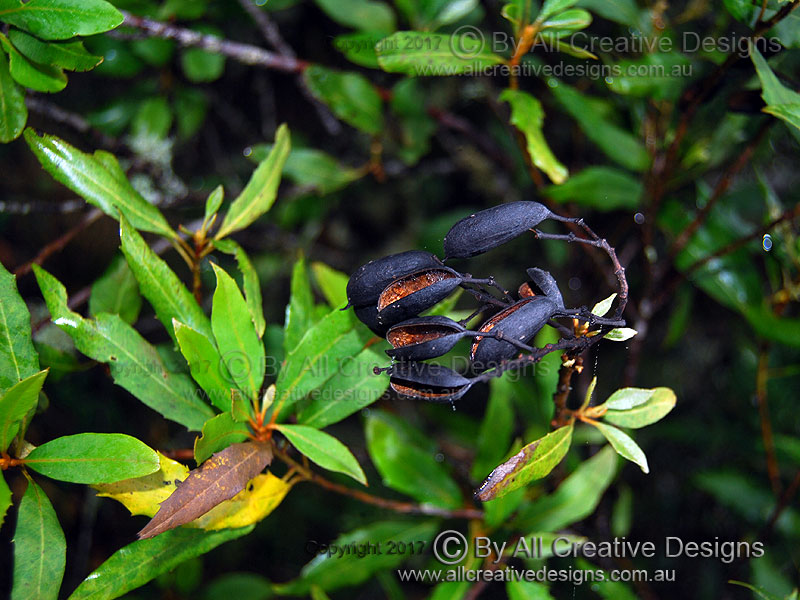
(3)
(4)

(5)
Silky Myrtle Decaspermum humile
Silky Myrtle Decaspermum humile
Under favourable conditions this small to medium sized tree species reaches a height of up to 25m. It has wide distribution range and occurs in habitats ranging from subtropical rainforests to drier environments (Photo 1). Bark is mid to dark brown in colour with a firm texture and prominent longitudinal fissures (2). The fruit is a globose berry, which measures up to 5 mm in diameter and turns dark purple to black in colour when fully ripe (3). Simple leaves feature a neat opposite arrangement and are; up to 7cm long, broadly ovate in shape with entire (in-rolled) margins, dark green, glossy on top, paler green, glossy beneath, hairless, smooth and soft in texture. Leaf apex shape is short acuminate ending in a fine point, base shape is rounded. Petiole (leaf stalk) is rather short at up to 5 mm long and grooved on top. Mid vein is slightly raised on both surfaces, otherwise venation is faint. Leaves emit a pleasant fruity smell with a hint of nutmeg when crushed (4 & 5). Distribution: From NSW central coast to northern Qld and south-east Asia. See Leaf Characteristics Page for explanations of botanical definitions used.

(1)

(2)

(3)

(4)
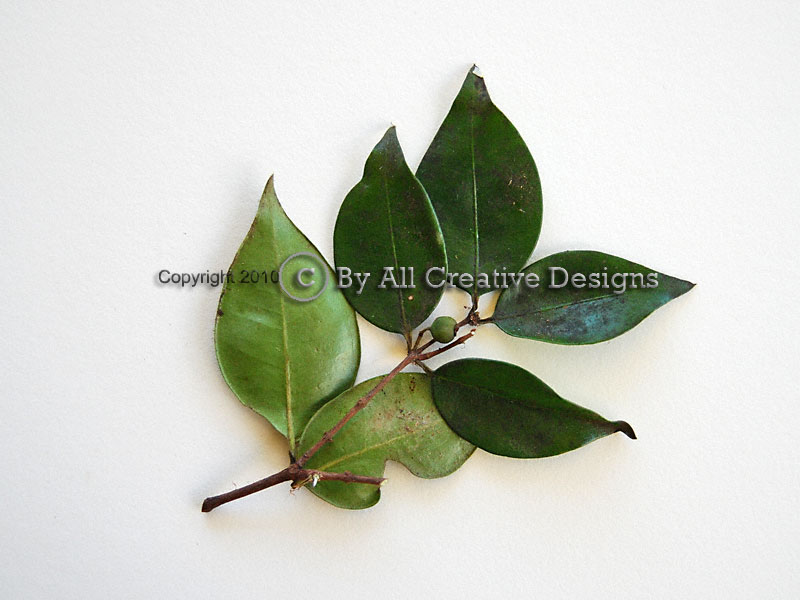
(5)
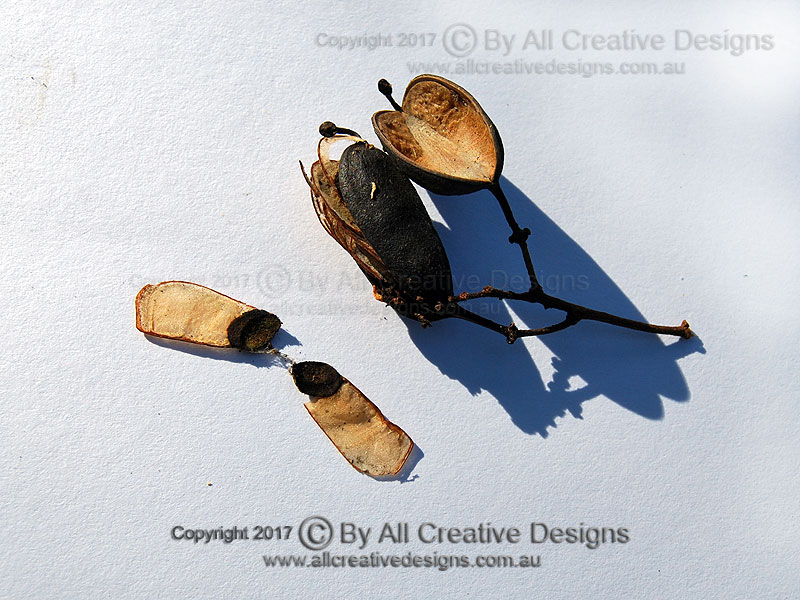
Silky Persimmon Diospyros mabacea
Silky Persimmon Diospyros mabacea Other names: Red-fruited Ebony
This subtropical rainforest species is rare due to its very limited distribution range and diminishing habitat. It is a small or medium sized tree (Photo 1). The dark trunk is a prominent characteristic in identification. Bark is dark nearly black or dark grey in colour, tough and fissured in texture (2). One to five small white flowers are held on short stalks emerging from axillary joints. They are cylindrical in shape and bloom in late winter to spring (3). Branchlets are hairy and grow in a zigzag shape. Simple leaves with a regularly spaced alternate arrangement are; up to 16cm long, mainly elliptic to oblanceolate (reverse lance-shaped) with entire margins, dark green, glossy on top, paler green below, smooth and firm in texture. Leaf apex is rounded with a blunt point, base shape is attenuate. Mid-vein is raised on both leaf surfaces. Growing buds are finely hairy (Photos 4 & 5). Distribution: Growing naturally only in the Tweed River Valley of NSW. See Flower Characteristics Page and Leaf Characteristics Page for information on terms used.
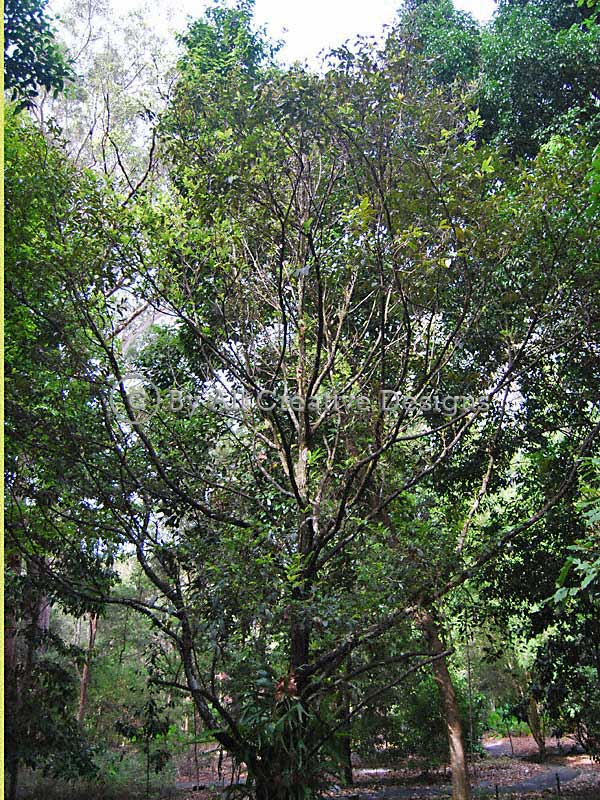
(1)

(2)
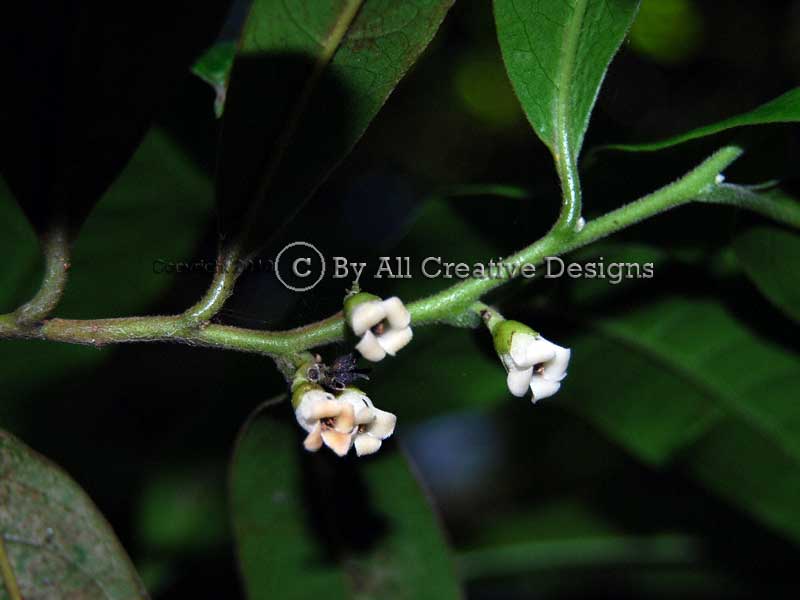
(3)
(4)

(5)
Silver Birch Casearia dallachii
Silver Birch Casearia dallachii
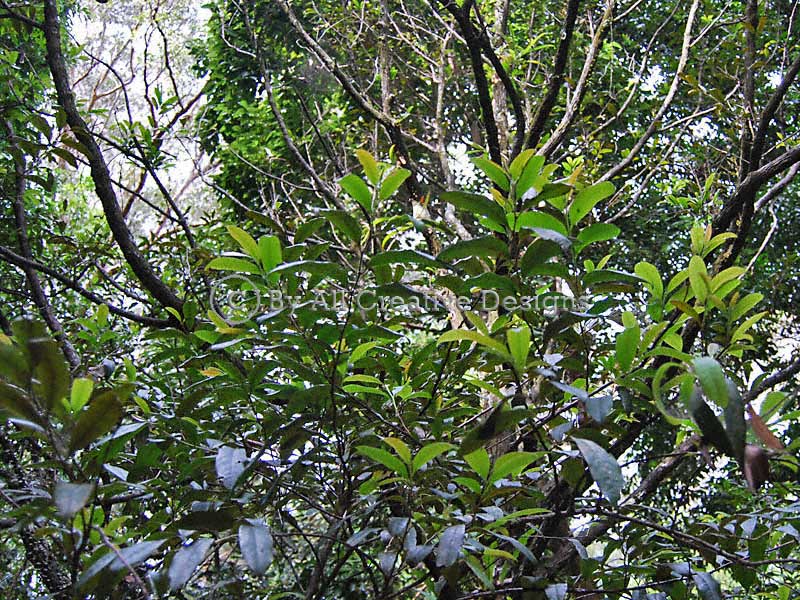
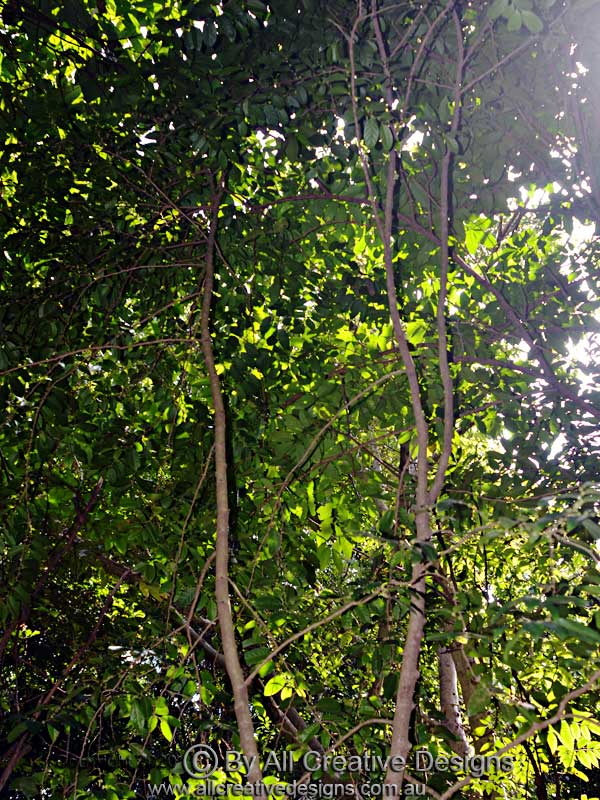
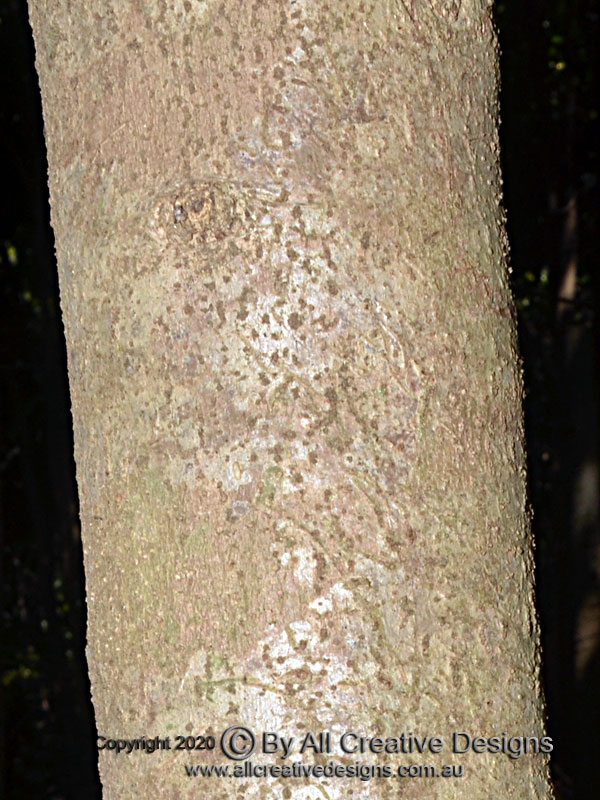
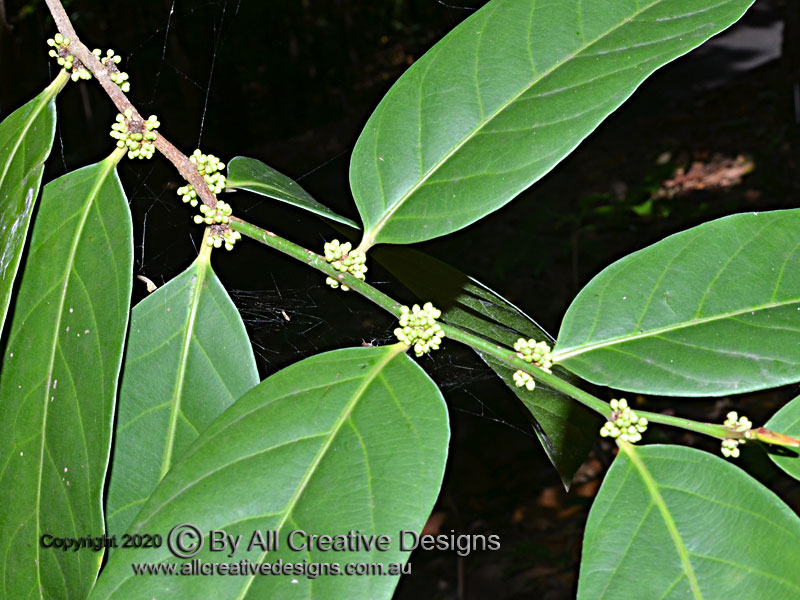
The common name Silver Birch is also used for the European tree (Betula pendula) which has been planted in temperate regions of Australia. The native Silver Birch is a small tree normally less than 10m tall that is found growing as an understorey species in lowland and upland, and other forms of tropical rainforests (Image 1). Bark on the trunk of more mature trees is grey coloured and marked by irregular lines of small protrusions (2). Tight clusters of cream coloured flowers emerge from axillary positions (in leaf axils) along younger branches (3). The zig-zag shaped young branches are a helpful identification characteristic and bear rather evenly sized leaves (4). Simple leaves with an alternate arrangement are; up to 12cm long, mostly broadly oblong in shape with entire margins, hairless, rather dull and dark green on top, paler green beneath, strong and smooth. The mid rib is raised and a yellowish colour on the lower leaf surface. The petiole (leaf stalk) is about 10mm long. Distribution: Tropical north-eastern Qld and Cape York. Note: See also Casearia C. multinervosa on Page 3.
(1)
(2)
(3)
(4)

(5)
Silver Leaf Argophyllum nullumense
Silver Leaf Argophyllum nullumense
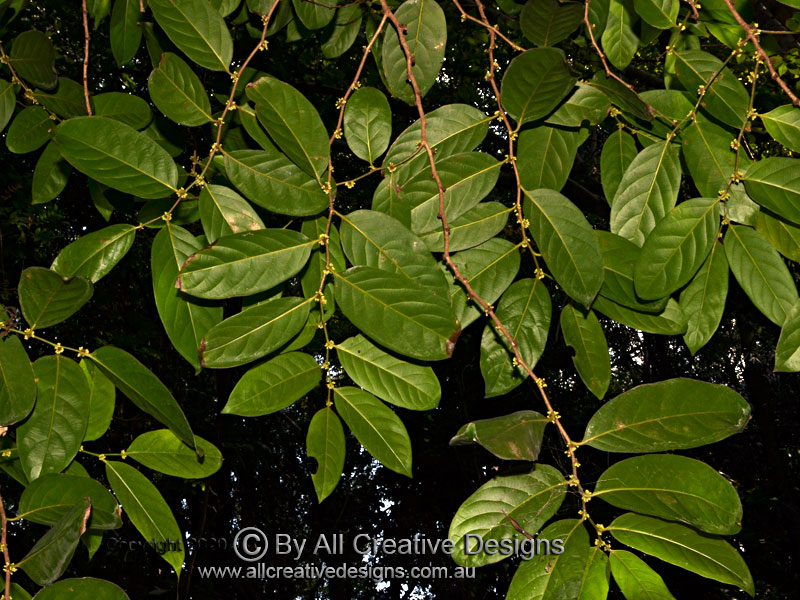
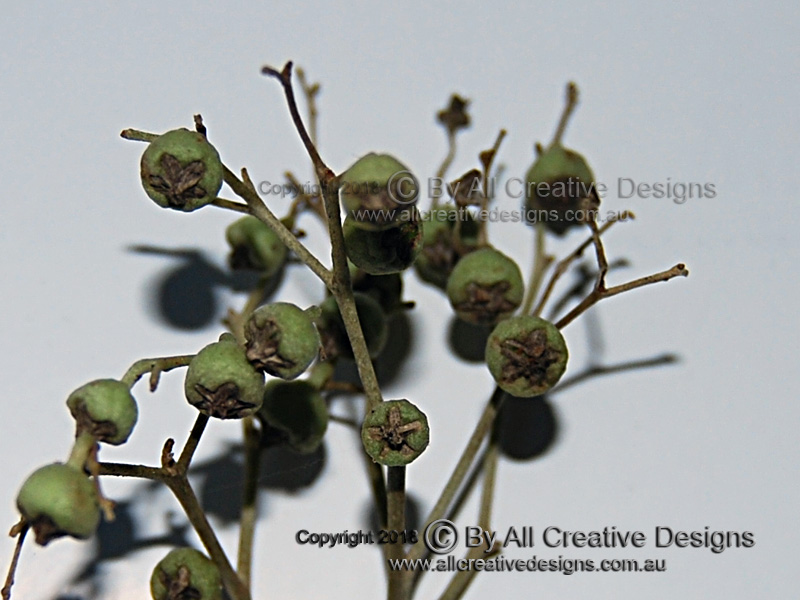
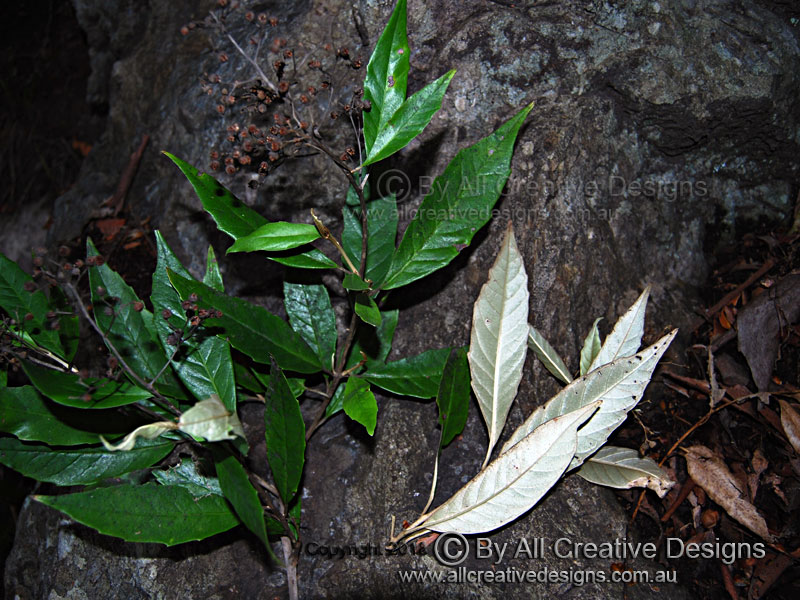
This eye-catching tall shrub or small tree is easily recognised by the bright silvery underside of the leaves. It is an understorey species that reaches a height of 6 to 8m and inhabits warm temperate and subtropical rainforests. Habitat destruction has made the Silver Leaf an uncommon occurrence. The specimen shown is growing at an elevation above 800m within warm temperate rainforest (Picture 1). On older trunks, fresh bark is cream with a pink hue, weathering to grey and becomes rough, due to fine fissures and wrinkles (2). The multi-branching flower panicles are up to 15cm long and appear at very end of young branches over summer. The five triangular petals are about 3mm long and cream or pale yellow-coloured. The style in the centre is crowned by a prominent spherical stigma, which is surrounded by bright yellow bristles. They are fringed appendages, called corolline ligules, interspersed with stamens, featuring inconspicuous elongated anthers (3). The cup-shaped fruit, a capsule, releases numerous seeds by opening valves at the apex. It measures up to 5mm in diameter and changes from green to dark grey at full maturity (4 & 5). Simple leaves with an alternate arrangement are; up to 12cm long, elliptic or lanceolate (lance-shaped) with widely spaced toothed margins, dark green, hairless on top, fine silvery hairy beneath, relatively thin and soft in texture. The petiole (leaf stalk) is about 1cm long and silvery hairy (5). Distribution: Far northern NSW and subtropical Qld.
See Flower Characteristics Page for information on terms used.
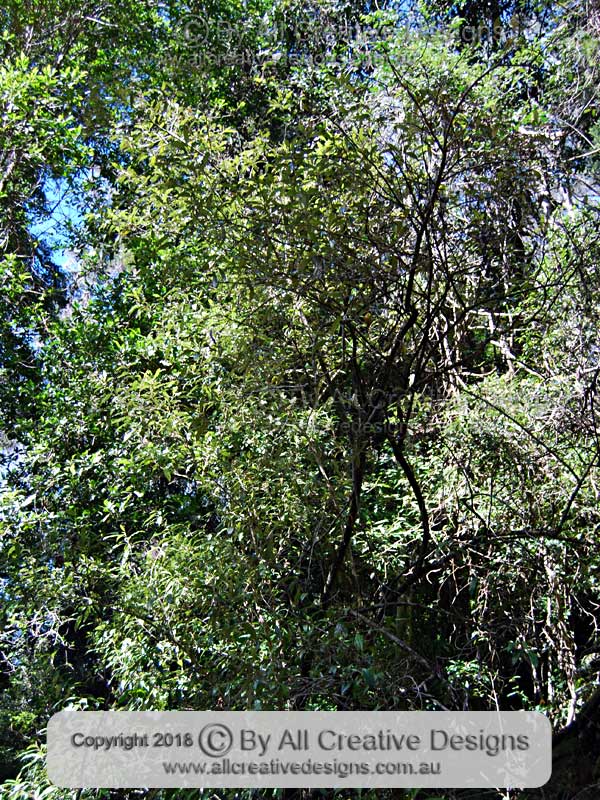
(1)
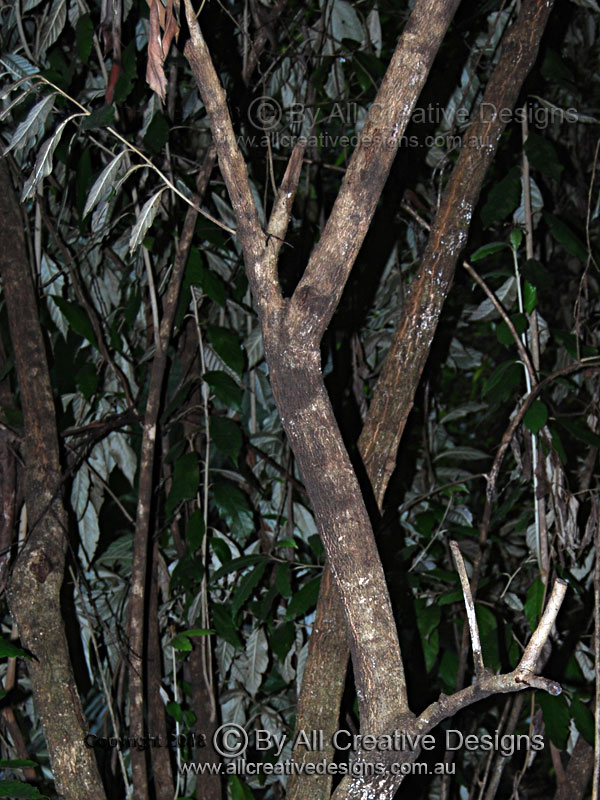
(2)
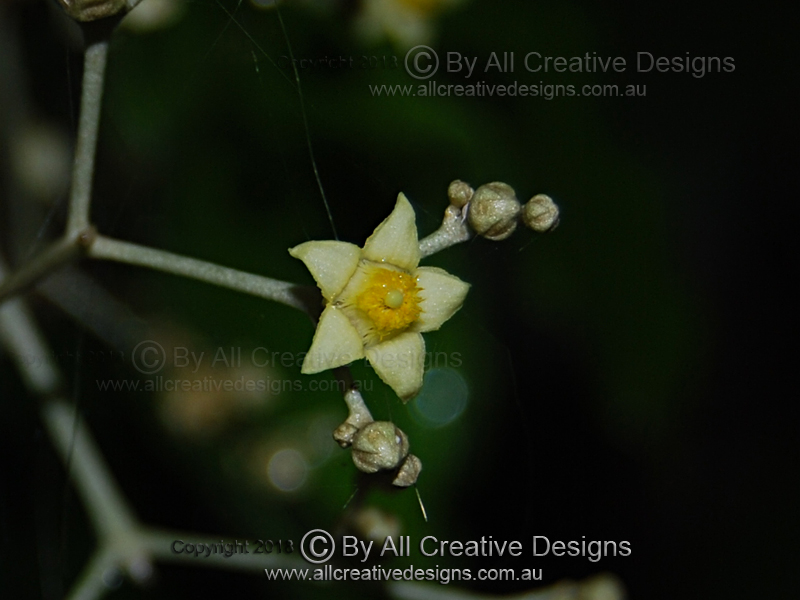
(3)
(4)
(5)
Slender Harpullia Harpullia rhyticarpa
Slender Harpullia Harpullia rhyticarpa
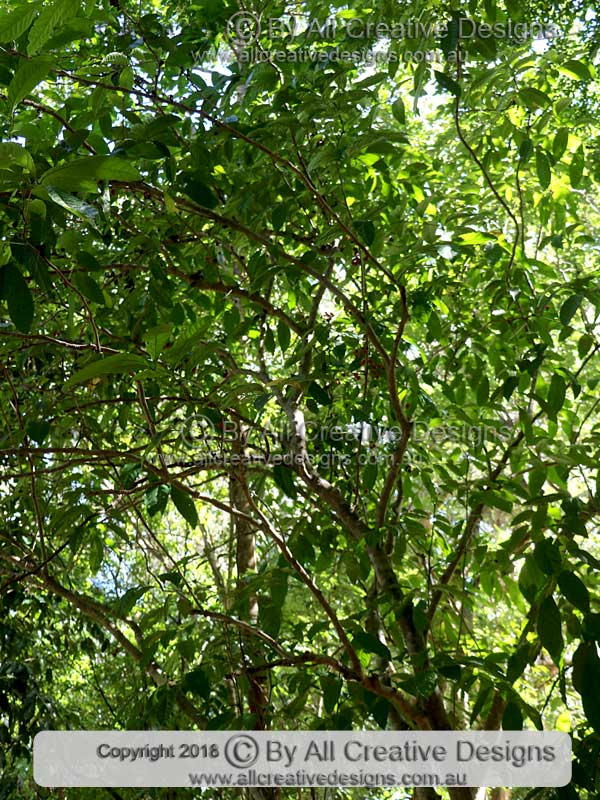
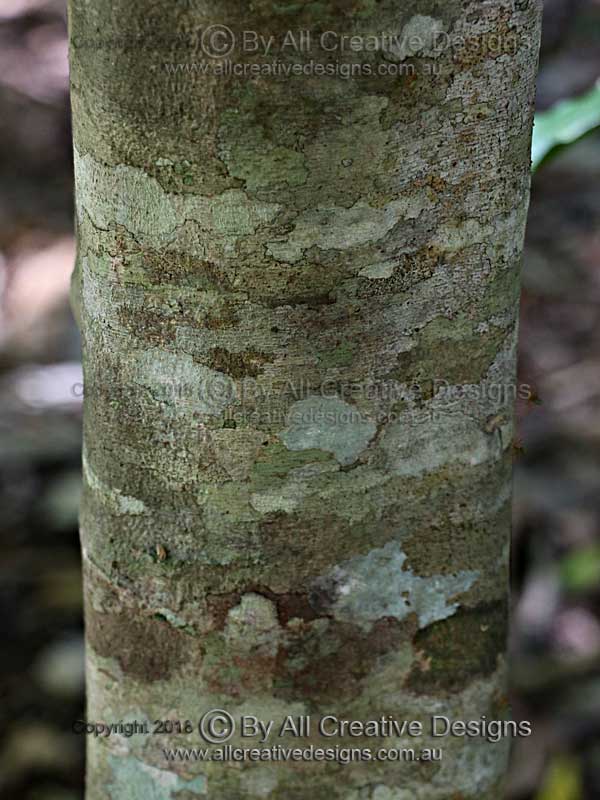
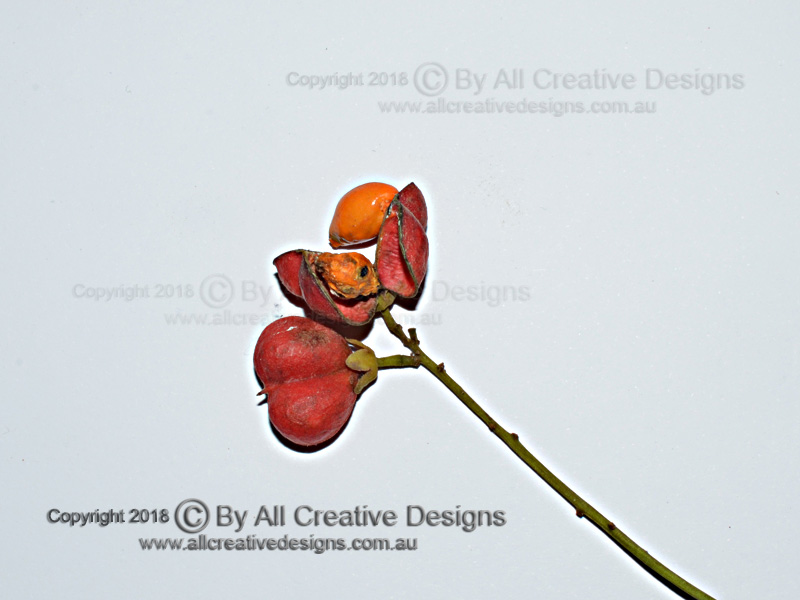
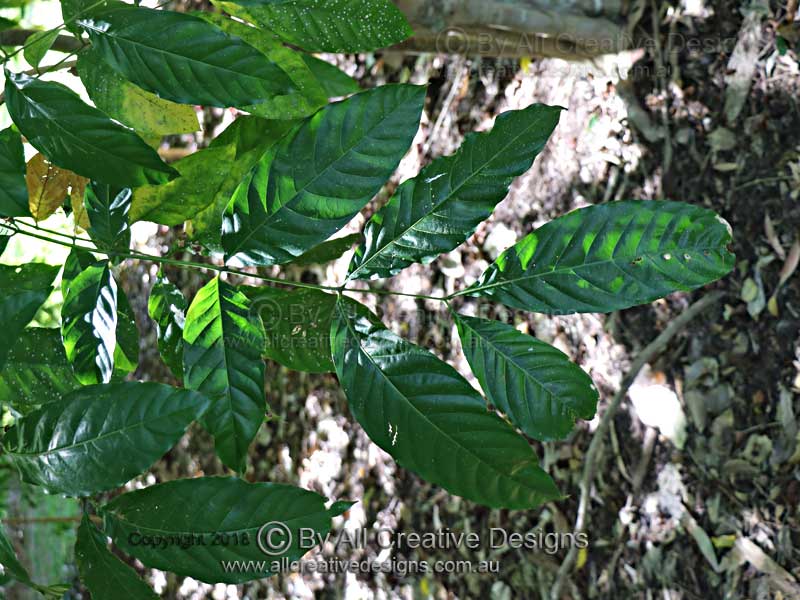
This attractive tall shrub reaches a height of 4-5m and belongs to a genus of shrubs and trees commonly known as Tulipwoods. The Slender Harpullia inhabits lowland and upland tropical rainforests and as an understorey species prefers sheltered conditions under a protective canopy of taller trees (Image 1). Bark is grey and firm in texture (2). The fruit (a capsule) is typical for the genus and reaches a length of 2.5cm. It is pear-shaped, yellow or orange in colour and consists of 2 separate lobes (segments), each containing a single black seed that is covered in a bright yellow/orange aril (skin). The persisting calyx (flower base) is visible at the base of the fruit (3). The pinnate compound leaf consists of up to 12 leaflets, which are; up to 18cm long, elliptical with undulating or entire margins, hairless, dark green, glossy on top, paler green beneath and firm in texture (4 & 5). Distribution: Northern Qld. Locate related species under the genus Harpullia on the Botanical Species List.
(1)
(2)
(3)
(4)

(5)