
< Expand the Menu to access our Tree Identification Pages
Australian Tree Identification by Flower Characteristics; Vic, NSW & Qld
Flower composition and arrangements (inflorescence types) play an important role in the classification of Australian trees and shrubs. View the Flower Identification page for more information. Find informative descriptions and enlarged photos of native forest trees showing flower characteristics, leaves, bark, and fruit samples to aid in the identification of native species. We hope to raise the awareness to the high conservation value of remaining old growth rainforests in Australia with these web pages. Species in following genera are listed in groups on our web pages: Australian Fig trees (Ficus spp.), Eucalypts (Eucalyptus spp.), Grevilleas (Grevillea spp.) and Lilly Pillies, Satinashes (Syzygium species). Otherwise all native Australian tree species are listed by common name in alphabetical order. Note the genus name and use the Botanical Species List to locate related species and find all family names. Refresh the page in your browser to view updated content.
Bolwarra Eupomatia laurina
Bolwarra Eupomatia laurina
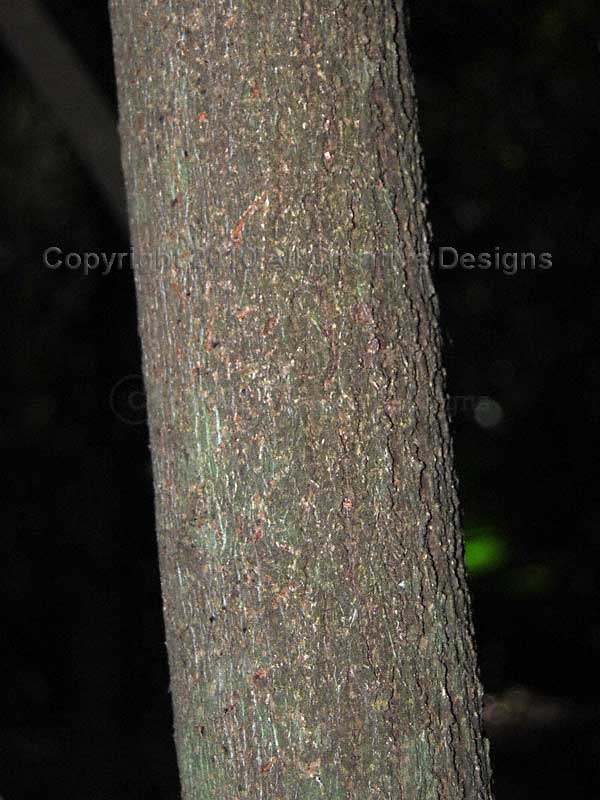
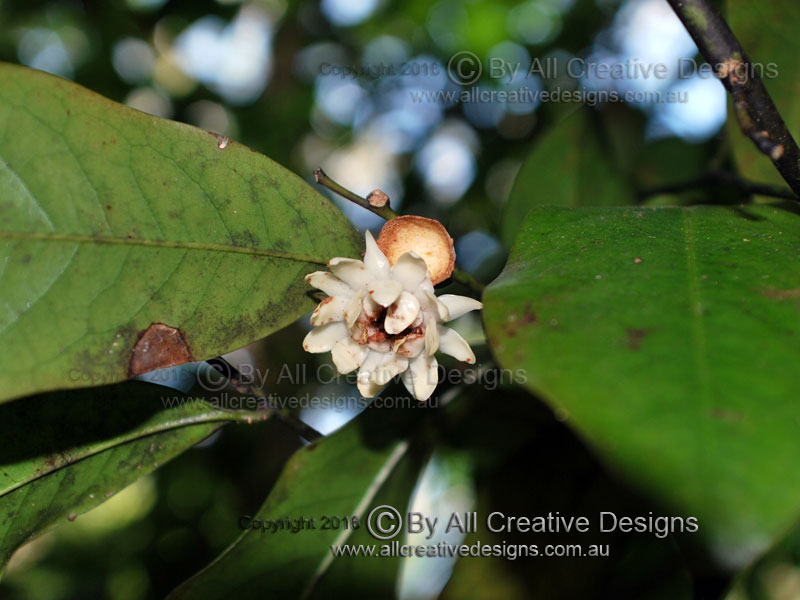
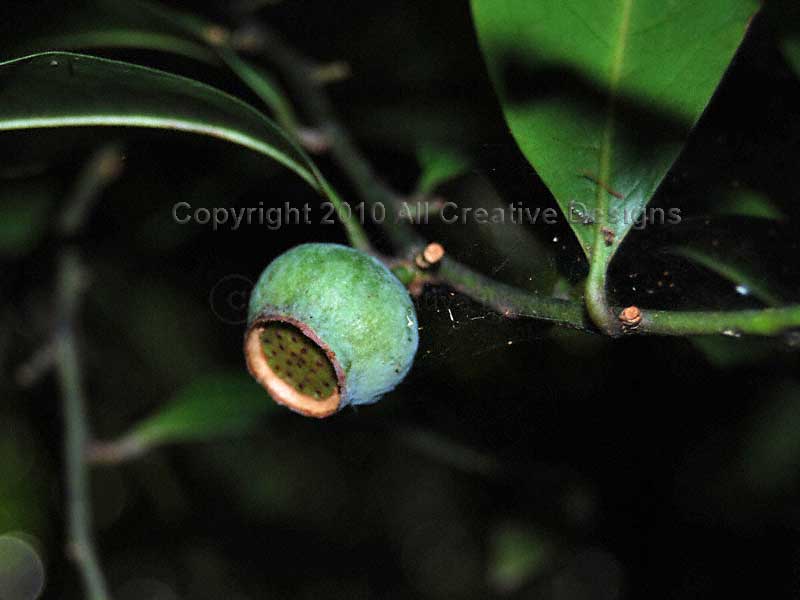
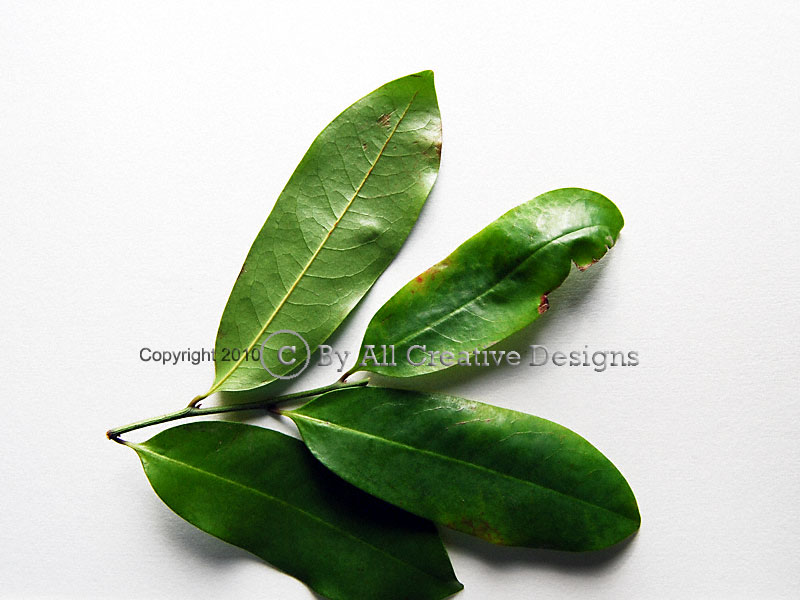
This tall shrub or small understorey tree attains a height of up to 10m and has an extensive distribution range along Australia's east coast. Natural habitats include different types of rainforests and surrounding transition zones (Photo 1). Bark is dark brown, firm with longitudinal ridges and rough in texture (2). Cream coloured solitary flowers are strongly scented and reach up to 2.5cm in diameter. Whorls of broadly flattened infertile stamens, which closely resemble petals, are strong and wax-like in consistency. The cap (operculum) protecting the flower before opening is visible in the background (3). The fruit, a berry, ripens in late autumn on the NSW north coast and is up to 30mm across. It is cup-shaped with a distinctive rim at the top and light green in colour (4). Simple leaves with an alternate arrangement are held on zigzag shaped branches. Leaves are; up to 12cm long, oblong to oblanceolate (reverse lance-shaped) with entire margins, very glossy on both surfaces, fairly soft, smooth and hairless. Leaf apex is short acuminate ending in a rounded tip. Venation except for the centre vein is rather faint (5). Distribution: From Victoria to north Qld. (See Leaf Characteristics Page for explanations of botanical terms used in descriptions.)

(1)
(2)
(3)
(4)
(5)
Rainforests of Australia's East Coast, HAND SIGNED BOOKS; (Out of Stock) A practical and informative field guide to the identification of native rainforest species. More than 800 colour photographs, informative graphics, maps and detailed description of more than 300 species.
This book is a valuable information source for bushwalkers, students, gardeners and anyone with an interest in Australia’s native flora.
The book was written and illustrated by Peter Krisch, the author of the tree identification web pages.
New Holland Publishers: May 2019
ISBN: 9781925546293
Format: Paperback with PVC
Pages: 304 pp.
Size: 23 cm high x 15 cm wide
Full Colour Photography
Rainforests: Identification - Evolution - Reproduction
Dedicated photography of rainforest species including; mosses, mushrooms, lichens, slime moulds, ferns, conifers, flowering trees, climbing plants, orchids and palms enable the reader to identify commonly encountered species.
CLICK HERE FOR MORE INFORMATION
Brisbane Golden Wattle Acacia fimbriata
Brisbane Golden Wattle Acacia fimbriata Other names: Fringed Wattle
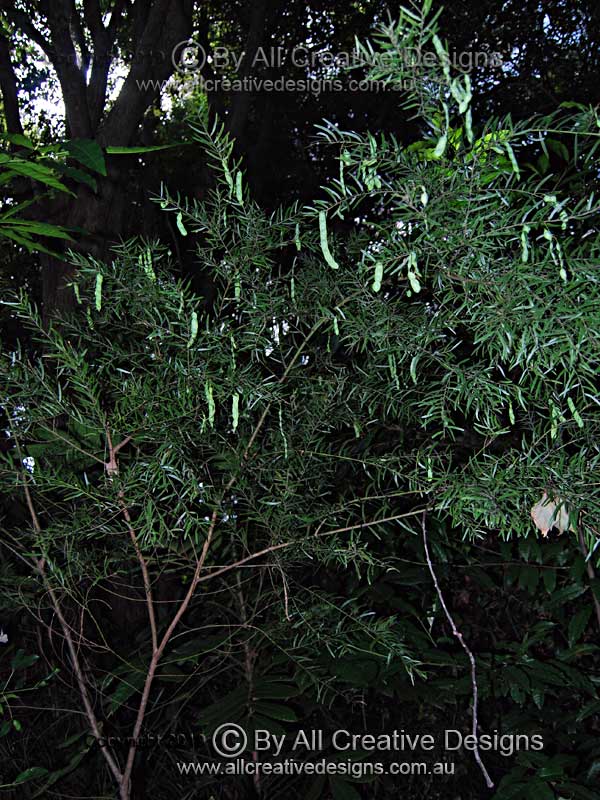
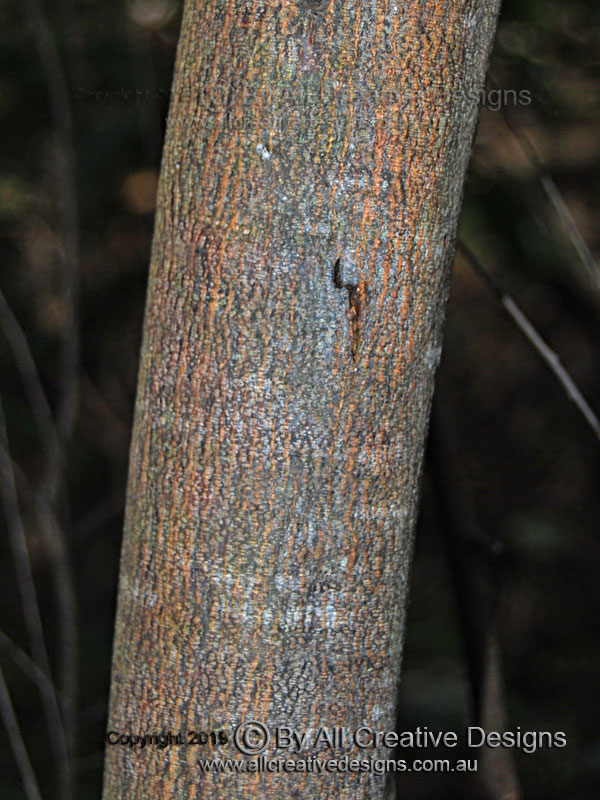
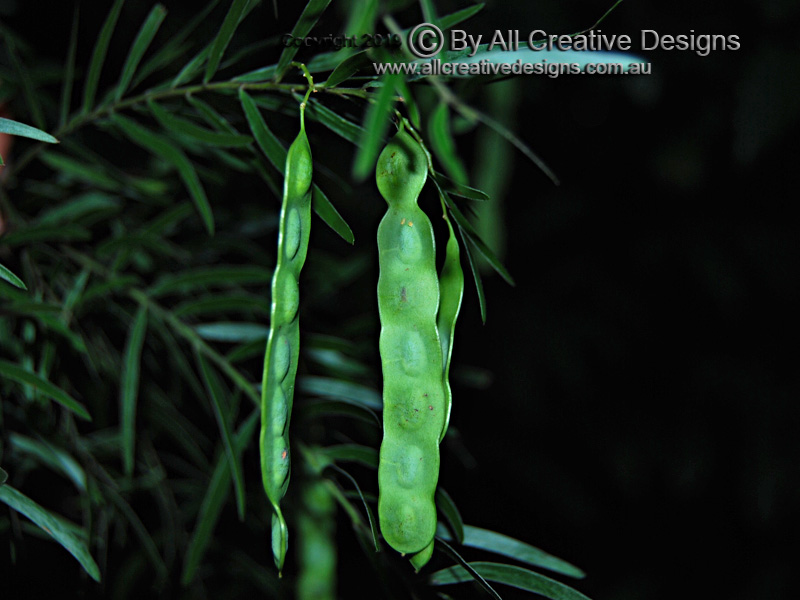
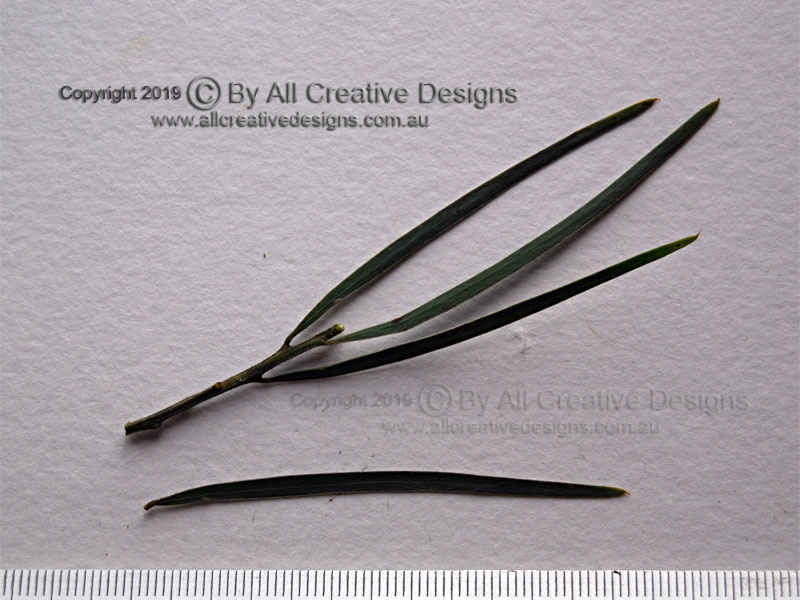
The first image shows this Acacia species growing in a wet location on the margins of subtropical rainforests, but it is also found in drier open forests and woodlands. It is an attractive tall shrub or small tree that under ideal conditions reaches a height of 7m. Globe-shaped yellow flower heads (not shown) are borne on a raceme (Image 1). Bark on the trunk is brown weathering to grey, firm and marked by small longitudinal ridges and fine fissures. Branches are covered in small lenticels (2). The pods are up to 9cm long, hairless (glabrous), flattened and normally rather straight sided or sometimes shallowly indented between the oblong shaped seeds,
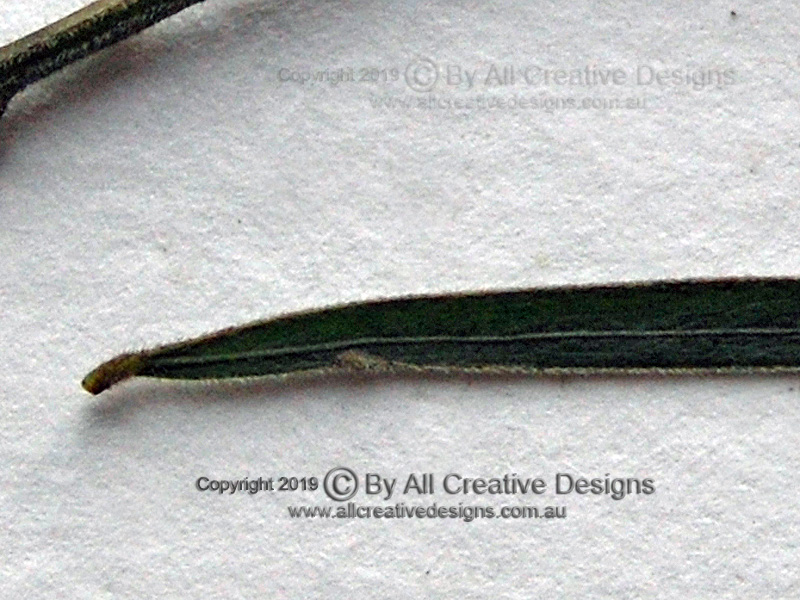
which are arranged in a longitudinal direction (3). Young twigs (branchlets) have an angular appearance and are normally covered in fine hair along the ridges. Phyllodes (leaves) with an alternate arrangement are; less than 7cm long, linear in shape with margins that are fringed by very fine silvery white hair. The phyllode apex terminates in a fine tip (mucronate). A small gland is visible about 5mm above the base (4 & 5). Distribution: Coastal regions and tablelands of southern NSW to central Qld. This species is a popular ornamental plant and has naturalised in some areas of Victoria. View the Botanical Species List to locate other Acacia species.
(1)
(2)
(3)
(4)
(5)
Brittlewood Claoxylon australe
Brittlewood Claoxylon australe
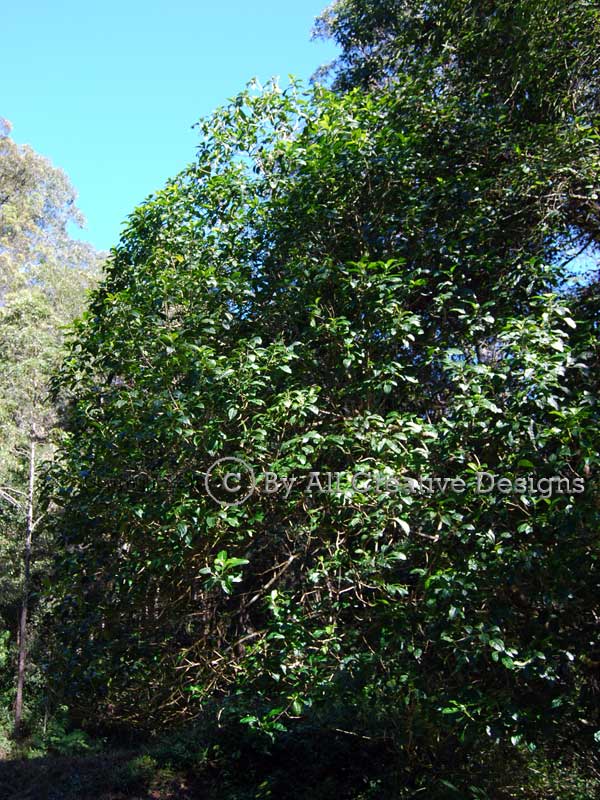
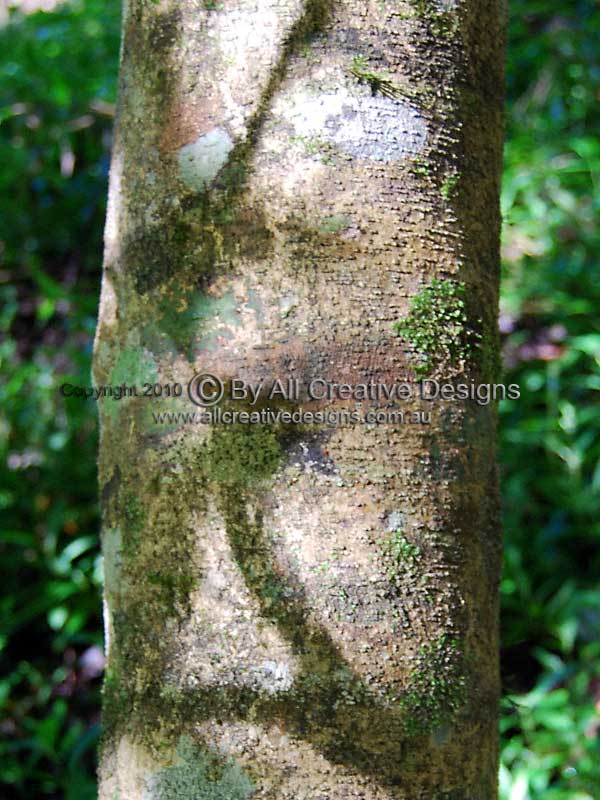
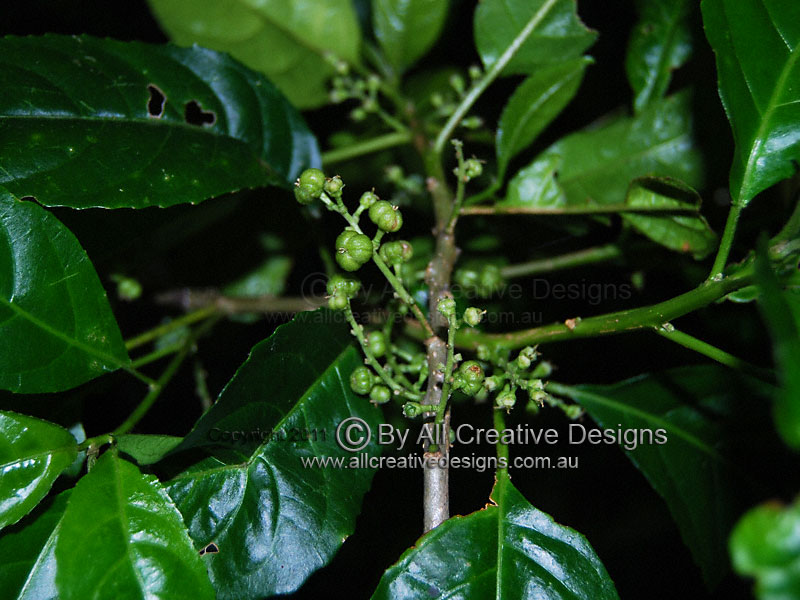
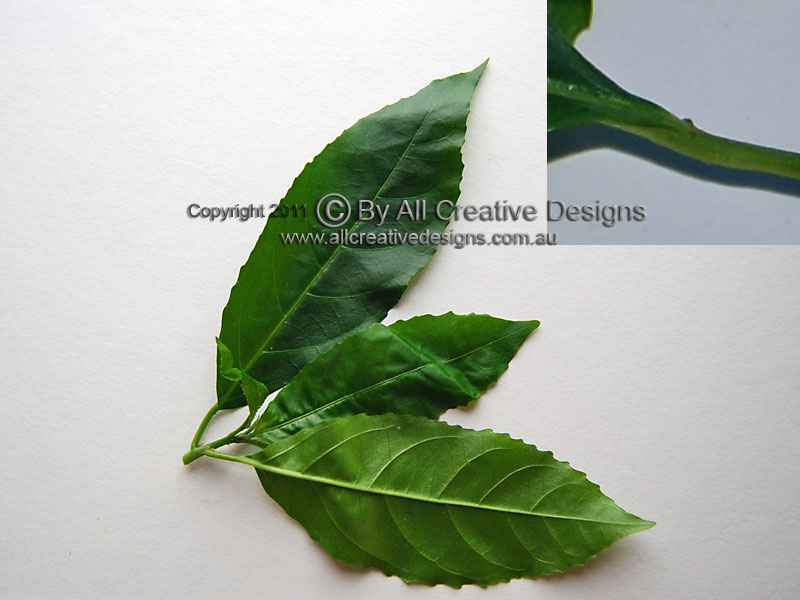
The Brittlewood is an attractive small tree or large shrub (depending on conditions) that reaches a maximum height of less than 10m. Natural habitats include a wide range of environments, ranging from exposed coastal positions to within subtropical rainforests (Picture 1). Bark (on mature specimen shown) is firm and has a rough texture, due to bands of small horizontal blisters. It is cream coloured, whereas bark on young trees is olive green (2). Small white flowers with prominent stamens are held on racemes up to 15cm long (3). The rounded fruit (a capsule) measures up to 8mm in diameter and features 3 lobes, each containing a red coloured seed (fruit will turn nearly black before opening) (4). Alternately arranged simple leaves are; up to 16cm long, varied in shape from elliptic to obovate (reverse egg-shaped) with irregular toothed margins, hairless, dark green and very glossy on top, paler beneath, rather thin and soft in texture. Special identification characteristics are the small glands (Picture 5 inset) located at the top of the petiole (leaf stalk). Leaf apex shape is acute, base shape is cuneate to nearly rounded. Mid-vein and curved laterals are very evident and distinctly raised on lower leaf surface (5). Distribution: NSW south coast to Qld.
(1)
(2)

(3)
(4)
(5)
Broad-leaf Star Hair Astrotricha latifolia
Broad-leaf Star Hair Astrotricha latifolia Other names: Broad-leaved Star-hair
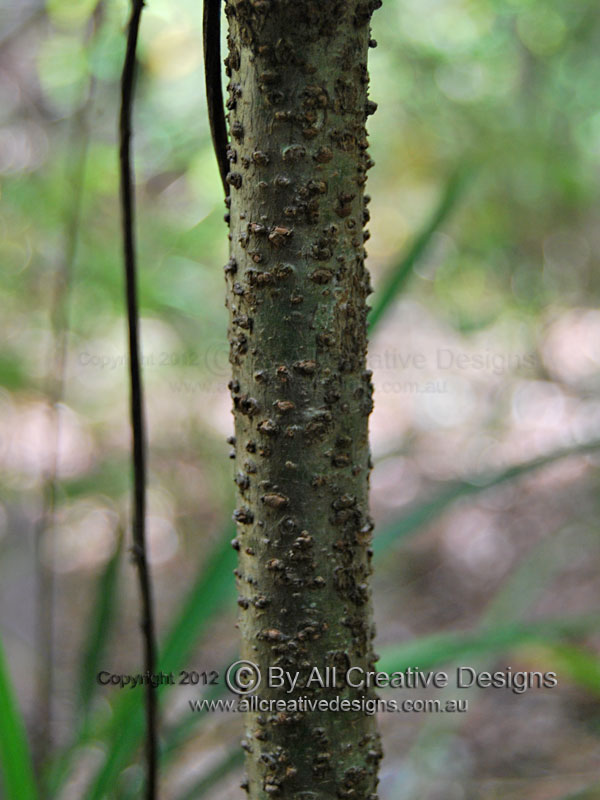
When this species inhabits the margins of rainforests, it is mostly an upright shrub less than 4m tall, whereas in dryer and more open forests it can reach a height of 10m (Photo 1). Bark is olive green with a firm and rough texture, due to warty blisters (lenticels) covering the surface on older specimens (2). Over spring to early summer (southern locations) large spread-out panicles hold numerous minute greenish flower, which reach about 4 mm in diameter. The five stamens are topped by yellow anthers and in the centre the flower style is divided at the base. Globe-shaped hairy flower buds (centre left) are visible in the image (3). The small ovoid-shaped fruit turns greenish yellow in colour and shows the persisting petals (sepals) and style at the flattened apex. It is quick to develop, so flower buds, open flowers and maturing fruit can be found on the same panicle (4). Simple alternately arranged leaves are; from 8 to more than 20cm long, mostly oblong in shape with entire or slightly undulating margins, mid-green, rather dull and hairless on top, whitish grey beneath due to a dense cover of woolly hair (star hairs), rather soft and thin in texture. Leaf apex is attenuate, base shape is cordate. The straight petiole is up to 8cm long and covered in woolly hair. Young growth and stems are also hairy. Venation is clearly visible on lower leaf surface with mid rib and laterals veins being strongly raised (5). Distribution: Southern NSW to Qld. See Flower Characteristics Page and Leaf Characteristics Page for information on terms used.

(1)
(2)

(3)

(4)

(5)
Broad-leaved Geebung Persoonia levis
Broad-leaved Geebung Persoonia levis
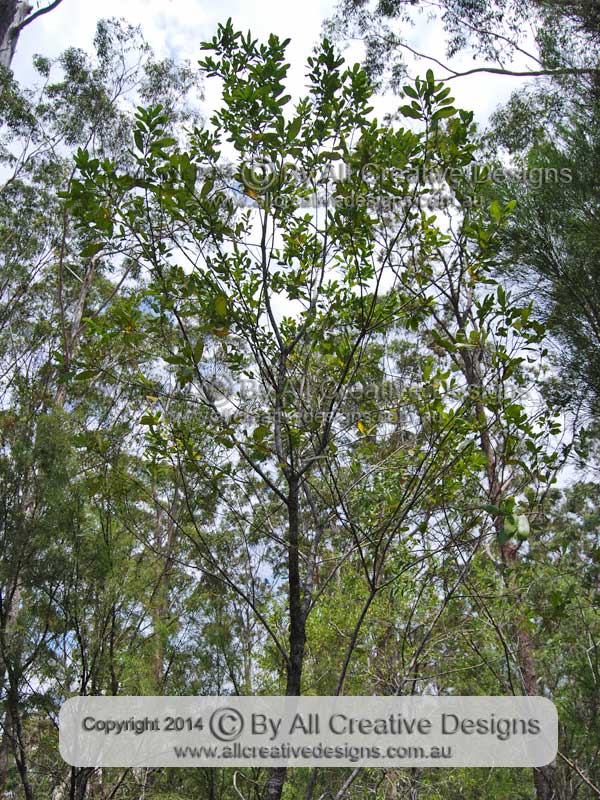
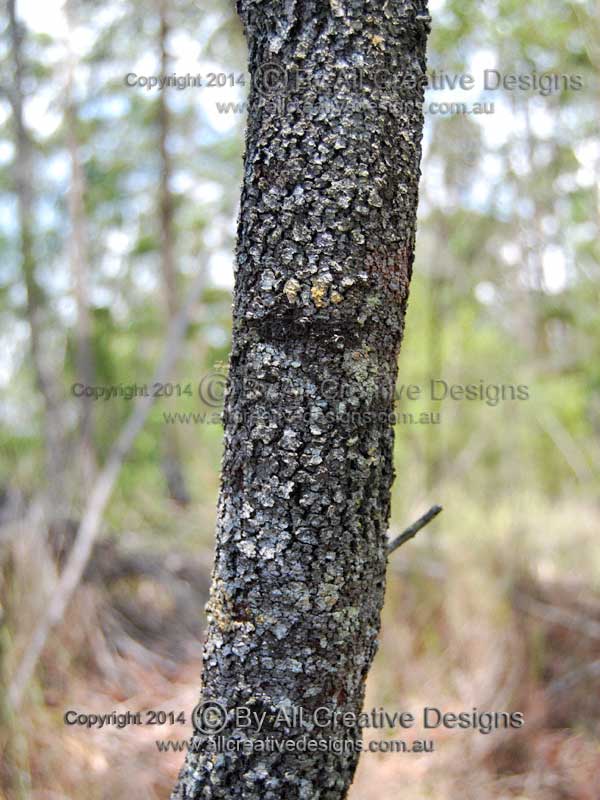
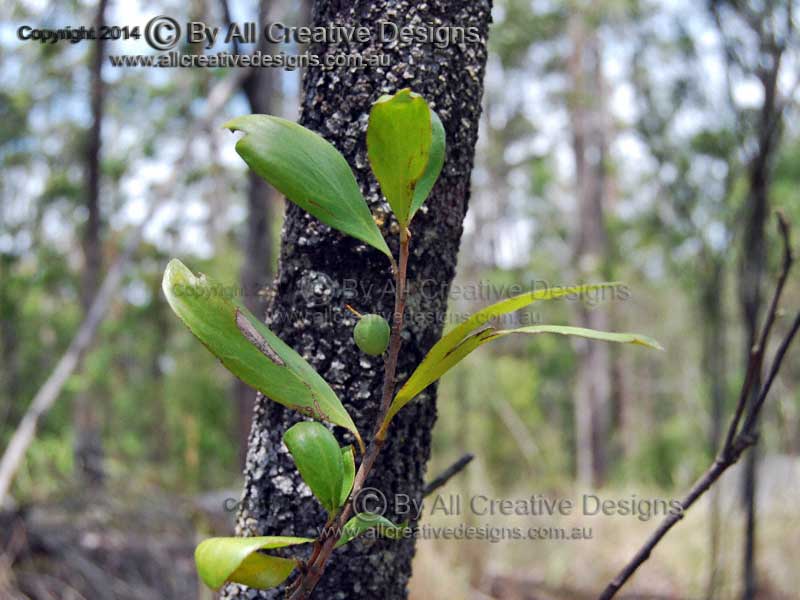
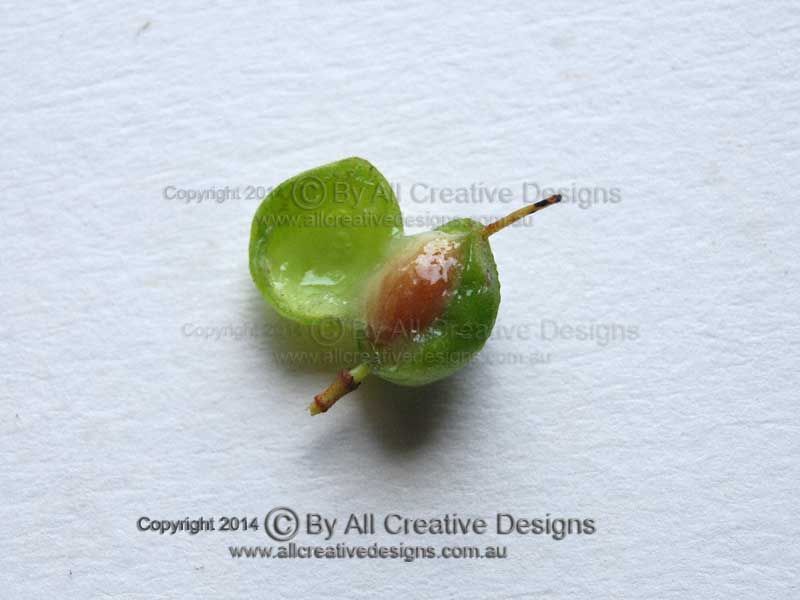
This tall shrub or small tree is frequently found as an understorey species in dry tall open forests and heath lands in proximity to the coast. Under optimum conditions it can reach up to 8m in height and produces bright green foliage (Photo 1). Bark is very rough; densely warty, somewhat scaly in texture and weathers to grey on the surface, but has a reddish brown under-layer (2). The fruit, a fleshy drupe, turns a yellowish green with maturity andis edible. It is close to 20mm long and features the remaining flower style at the apex. The whitish, translucent fruit flesh congeals and becomes very sticky with exposure (3 & 4). Simple leaves with an alternate arrangement are; up to 12cm long, varied in shape from broadly oblanceolate to elliptical with entire margins, hairless, firm and leathery in texture. Leaf apex varies from rounded to acute, base shape is cuneate. Venation is faint, but under closer inspection looping lateral veins are visible (5). Distribution: Victoria to NSW mid-north coast. See also Tall Geebung Persoonia media Page 10.
(1)
(2)
(3)
(4)

(5)
Broad-leaved Paperbark Melaleuca quinquenervia
Broad-leaved Paperbark Melaleuca quinquenervia Other names: Five-veined Paperbark
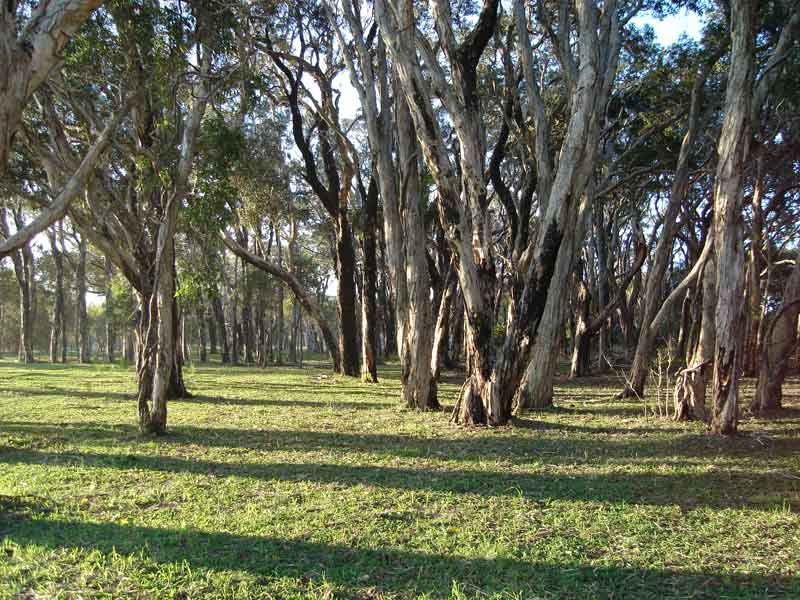
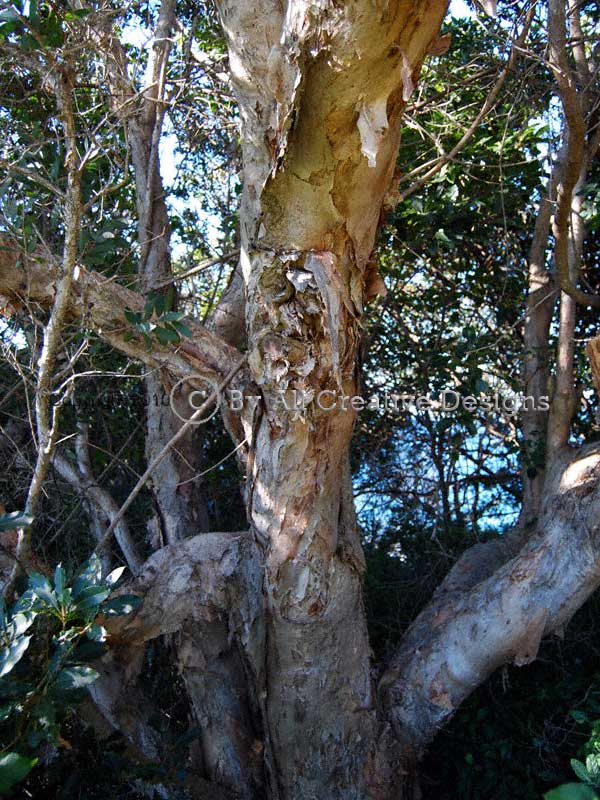
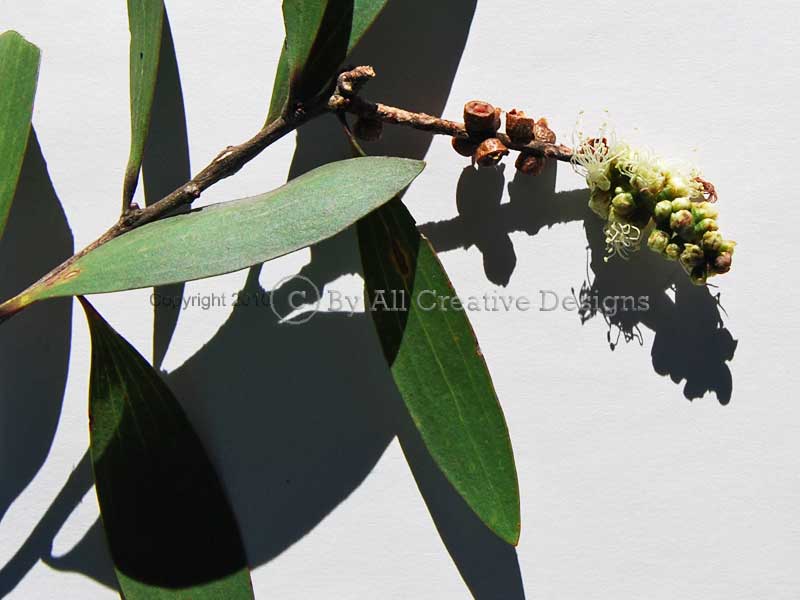
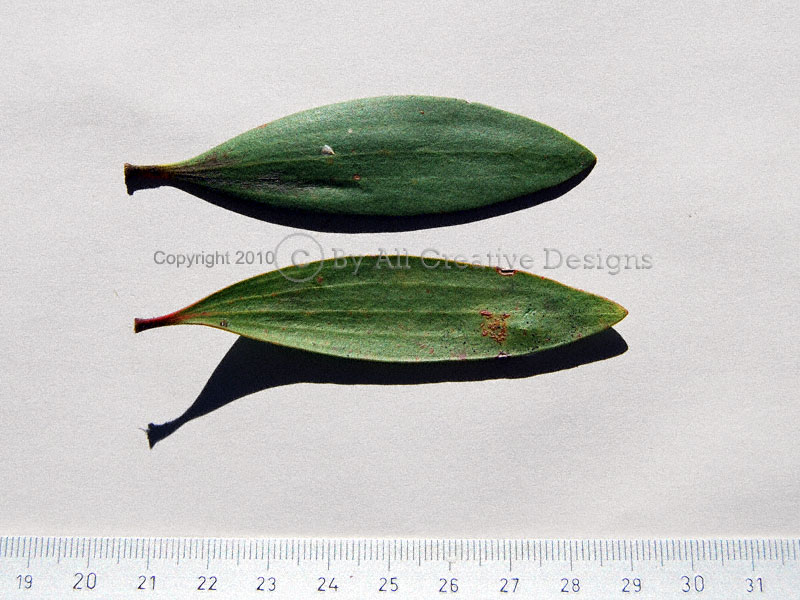
This native tree species is a very common sight in wetter coastal areas and is also known under the name of Five-veined Paperbark. It can attain a height of 20m or more with trunks and limbs shaped by the prevailing winds (Picture 1). The thin papery bark's outer layers are pale grey whereby newly exposed bark is salmon coloured (2). Showy flowers with pure white stamens appear on top of the same spike (stem) holding last season's fruit, which is a brown capsule up to 5mm in diameter (3 & 4). Alternately arranged simple leaves are; up to 9cm long, mostly elliptic in shape with entire margins, firm and quite leathery in texture, hairless and emit a strong scent when crushed. Five longitudinal veins are clearly visible on the lower leaf surface (5). Distribution: NSW central coast to central Qld.
(1)
(2)

(3)
(4)
(5)
Brown Beech Pennantia cunninghamii
Brown Beech Pennantia cunninghamii
This medium to tall tree species is able to reach a height of 30m and occurs in subtropical and warm temperate rainforests, where it favours locations near watercourses (Photo 1). On mature trees, bark is covered in rounded blisters, grey/brown in colour with a corky flaky texture and some fissures (2). In some years an abundant amount of fruit is produced over late autumn and winter. The drupe is ovoid (olive-shaped), up to 15mm long and turns black at full maturity (3). Simple leaves with an alternate arrangement are; up to 16cm long, elliptic to ovate in shape with undulating (wavy) margins, hairless, glossy and smooth in texture (4). Domatia (red circles) are very prominent and occur mainly in lateral vein angles. They appear as swellings on the upper and as indentations on the lower leaf surface (5). Distribution: From the south coast of NSW to central Qld.

(1)

(2)

(3)
fs.jpg)
(4)
fs.jpg)
(5)
Brown Damson Terminalia arenicola
Brown Damson Terminalia arenicola
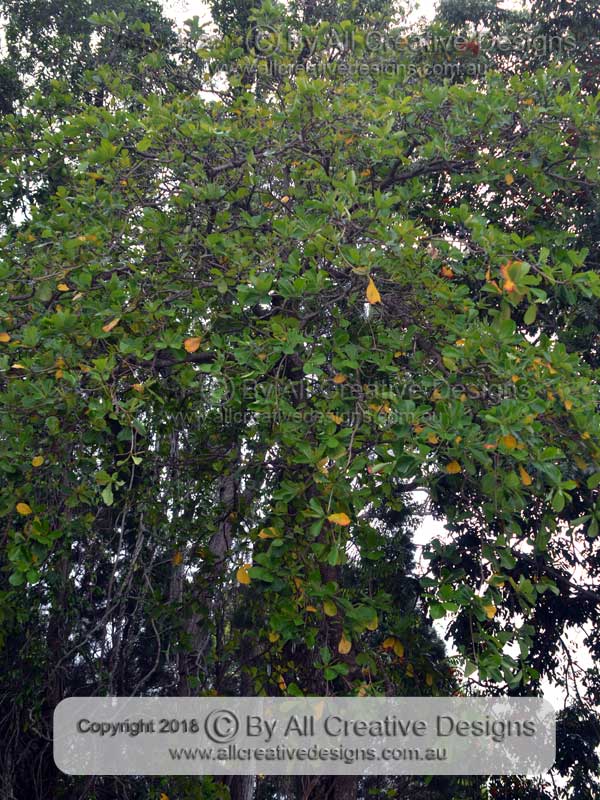
Tropical monsoonal rainforests and other lowland forest types in close proximity to the shore are the preferred habitat for this small to medium sized tree. Coinciding with the dry season, trees are deciduous for a short time over spring, a typical trait for species belonging to the genus (1). Bark is brown in colour, weathering to a dark grey with age and has a rough tessellated (scaly) texture (2). White to cream coloured flowers are borne on racemes up to 20cm long, which normally emerge at the very end of young branches (terminal). Flowers measure about 5mm in diameter and feature 5 triangular shaped sepals, whereas petals are absent (3). The fleshy damson like fruit is up to 4cm long and beaked at on side. It turns dark blue to black at full maturity and contains a single almond-shaped seed (4). Simple leaves are crowded in a whorl arrangement at the end of branches. They are; up to 20cm long, obovate (reverse egg-shaped) with entire margins, hairless, mid green dull on top, pale green beneath, firm and strong in texture. Domatia are visible in the forks of lateral veins on the lower leaf surface (5). Distribution: Northern Qld and Cape York Peninsula.
(1)

(2)

(3)

(4)
(5)
Brown Gardenia Atractocarpus fitzalanii
Brown Gardenia Atractocarpus fitzalanii [Randia fitzalanii] Other names: Yellow Mangosteen
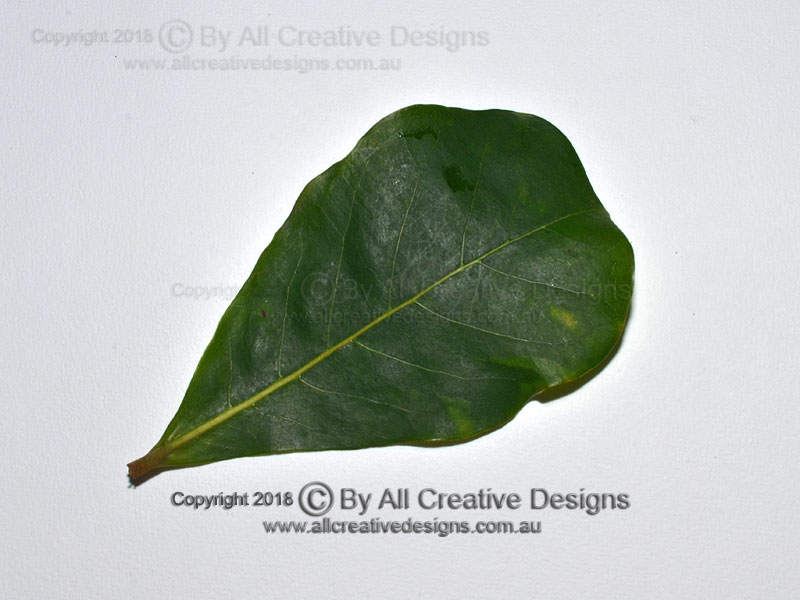
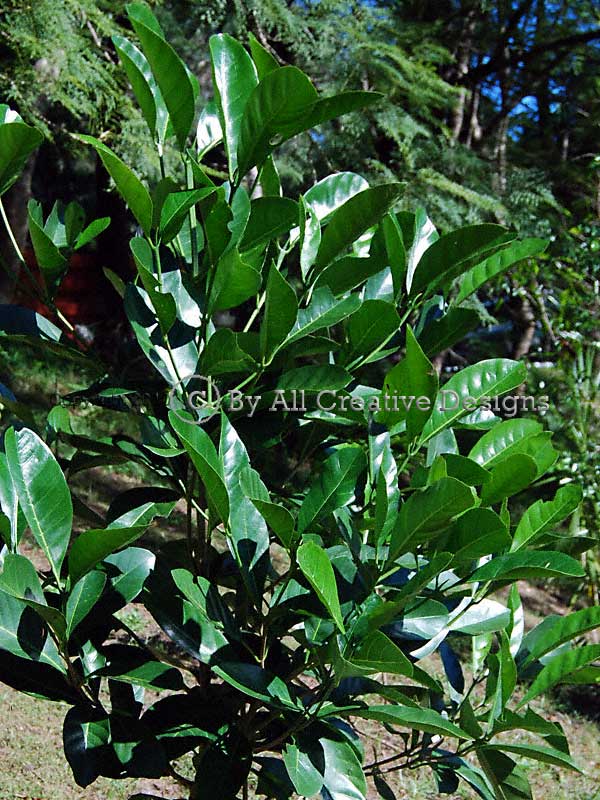
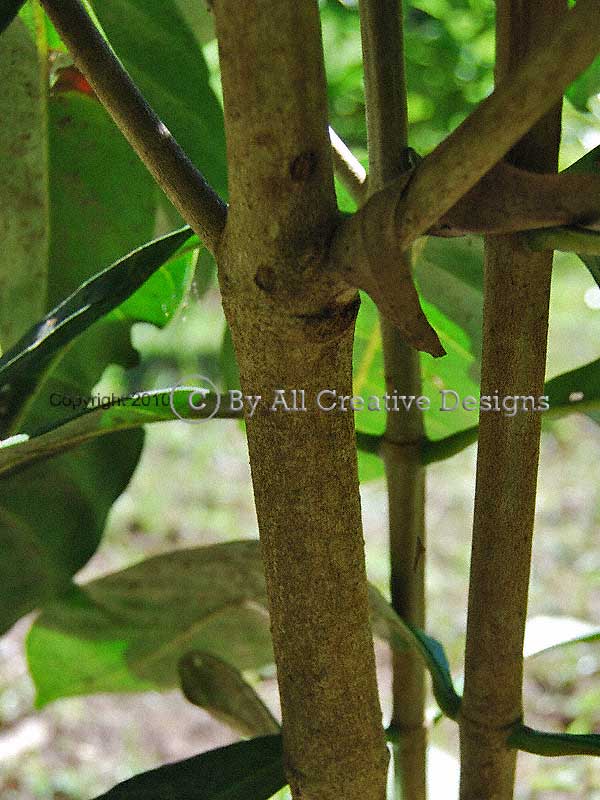
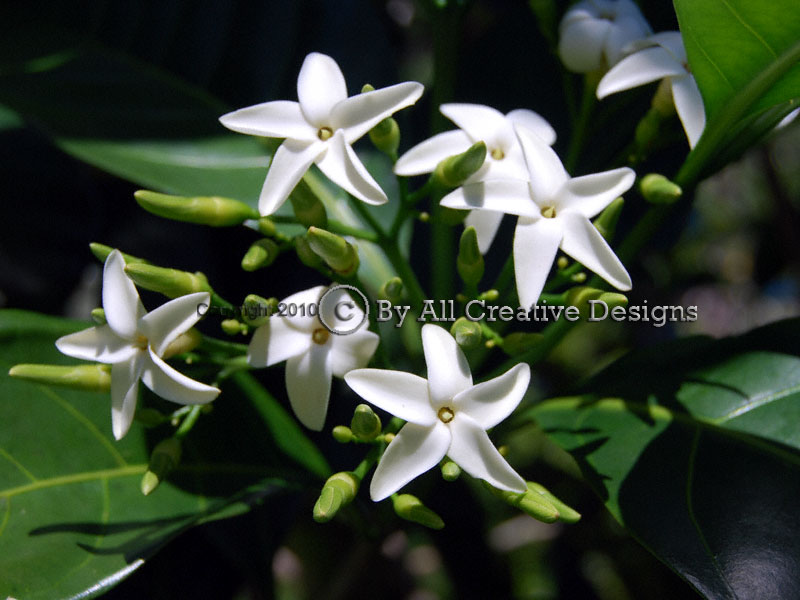
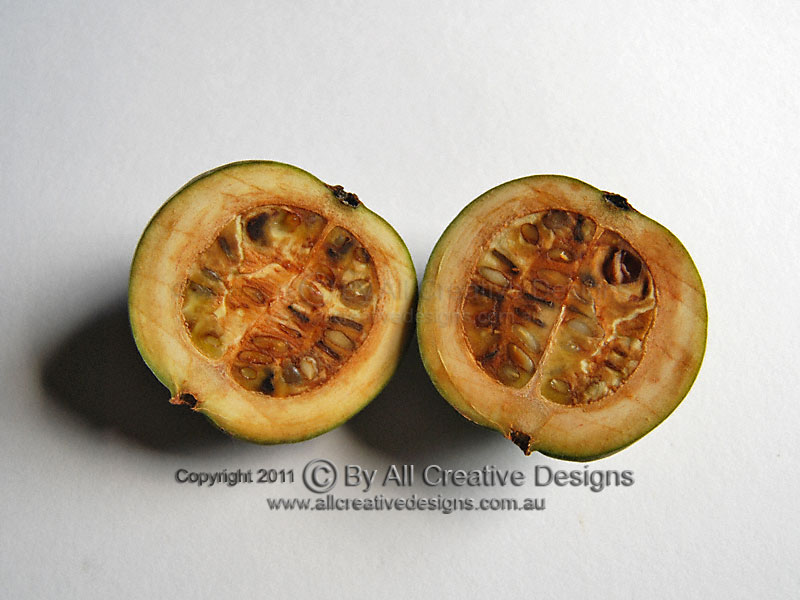
The Brown Gardenia is a very attractive shrub or small understorey tree that reaches a height of 6m in its natural habitat of tropical rainforest (Photo 1). Bark is beige to light brown in colour with a finely rough texture (2). Superbly scented flowers are pure white, up to 3cm in diameter and feature 5 overlapping petals (3). The large fruit (a berry) is rounded in shape, up to 8cm in diameter and turns a yellowish green when mature. It contains numerous small black seeds embedded in an edible pulp (4). Oppositely arranged simple leaves are; more than 20cm long, mostly elliptic in shape with entire margins, dark green and glossy on top, mid-green and glossy below, hairless, thick, smooth and firm in texture. Petiole (leaf stalk) is up to 25mm long. Leaf apex is rounded, base shape is cuneate. Mid vein and laterals are raised on both surfaces (5). Distribution: Tropical east coast of Qld. (A beautiful ornamental species for frost free areas.)
(1)
(2)
(3)
(4)

(5)
To find related species go to: Species List Botanical, and look up the genus Atractocarpus. The page also shows all family names.
Brown Kurrajong Commersonia bartramia
Brown Kurrajong Commersonia bartramia Other names: Scrub Christmas Tree
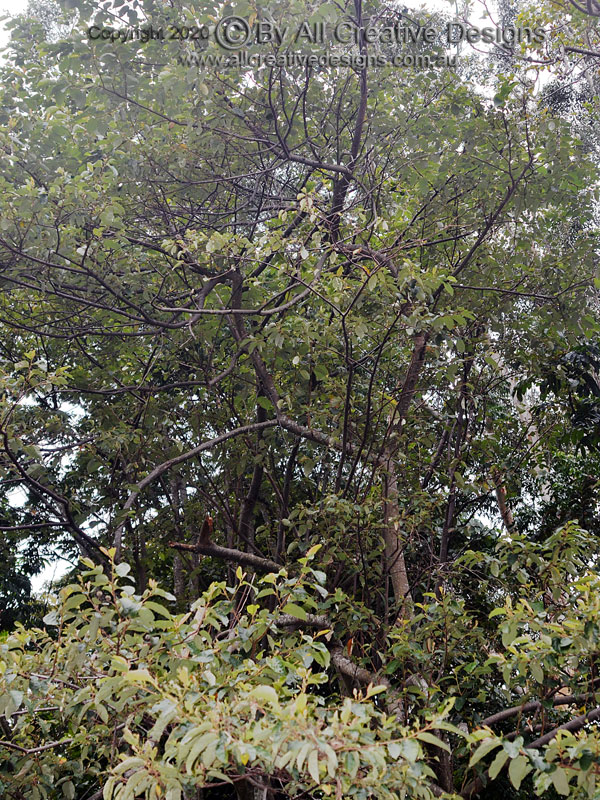
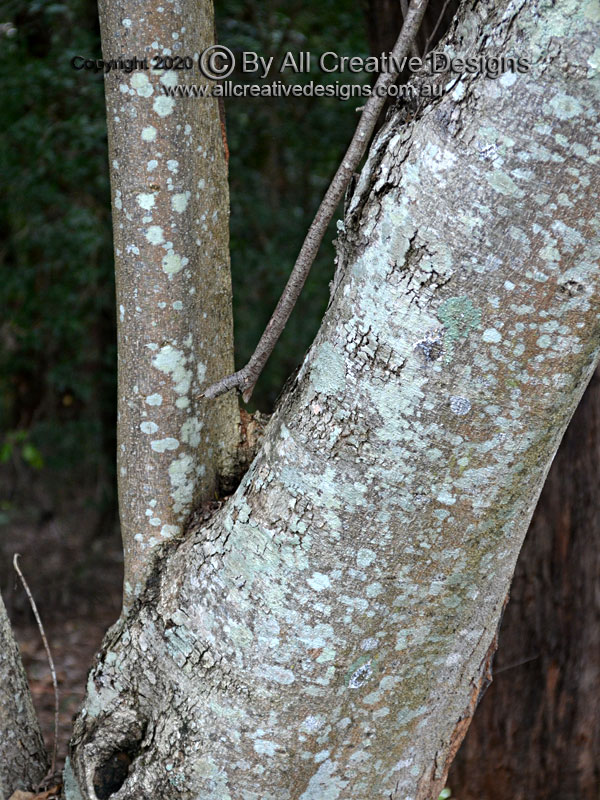
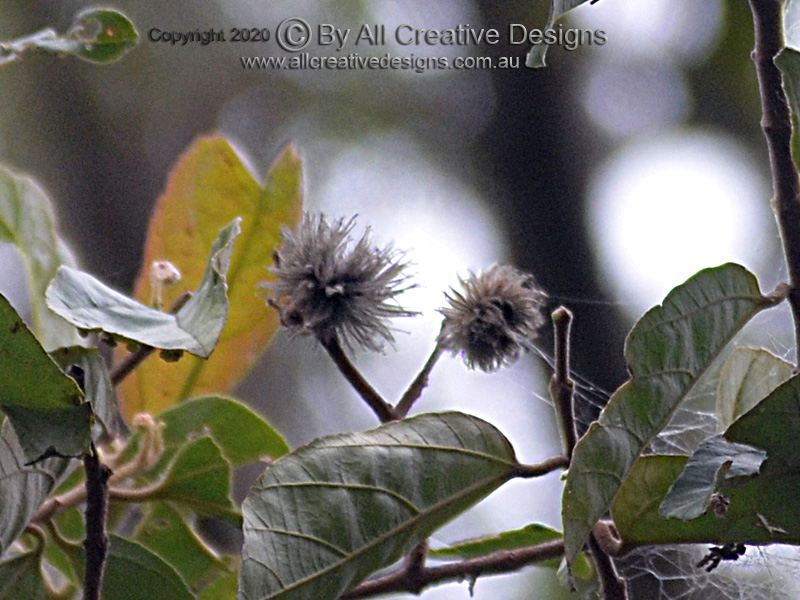
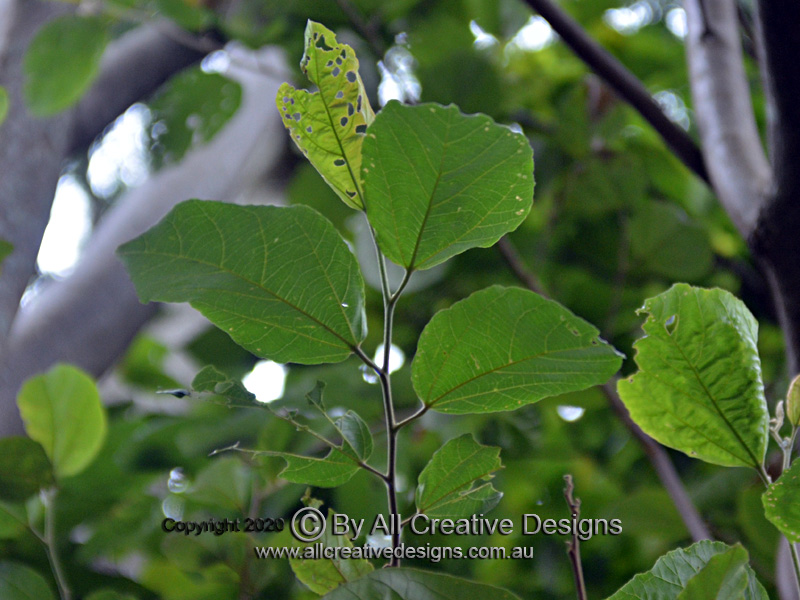
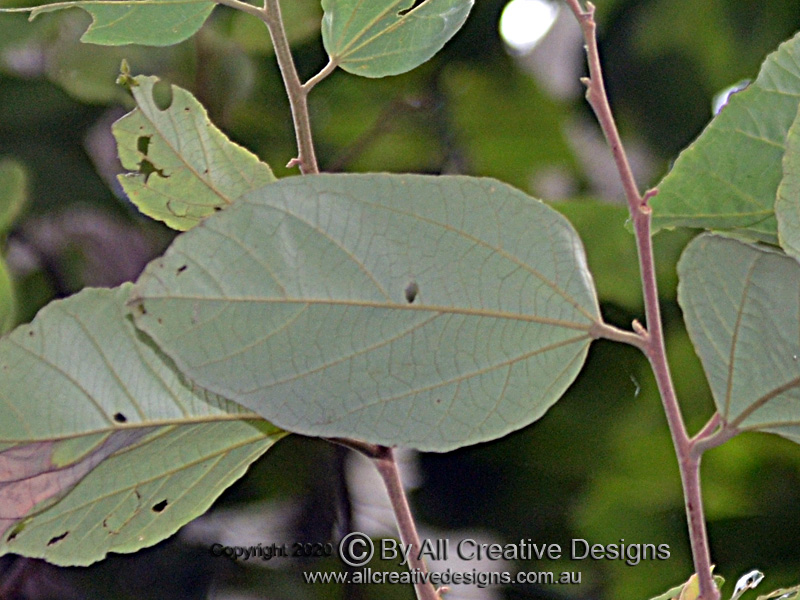
This widespread and very adaptable species can be more than 20m tall, but a height of around 10m is more common. It inhabits subtropical and tropical rainforests, and as a fast growing species is frequently found in regrowth areas (Image 1). Bark at the base of older trunks is greyish brown and becomes scaly, whereas younger branches show characteristic whitish lenticels (protrusions). Older trees develop a buttress root system (2). The fruit is a rounded and soft bristly capsule that reaches a diameter of 2.5cm. It is grey or more greyish brown in colour and matures over autumn and early winter (3). Young twigs are densely covered in fawn-coloured hair. Simple leaves with an alternate arrangement are; mostly up to 14cm long, ovate (egg-shaped) with finely toothed to nearly entire (smooth) margins, normally hairless on top (mature leaves), pale and whitish hairy beneath, relatively thin and soft felt-like beneath. Venation is raised and prominent on lower leaf surface (Images 4 & 5). Distribution: From the mid-north coast of NSW to Cape York Qld and NT. Note: The similar Brush Kurrajong (Commersonia fraseri) is listed below on this page.
(1)
(2)
(3)
(4)
(5)
Brown Malletwood Rhodamnia rubescens
Brown Malletwood Rhodamnia rubescens Other names: Malletwood, Scrub Turpentine
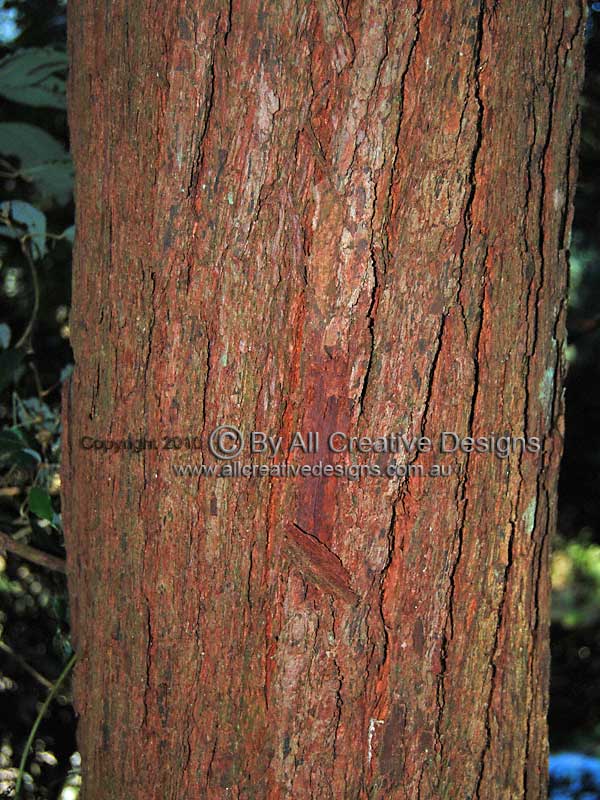
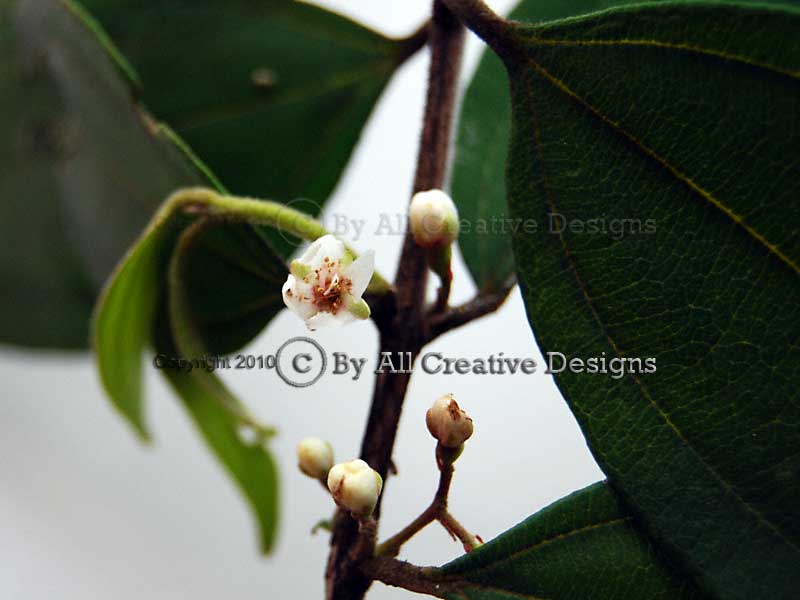
This small to medium sized tree is a common and widespread species growing to a height of 20m. It is found within and along margins of different types of rainforests and in drier more open tall forests (Image 1). Bark is brown in colour with a rough and stringy texture on younger specimens; turning a reddish brown with a softer and more fibrous texture on older trees (2). Small white flowers are either borne solitary on individual stalks up to 2cm long or up to 4 flowers appear on a common axil (small raceme) and bloom over spring (3). Mature simple leaves with an opposite arrangement are; up to 12cm long, elliptic to ovate (egg-shaped) with entire margins, mid-green, semi glossy to dull on upper surface, whitish or yellowish green below with a rather firm texture. Leaf apex is short acuminate ending in a blunt point, base shape is rounded or broadly cuneate (wedge-shaped). The hairy petiole (leaf stalk) is on average up to 6mm long. The underside of the leaf is covered in very fine and soft hair. The three pronounced veins are often a yellowish brown colour (4 & 5). Distribution: NSW central coast to Qld. Note: Due to the effects of Myrtle Rust, this species is listed as being critically endangered.
fs.jpg)
(1)
(2)
(3)
fs.jpg)
(4)
(5)
Brown Pearwood Amorphospermum antilogum
Brown Pearwood Amorphospermum antilogum Other names: Pear Wood, Plum Boxwood, Milky Plum, Silky Hornbeam
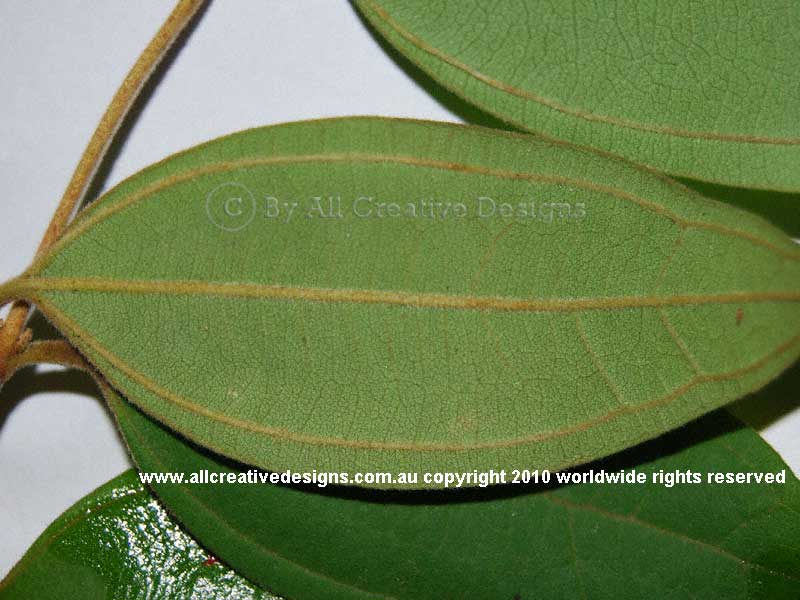
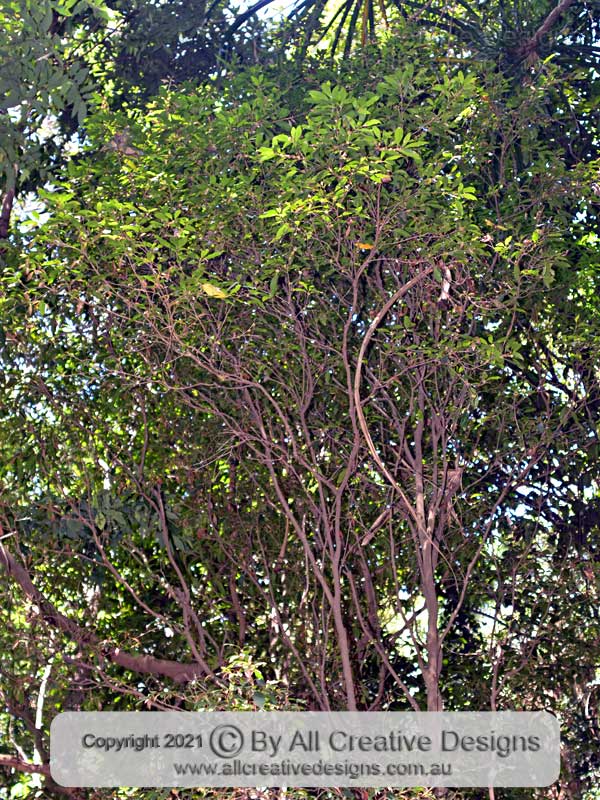
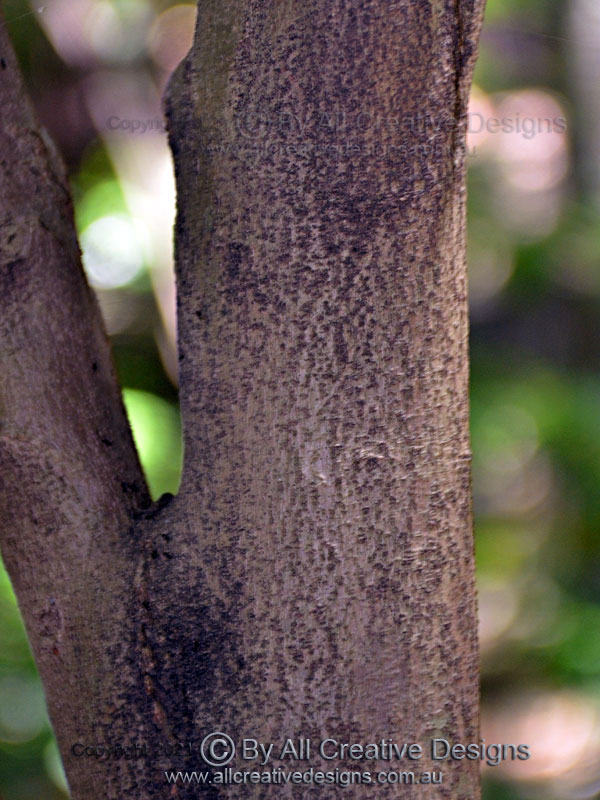
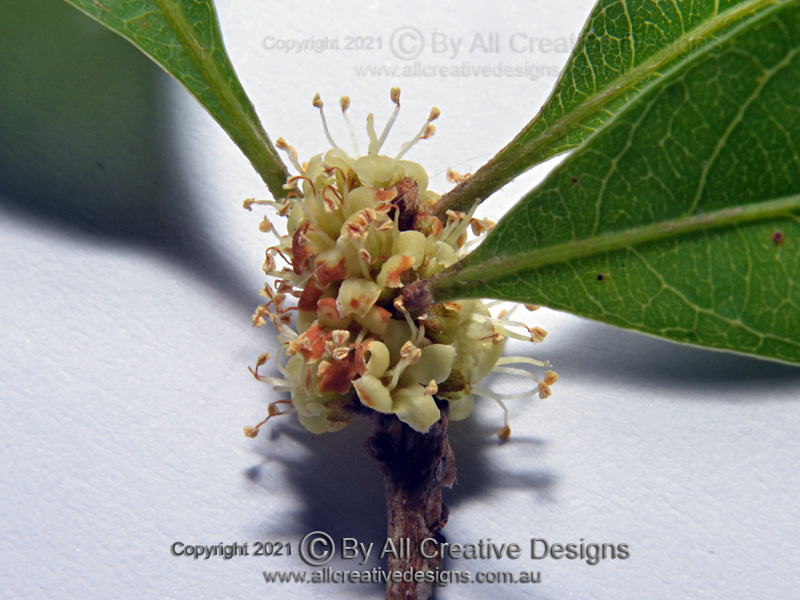
Depending on conditions the Brown Pearwood is able to reach a height of 30m but a height of 15m to 20m is more common. This adaptable species is found in different climate zones and varied habitats ranging from rainforests to areas with prolonged dry periods (Image 1). Bark is grey or more greyish brown and becomes rough at the base of older trunks (2). The tiny flowers are 2 to 3mm in diameter and arranged in densely packed bundles (fascicles) arising from leaf axils (axillary) along younger branches. Flowers feature 5 cream-coloured petals (with a green hue when opening) which are obovate (reverse egg-shaped), re-curving and of waxy consistency. The 5 stamens consist of pure white filaments crowned by beige/brown anthers (nearly white at first). The ovary in the centre is densely hairy and the elongated style is prominent. The calyx features pointed lobes and is also densely hairy (3). Simple leaves with an alternate arrangement are; up to 12cm long, elliptical or more oblanceolate (reverse lance-shaped), hairless when mature (young leaves and shoots are covered in rusty brown hair), dark green and relatively glossy on upper surface, paler green (mature leaves) beneath and leathery in texture. Leafstalk (petiole) is up to 15mm long and exudes a milky sap when broken. Distribution: Northern NSW to North Qld. The botanical name is synonymous with Niemeyera antiloga.
(1)
(2)
(3)
(4)
(5)
Brown Pine Podocarpus elatus
Brown Pine Podocarpus elatus Other names: Plum Pine, Yellow Pine
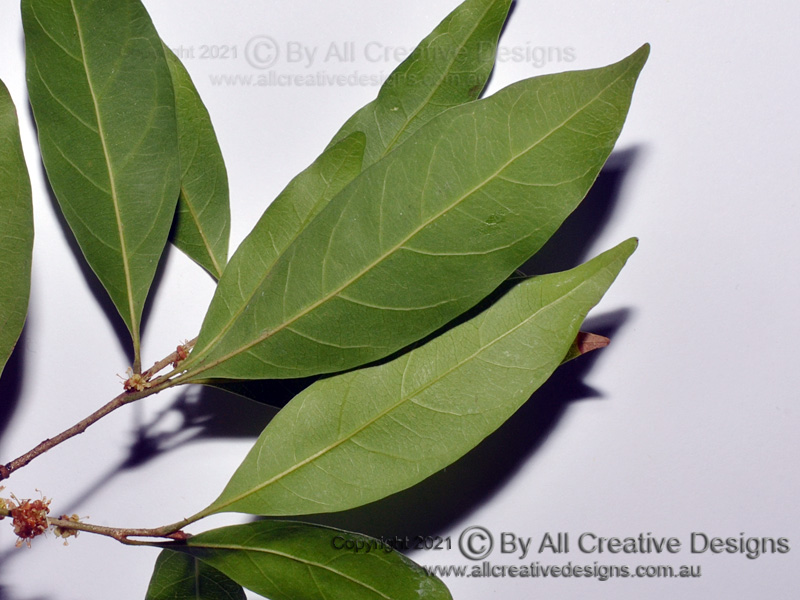
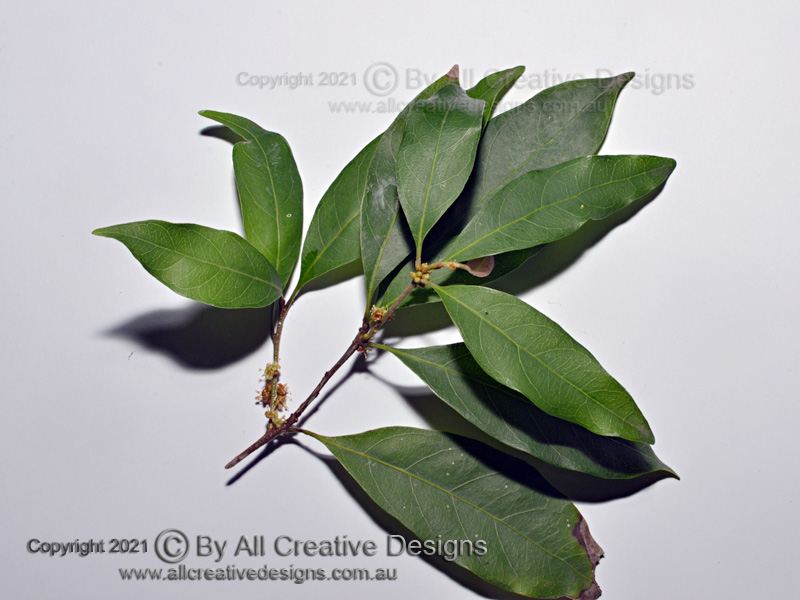
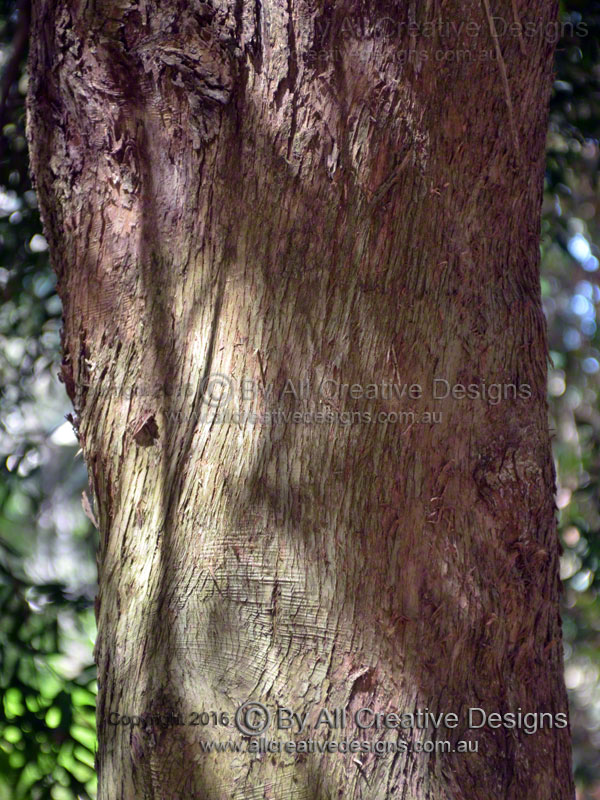
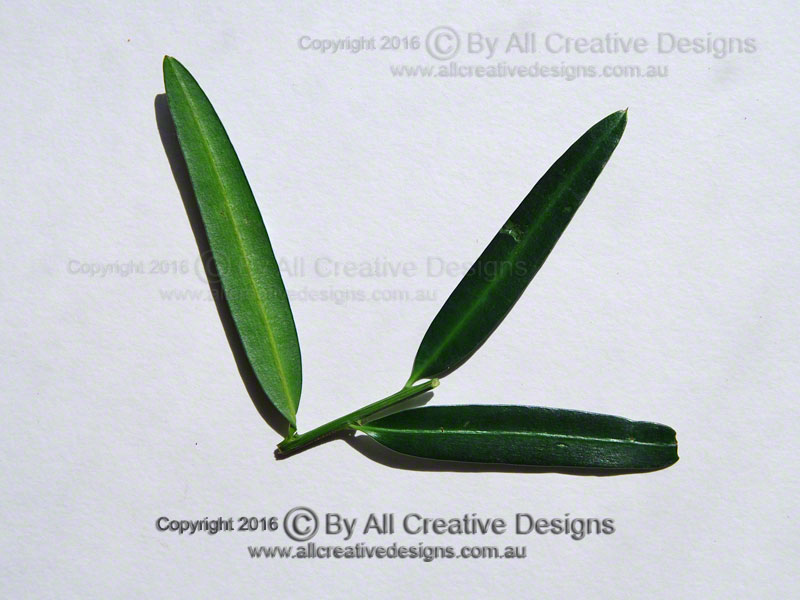
Warmer types of rainforests in proximity to the coast are the preferred habitat of this tall conifer. The picture shows dark green foliage being highlighted by the bright yellowish green new growth in spring. The Brown Pine can reach a height of 40m and often features a channelled or twisted trunk (1). Bark on the lower trunk of older trees becomes fissured, fibrous and flaky in patches. It is brown in colour and relatively soft when pressed (2). Male reproductive organs are referred to as strobili or catkins and have a spike-like appearance. They are up to 2.5cm long and borne in groups of 2 to 10 individuals, appearing from axillary joints towards the end of young branches. Female reproductive organs are borne on separate trees (3). Young branchlets are dark green, very smooth and hairless. Simple leaves with an alternate arrangement are; from 5 to more than 15cm long, narrowly lance-shaped (lanceolate) or oblong with entire margins, hairless, dark green, shiny on top, pale green beneath, rather thick and stiff in texture, aided by in-rolled margins. The leaf apex features a fine stiff tip (mucronate) (4 & 5). Distribution: From the south coast of NSW to northern Qld and NT.

(1)
(2)

(3)

(4)
(5)
Descriptions and all images copyright ©2023 by www.allcreativedesigns.com.au world wide rights reserved.
Click Images for Full Size View
Brown Silky Oak Opisthiolepis heterophylla
Brown Silky Oak Opisthiolepis heterophylla Other names: Pink Silky Oak
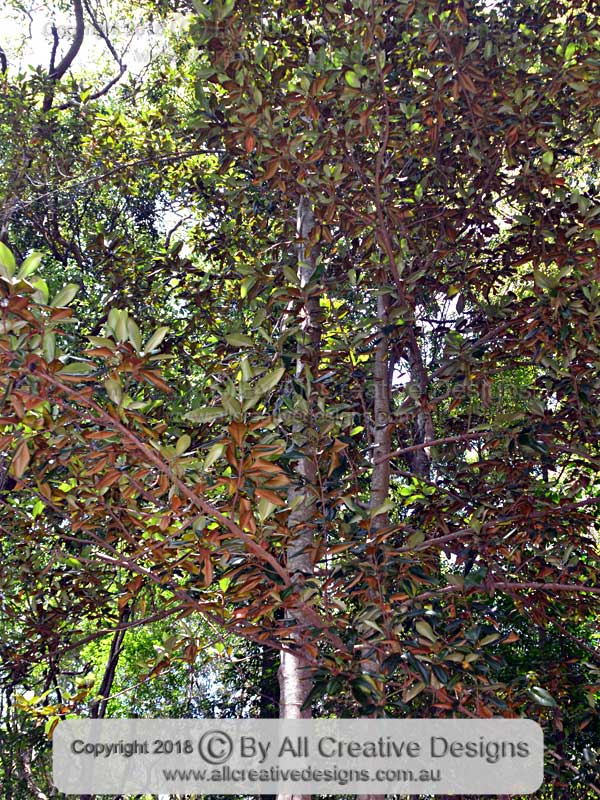
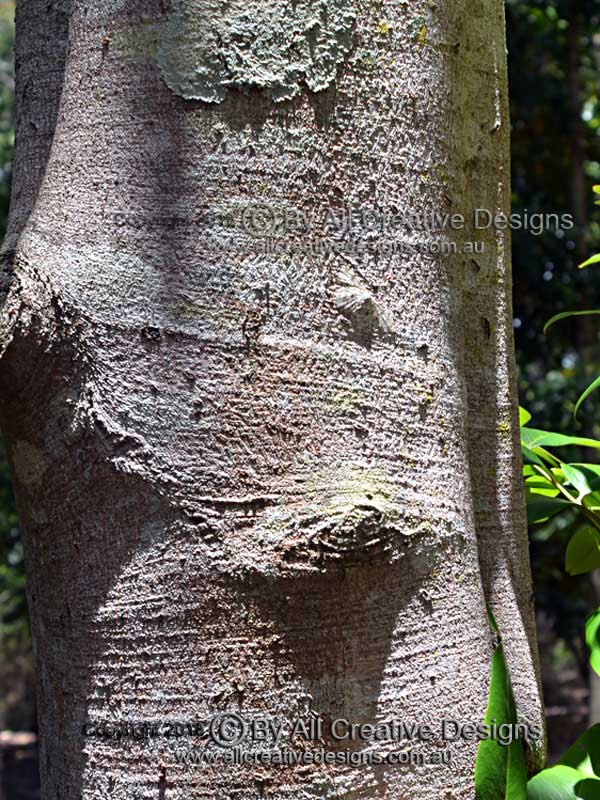
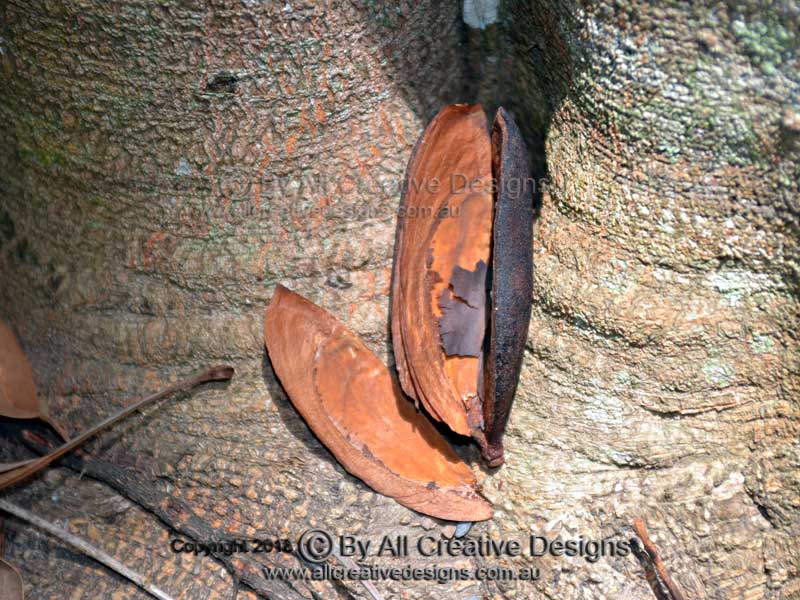
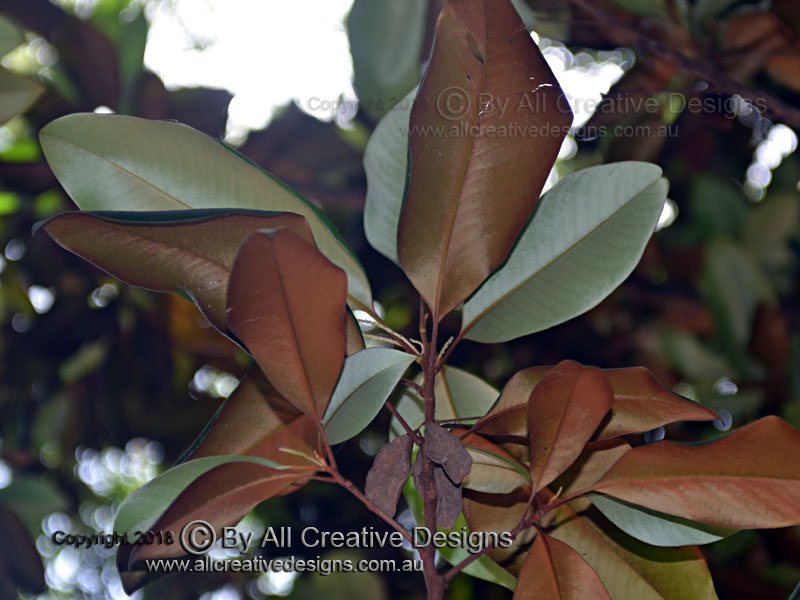
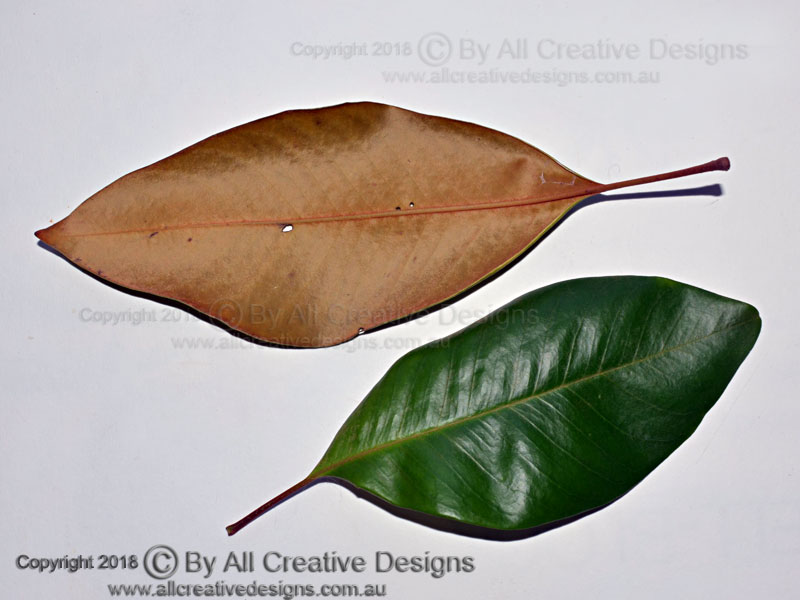
The natural habitat of this very ornamental tree is restricted to tropical rainforests of northern Queensland, where under ideal conditions it can reach a height of more than 25m. The beautiful foliage, consisting of large leaves that are copper-coloured on their underside, is a standout feature. It is the only species assigned to the genus (Opisthiolepis) and belongs to the family PROTEACEAE, a family of flowering plants with origins dating back more than 60 million years (Photo 1). Bark is grey brown in colour, hard, rather rough and marked by wrinkles and horizontal ridges (2). The fruit is a brown woody follicle that reaches a length of about 12cm and contains a number of thin winged seeds (3). The species name (heterophylla) relates to the different leaves, which are pinnately compound (with up to 15 leaflets) on saplings and on coppice shoots emerging from the base of older trunks. Leaves in the canopy of older trees are simple and feature an alternate arrangement. They are; more than 20cm long, broadly elliptic or ovate (egg-shaped) with entire in-rolled margins, dark green above, copper-coloured with a satin sheen beneath (when mature), silvery (when young), thick but soft in texture (4 & 5). Distribution: north-eastern Qld. Note: This species is not closely related to the well-known Silky Oak (Grevillea robusta), but shares the typical oak timber grain.
(1)
(2)
(3)
(4)
(5)
Green Guide Trees of Australia
How to recognise Australian tree families and genera.
A practical field guide to the identification of native species. More than 200 full colour photographs and detailed descriptions explaining leaf, bark, flower, fruit and other tree characteristics. The guide was written and illustrated by the author of these web pages.
New Holland Publishers: January 2016
Format: Paperback with PVC
Pages: 128 pp.
Size: 13 cm wide x 18 cm high
First Edition, Hand Signed Copies
CLICK HERE FOR MORE INFORMATION Brown Tamarind Castanospora alphandii
Brown Tamarind Castanospora alphandii
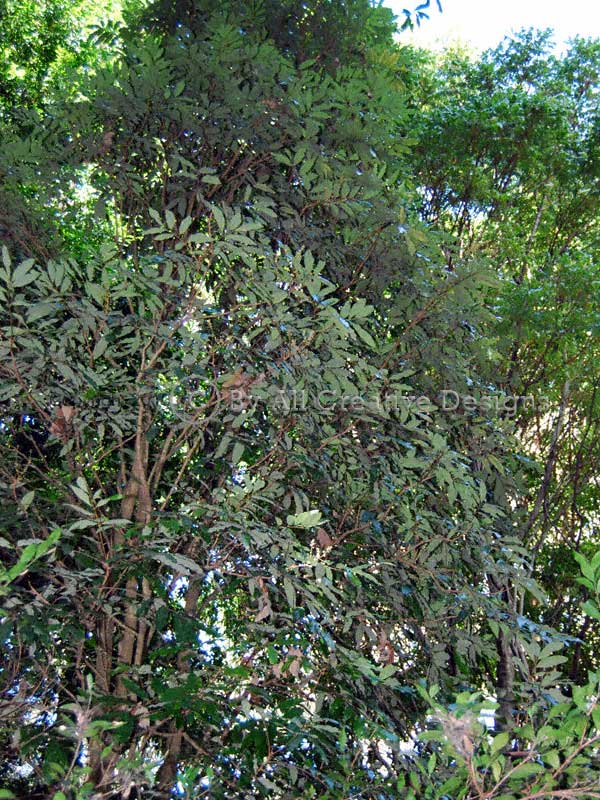
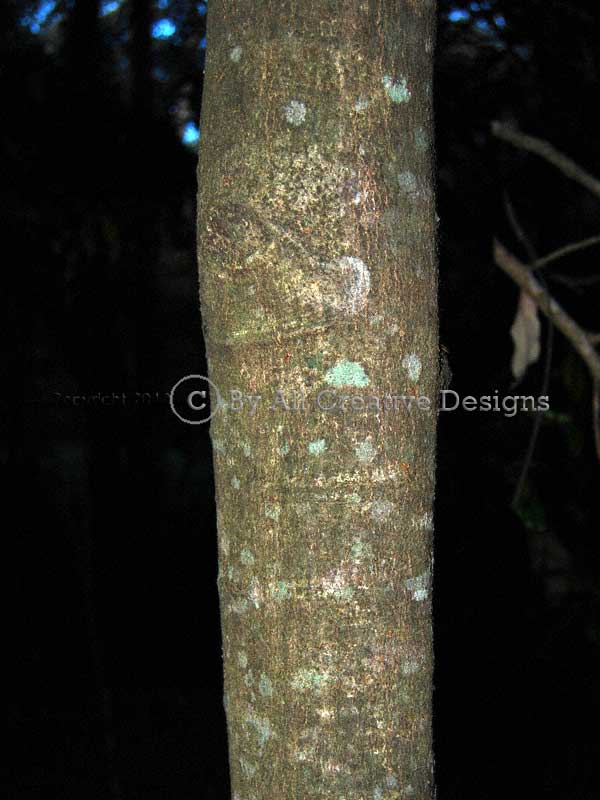
Under optimum conditions, this small to medium sized tree grows to a height of 25m. It inhabits subtropical and tropical rainforests as an understorey species (Photo 1). Bark texture is firm and slightly rough with small fissures, colour is cream to light grey, other colours are caused by mosses and lichens (2). The uniform pale grey/green underside of the foliage is characteristic for this species (3). Scented small white and yellow coloured flowers are held on panicles and bloom over winter (4). Pinnate compound leaves with an alternate arrangement are made up of mostly 10 or 12 leaflets. Leaflets are; up to 16cm long, elliptic to oblong in shape with entire margins, dark green, glossy on upper surface, pale grey/green and very finely hairy on their underside. Leaflet apex shape is mostly acute. Petiole (leaf stalk) and petiolules (leaflet stalks) are a rusty brown colour. Mid vein is noticeable raised on lower leaf surface and pale yellow in colour (5). Distribution: NSW north coast to northern Qld. (See Leaf Characteristics Page for explanations of botanical terms used in descriptions.)
(1)
(2)
(3)
(4)
(5)
Brown Tuckeroo Cupaniopsis flagelliformis
Brown Tuckeroo Cupaniopsis flagelliformis Other names: Rusty Tuckeroo
This small tree is rarely more than 10m tall and restricted to a habitat of subtropical rainforests. It has striking foliage and prefers damp shady conditions beneath taller trees (Photo 1). Older specimens develop a fluted trunk with a firm, smooth and dark brown coloured bark (2). Gorgeous small pink and yellow flowers are borne on panicles up to 50cm long and bloom over spring. Stamens consist of flattened and white coloured filaments which support bright yellow, spade-shaped anthers (3). The orange coloured fruit (a capsule) is 3-lobed, up to 2.5cm across and densely hairy on the outside. Each lobe contains a shiny black seed, which is partly covered in an orange aril (4). The pinnate compound leaf consists of up to 14 leaflets. Leaflets are; up to 18cm long, mostly oblong in shape with toothed margins, nearly hairless, dark green on top, hairy on their underside, firm and rather stiff in texture (5). Distribution: Northern NSW to southern Qld.
(1)
fs.jpg)
(2)
(3)
fs.jpg)
(4)
fs.jpg)
(5)
Brush Apple Mischocarpus pyriformis
Brush Apple Mischocarpus pyriformis Other names: Yellow Pear-fruit, Pear-fruited Tamarind
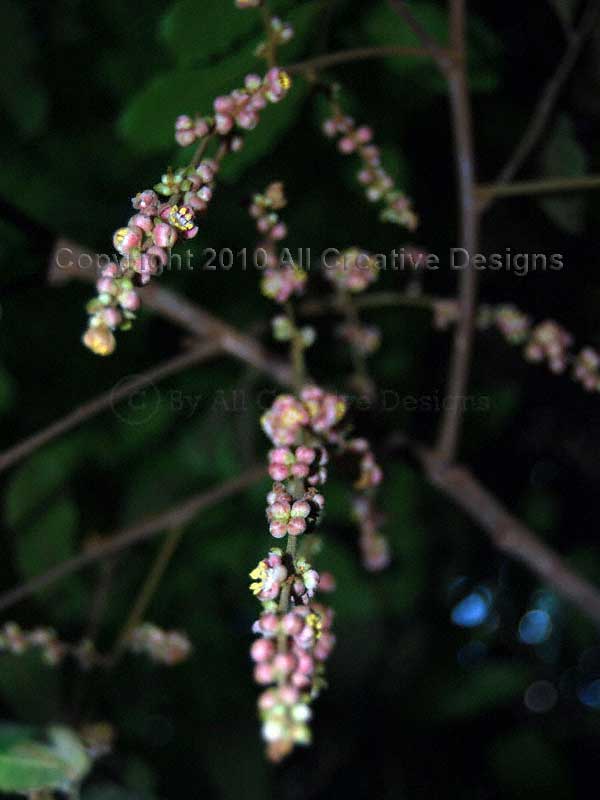
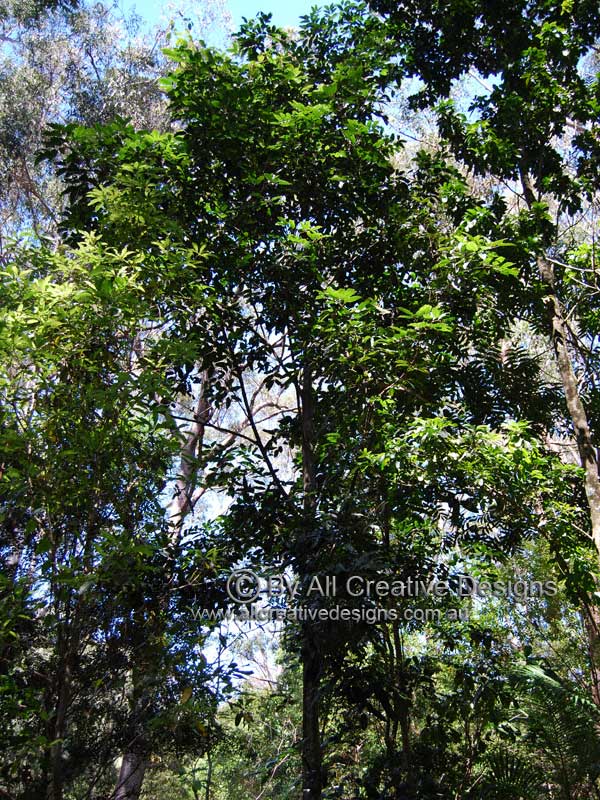
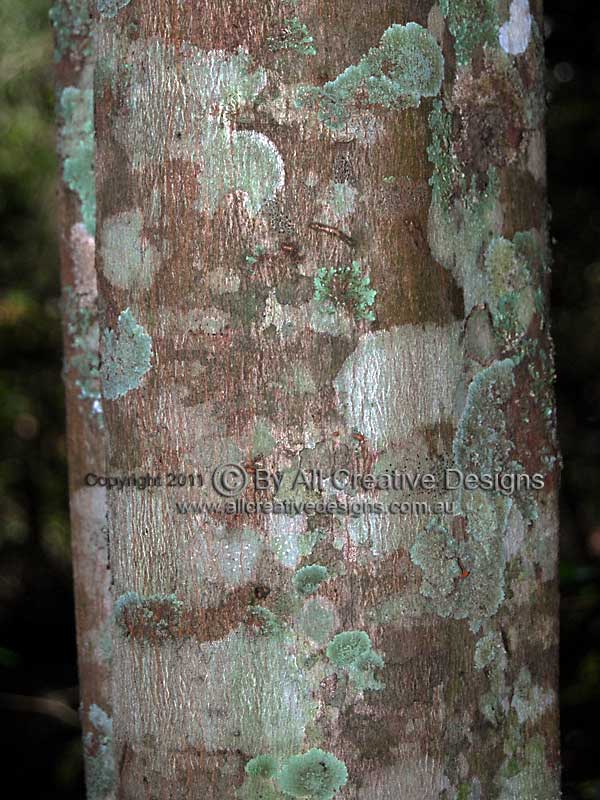
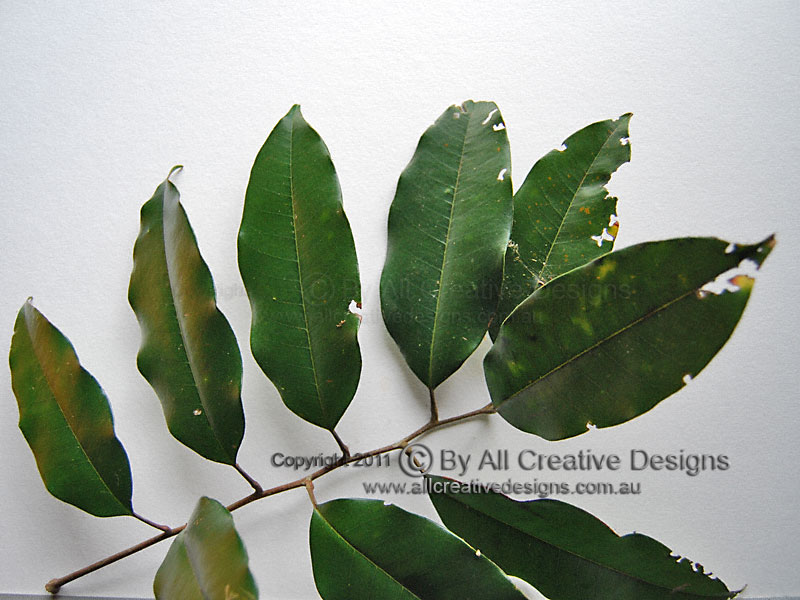
The Brush Apple or Yellow Pear-fruit can reach a height of 20m and develops an upright trunk and a densely foliated crown. Its natural habitats are different types of rainforests, where it prefers wetter locations (Photo 1). The bark is firm and shades of grey in colour (often obscured by lichen), with older specimen featuring fine vertical ridges (2). The fruit (a capsule) is a roughly pear-shaped, yellow at first turning to a glossy orange when mature. It measures 25mm in length and up to 15mm in diameter. The capsule splits into three sections dispersing one or sometimes two seeds covered in a bright red aril (3 & 4). The large compound leaf consists of up to 9 leaflets (as shown) which are; up to 20cm long, lanceolate to more oblong or ovate in shape with entire margins, alternately arranged along the rachis, smooth, rather thick and strong. Leaf apex is short acuminate, base shape is cuneate. The strong petiolules (leaflet stalks) are up to 20mm long. The mid vein is sunken on upper leaflet surface and prominently raised on the lower with fine net veins being visible (5). Distribution: Mid-north coast NSW to northern Qld. (See Leaf Characteristics Page for explanations of terms used).
(1)
(2)

(3)

(4)
(5)
See
Leaf -
Flower - Fruit - and Bark Identification Web Pages for explanations of botanical definitions and concepts.
Select images for Full Size View. (Opens new browser window).
Use the Key to Species, which is based on leaf characteristics, to identify native trees and shrubs found on Australia's east coast.
Brush Box Lophostemon confertus
Brush Box Lophostemon confertus
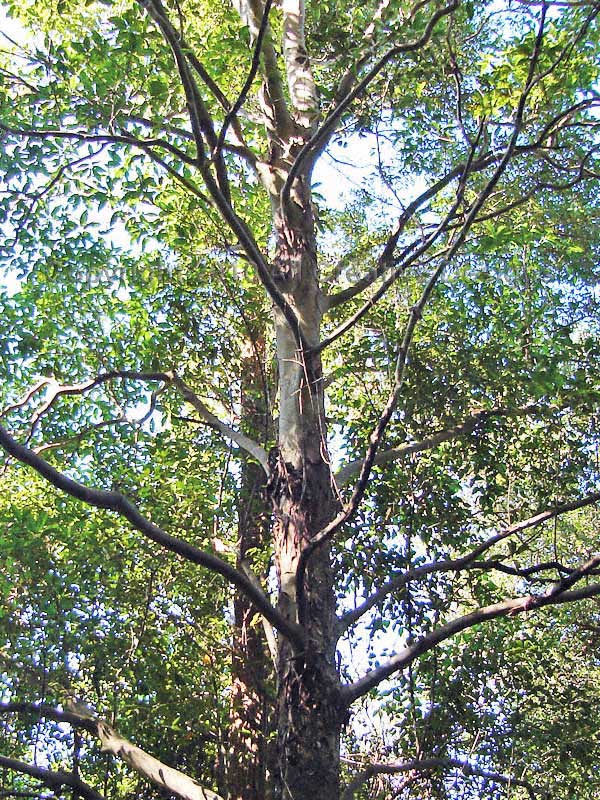
This imposing tree grows up to 60m tall and not only inhabits a range of rainforests types, but is also found in wet and drier tall (Eucalypt dominated) forests. Brush Boxes at the size shown mostly occur on nutrient rich soils within subtropical rainforest or on its margins. It is also grown in forest plantations producing a sought after hardwood timber (Photo 1). Bark on lower half to two thirds of trunk is brown, rough and stringy. Whereas the top half or the top third of the trunk and branches are covered in a smooth bark. Colour of smooth bark varies from grey to pink and salmon, depending on age (Photo 2). Stunning white flowers measure up to 3cm in diameter and feature numerous stamens with white filaments topped by yellow anthers. A defining feature is that stames appear in tight clusters, called staminal fascicles, which emerge from the bases of petals (3). The conical shaped fruit (a capsule) is around 10mm in diameter, up to 15mm long and contains a large number of small brown seeds (4). Simple leaves are arranged in a whorl of four or five leaves below the growing bud (opposite when maturing). They are; up to 15cm long, elliptic to ovate in shape with entire margins, firm and leathery in texture. Leaf apex is acute ending in a fine point, base shape is cuneate. Mid vein is raised and lateral veins are more visible on lower leaf surface (5). Distribution: Along Australia's east coast, north from the NSW mid-north coast.
fs.jpg)
(1)
(2)

(3)
(4)

(5)
Brush Caper Berry Capparis arborea
Brush Caper Berry Capparis arborea
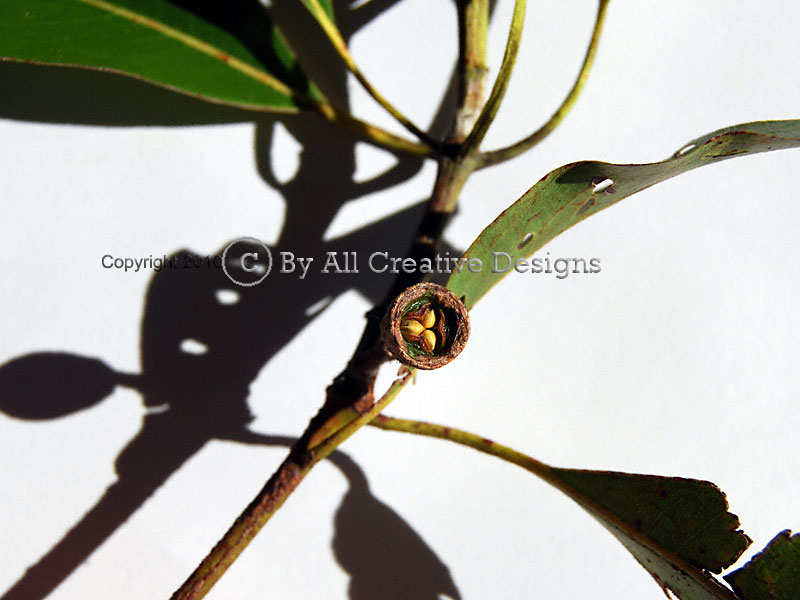
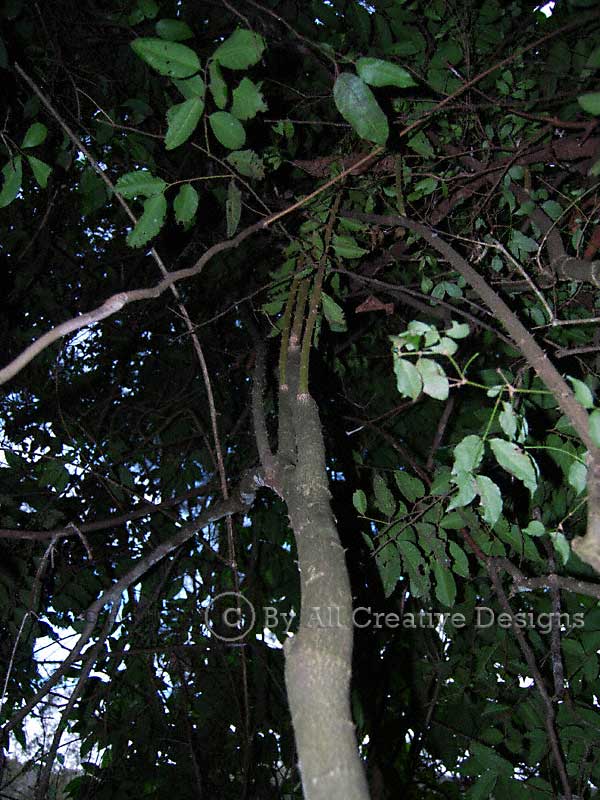
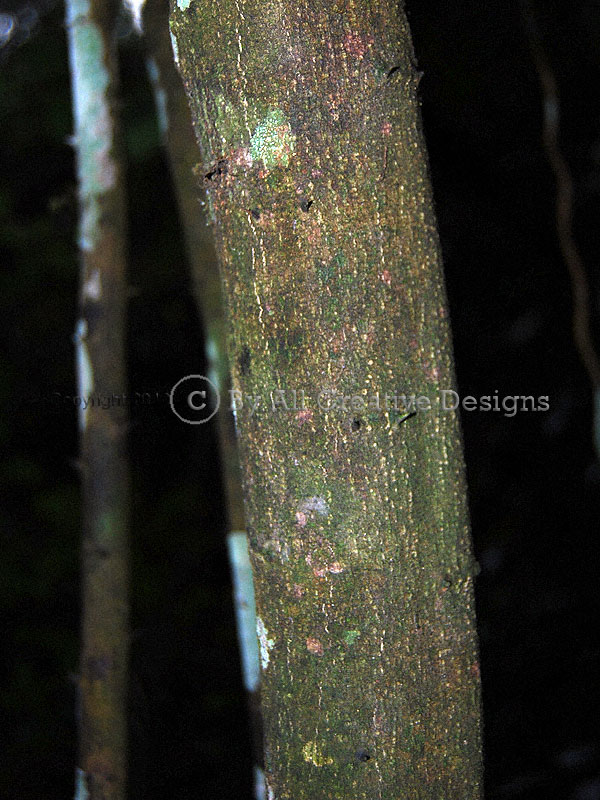
The Brush Caper Berry is a small native tree reaching a height of up to 10m and is found as an understorey species within subtropical rainforests (Photo 1). Bark on the main trunk of this mature tree is firm, rather rough with fine fissures and also features scattered spines. Colour is a light brown if not obscured by mosses and lichen in wet environments (2). Superb solitary flowers arise from axillary buds on young branches over summer. When fully opened the measure more than 4cm across with pure white petals that are fringed on their upper margins. Numerous white filaments topped by small brownish anthers are up to 5cm long. The ovary is situated atop a centre stalk that is as long as or longer than the stamens (3). Spines on older branches are the best developed on this specimen and are up to 15mm long, whereby spinose stipules on young growth are small but can be felt beneath the petiole (leaf stalk) joining the stem. Spines on immature trees can be longer and more prominent. Young stems are covered in fine rusty brown hair (4). Simple leaves with an alternate arrangement are; up to 12cm long, ovate to broad elliptic in shape with entire and slightly in-rolled margins, firm and smooth in texture, hairless, very glossy, dark green on top, paler underneath and very smooth in texture. Petiole (leaf stalk) is up to 12mm long and can be hairy on young leaves. Mid vein is often placed off centre and raised on lower leaf surface (5). Distribution: NSW mid-north coast to central Qld.
(1)
(2)

(3)

(4)

(5)
Brush Ironbark Bridelia exaltata
Brush Ironbark Bridelia exaltata Other names: Scrub Ironbark
If growing on nutrient rich soils within subtropical rainforest, exceptional specimens of the Brush Ironbark Bridelia exaltata can be tall trees attaining a height of 40m. The trunk can be up to 1.5m in diameter with buttress roots forming at the base of older trees growing on unstable to steep ground (Photos 1 & 2). Bark is brown in colour, deeply furrowed and very hard in texture, which are helpful identification features. It resembles the bark of Eucalypt Ironbark species (3). Simple leaves with an alternate arrangement are; up to 14cm long, ovate to oblong in shape with entire margins, fairly thin, smooth, hairless, dark green, glossy on top and pale greyish green on their lower surface. The prominent mid vein is yellowish in colour and raised on the lower leaf surface; fine reticulate venation is visible on both surfaces (4 & 5). Distribution: NSW mid-north coast to southern Qld.

(1)

(2)

(3)

(4)

(5)
Brush Kurrajong Commersonia fraseri
Brush Kurrajong Commersonia fraseri Other names: Commersonia
The Brush Kurrajong is normally a single stemmed shrub or small tree up to 8m high. It is found in different types of rainforests, drier tall forests and often in regrowth areas (Photo 1). Bark at the base of older trunks is a greyish brown colour (lichen are present) and rough with a firm texture. Bark on younger trees is dark grey (nearly black) and shows small protrusions, called lenticels (2). The white and pleasantly scented flowers are less than 1cm across and borne on compact panicles, which often appear opposite a leaf node. The sepals are up to 3mm long and hairy on the outside. The five white petals are 3 to 4mm long. In the centre surrounding the ovary, the white upright and tentacle-like shaped staminodes (infertile stamens) are 5 to 6mm long (3). The fruit is a dry, brown and bristly capsule measuring up to 2cm in diameter with 5 valves, each containing 1 or 2 small black seeds up to 2mm long (4). Simple leaves with an alternate arrangement are; mostly 7 to 14cm long (sometimes up to 16cm), ovate (egg-shaped) with irregular toothed margins or shallow lobes, dull and dark green on top, whitish hairy below with a felt-like texture, soft and rather thin. Leaf apex is acute ending in a fine point, base shape is rounded. The prominently raised and hairy midrib is conspicuous (inset 5), lateral and net veins are also hairy and clearly visible (5). Distribution: Widespread from Victoria to southern Qld. Note: This species is very similar to the Brown Kurrajong (C. bartramia) listed above on this page.
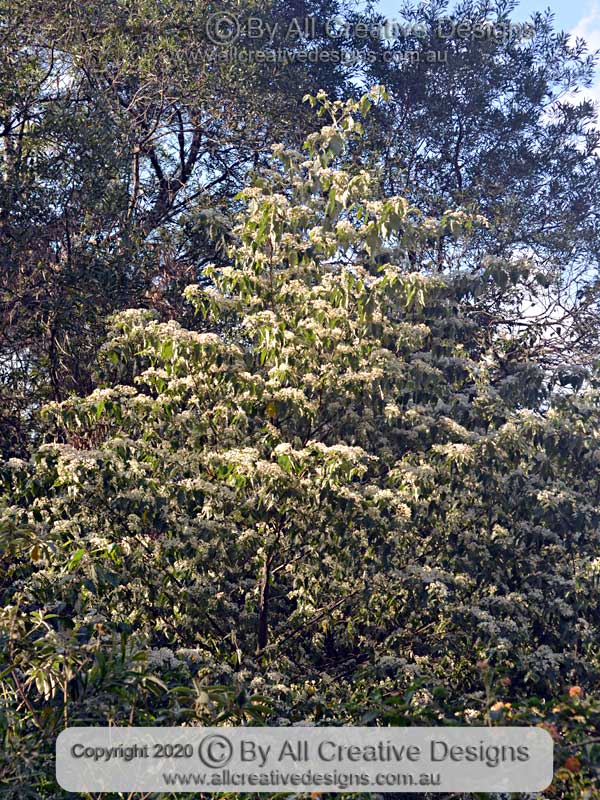
(1)
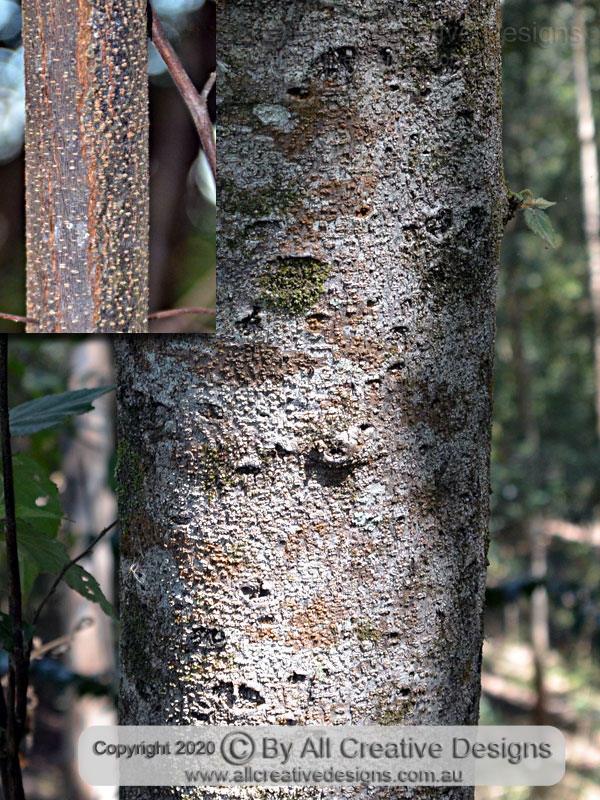
(2)

(3)

(4)
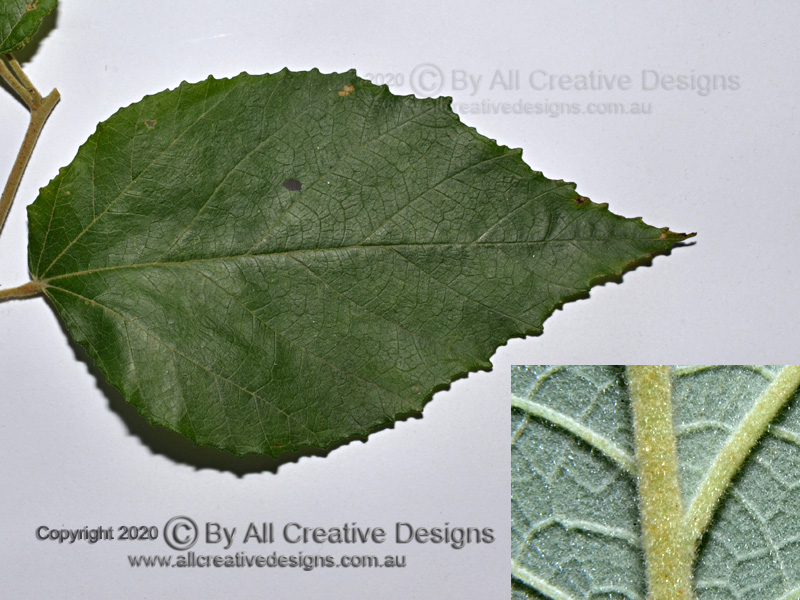
(5)
Descriptions and all images copyright ©2023 by www.allcreativedesigns.com.au world wide rights reserved.
Click Images for Full Size View
Brush Nightshade Solanum inaequilaterum
Brush Nightshade Solanum inaequilaterum
The ability to reach a height of 4m makes this native shrub one of the tallest Solanum species naturally occurring in Australia. Its preferred habitat includes mountainous subtropical and warm temperate rainforests to an altitude of more than 1000m (1). Bark on older stems is brown in colour, relatively smooth in texture without spines, whereas young stems feature a dense cover of fine prickles and bark is dark grey to nearly black in colour (2). Purple or sometimes white flowers are characteristic for the genus and feature 5 broadly overlapping petals. The bright yellow anthers are supported by short filaments (3). The fruit (a berry) is globe-shaped, up to 15 mm in diameter and turns bright red when fully mature (immature fruit shown). The remaining calyx with elongated sepals and the supporting stalk are free of prickles (4). Simple leaves with an alternate arrangement are; up to 20cm long (longer on juvenile plants), obovate (reverse egg-shaped) with shallow lobed margins (deeper lobed on juvenile plants), covered in fine but relative soft prickles on both surfaces, glossy when young, dark green, turning dull with age and rather thin. Leaf apex is acute ending in a fine tip; base is often asymmetric. Petiole (leaf stalk) is covered in prickles and up to 2cm long. Distribution: NSW mid-north coast to southern Qld.
Use the Botanical Species List to locate other Solanum spp.

(1)
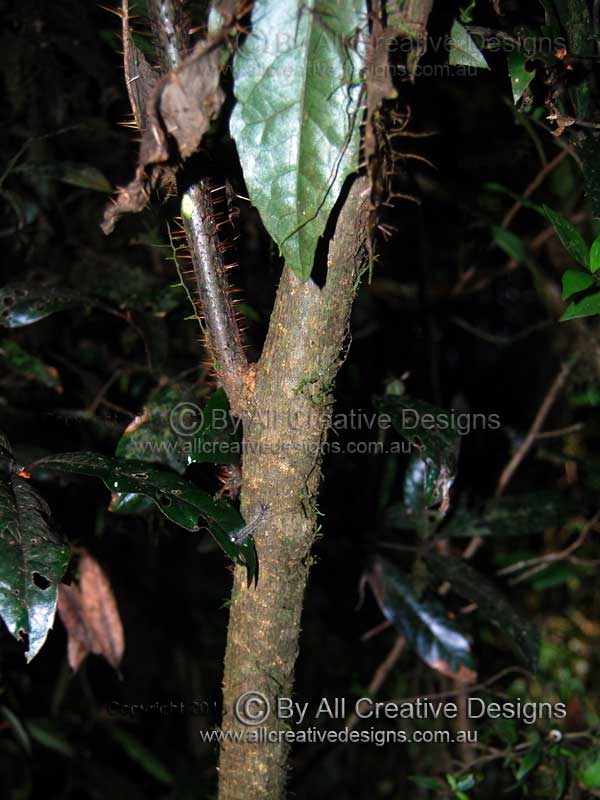
(2)
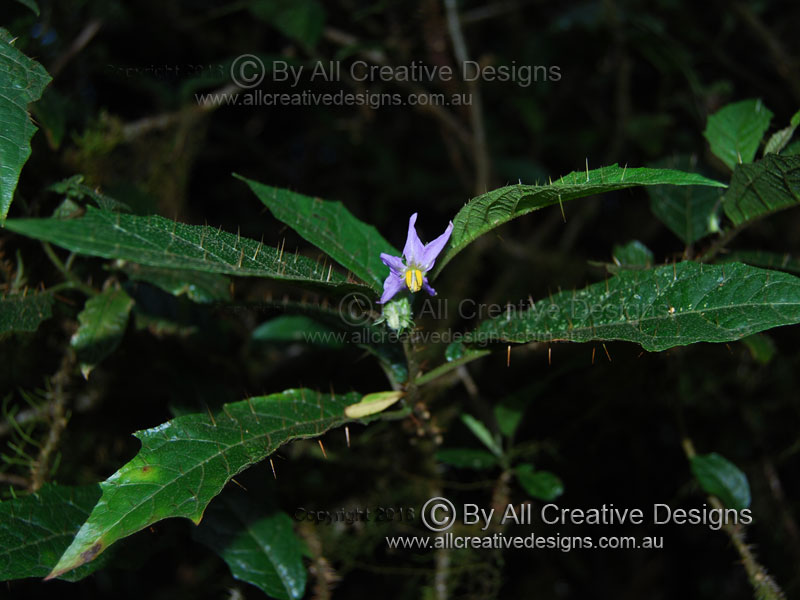
(3)
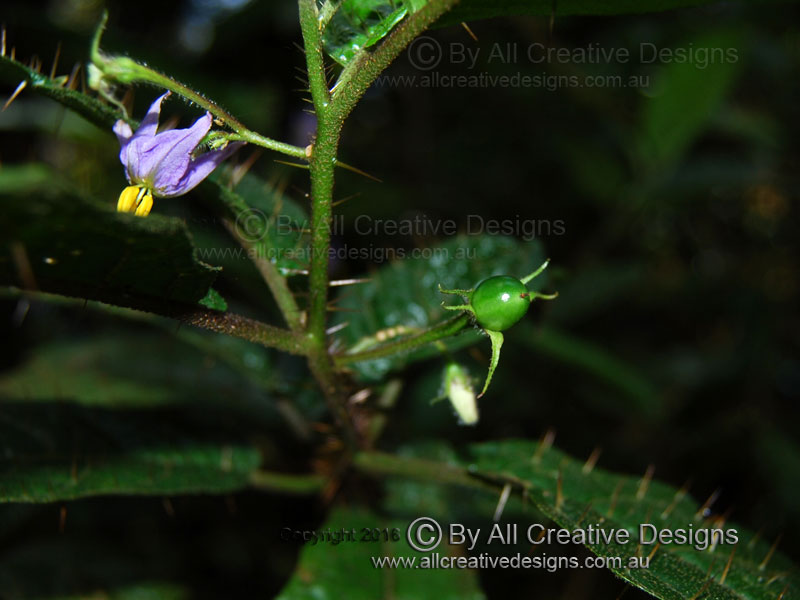
(4)
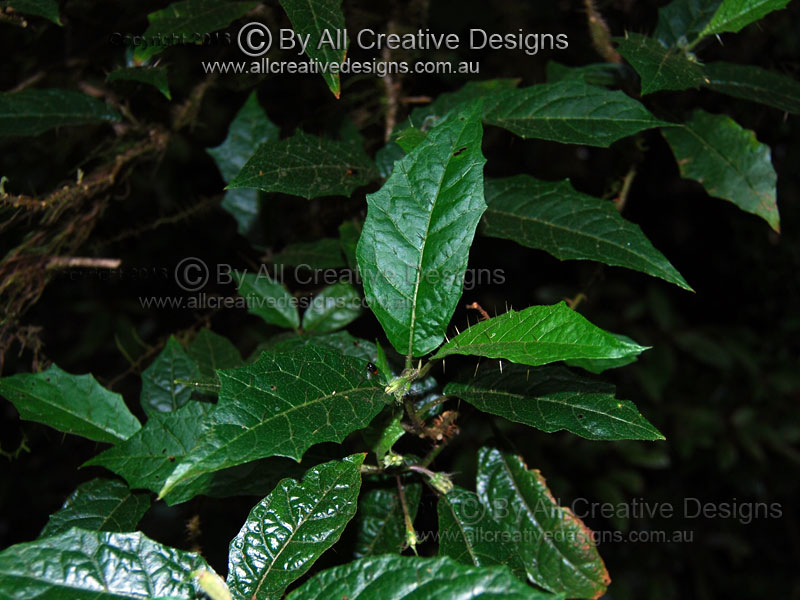
(5)
Brush Pepperbush Tasmannia insipida
Brush Pepperbush Tasmannia insipida Other names: Pepperbush, Scrub Pepperbush
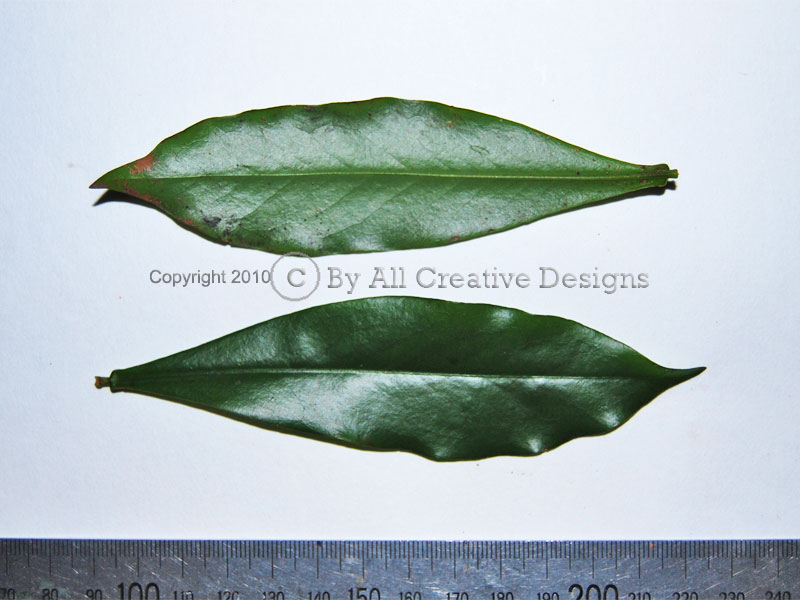
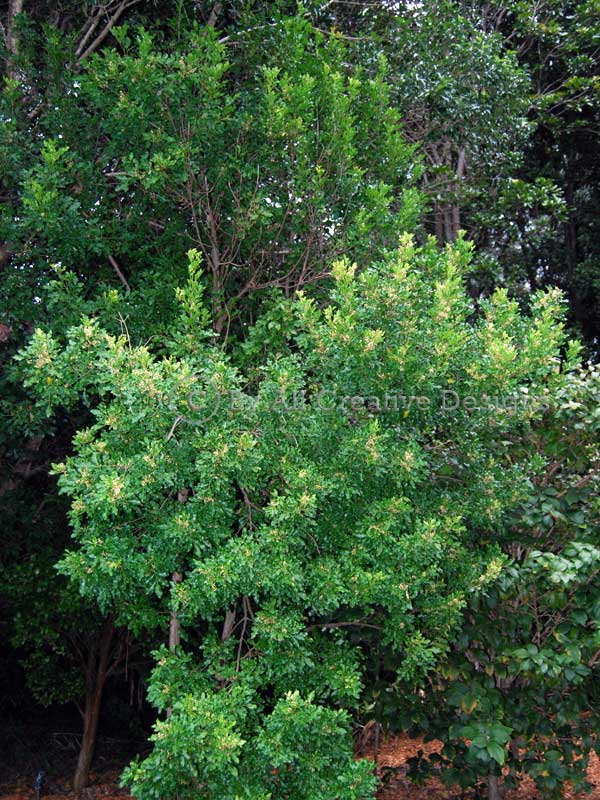
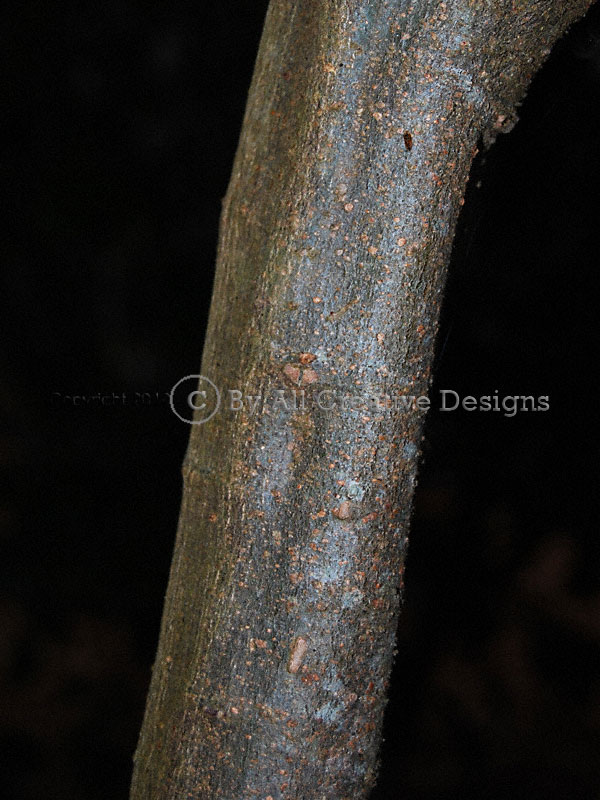
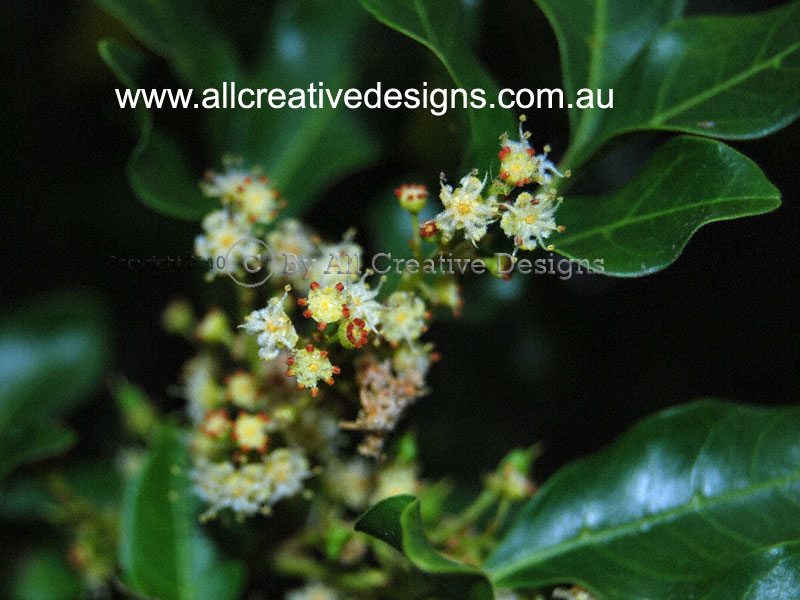
The specimen shown, growing under very low light conditions in old growth subtropical rainforest, is single trunked and about 5m tall. Under better light conditions the Pepperbush is often a multi-stemmed shrub less than 3m high (Photo 1). Bark on mature specimens is a reddish brown with a firm and rather smooth texture showing very fine fissures (2). A salmon coloured stipule is up to 2.5cm long and encloses up to 8 separate flower buds, which turn red before opening into beautiful flowers with vibrant yellow anthers. Flowers measure up 10mm across and are held on stalks (pedicels) up to 4cm long (3). The fruit (a berry) is oblong shaped and changes from whitish green over pink to a dark purple with maturity. It is up to 25mm long and contains a number of small seeds within the whitish fruit flesh (4). Four or five simple leaves are arranged in a whorl and are; up to 15cm long (longer for immature specimens), mostly oblanceolate (reverse lance-shaped) with entire margins, dark green and glossy on top, paler but glossy beneath, smooth and hairless. Leaf apex is short acuminate ending in a fine point, base outline is attenuate but terminates in a rounded shape. Leaves on this specimen are (if faintly) pepper-like scented (5). Distribution: Within different types of rainforests from NSW south coast to southern Qld. See Flower Characteristics Page and Leaf Characteristics Page for information on terms used.

(1)

(2)
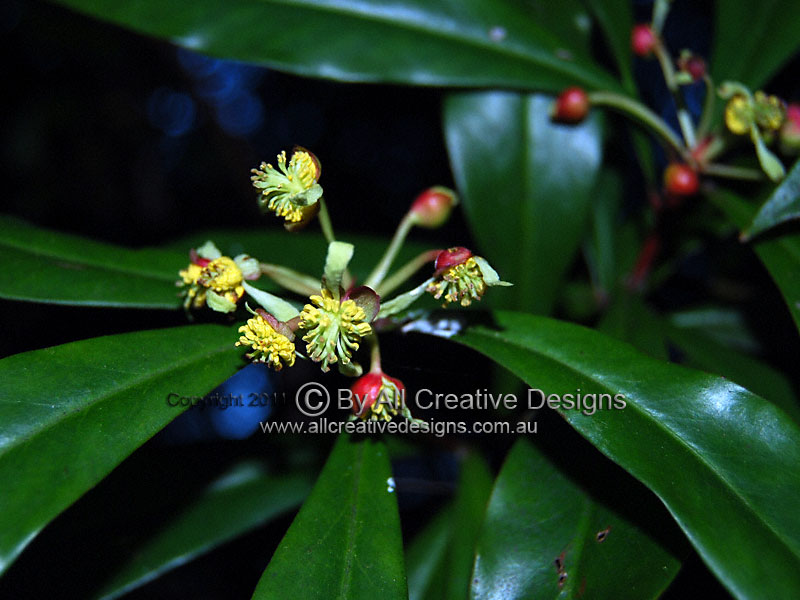
(3)

(4)
(5)
Brush Teak Toechima tenax
Brush Teak Toechima tenax Other names: Pitted-leaf Steelwood
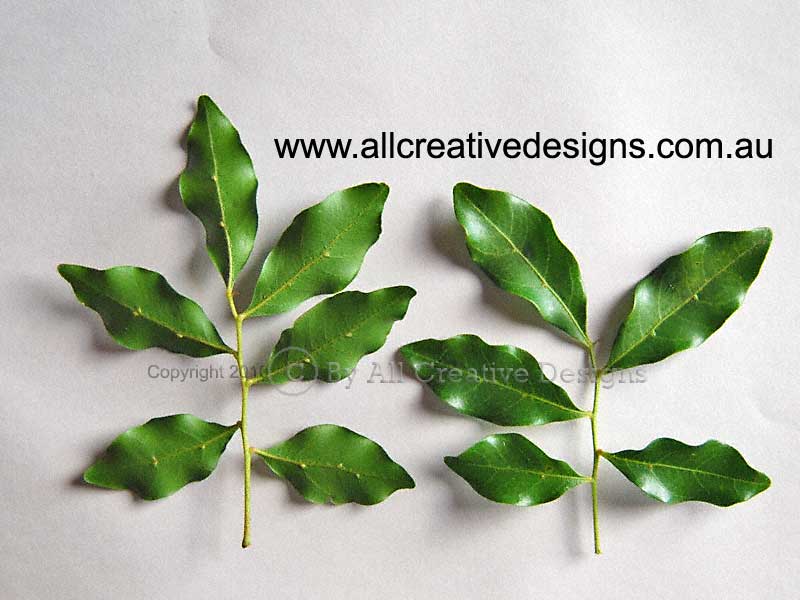
The Brush Teak or Pitted-leaf Steelwood can reach a height of 20m or more and is found within subtropical rainforests (Photo 1). Bark is dark greenish grey in colour, firm and relatively smooth with some surface blisters present (2). Interesting tiny flowers are cream yellow and feature 8 prominent white coloured and hairy filaments topped by anthers changing from brown to bright yellow. Flowers are borne on panicles and open over late winter and spring (3). The fruit (a capsule) is a pear-shaped, yellow and orange coloured when fully mature and up to 2 cm long. It splits into 2 or 3 lobes (valves), each containing a shiny black seed (4). Pinnate compound leaves consist of 4 to 6 leaflets, which are; up to 6cm long, mainly elliptic in shape with entire wavy margins, hairless, glossy on both sides, fairly thin but firm in texture. Mid vein is raised and laterals are visible on upper leaf surface. Domatia appear as swellings along the mid vein on both leaflet surfaces and are very helpful in identification of this species (5). Distribution: Northern NSW to central Qld. (See Leaf Characteristics Page for explanations of botanical terms used in descriptions.)
(1)
(2)
(3)

(4)
(5)
Brush Wedding Bush Ricinocarpos speciosus
Brush Wedding Bush Ricinocarpos speciosus Other names: Long-haired Ricinocarpos
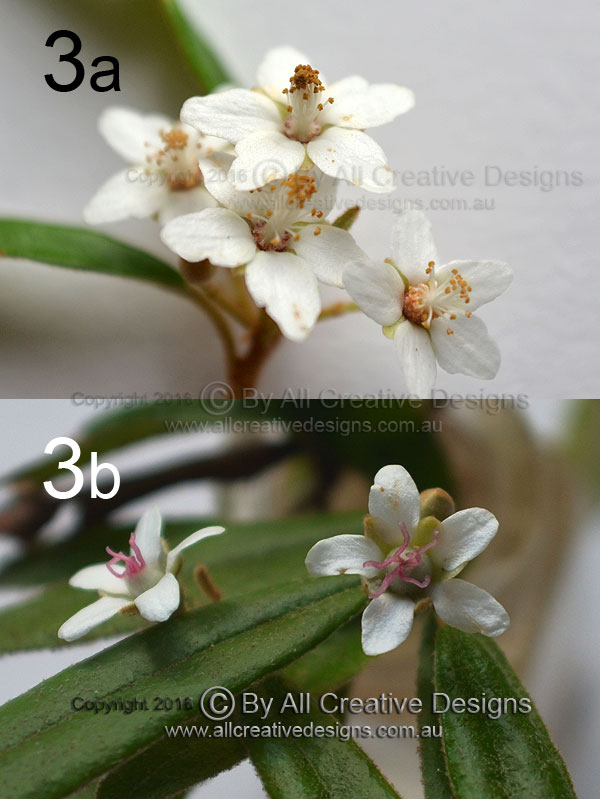
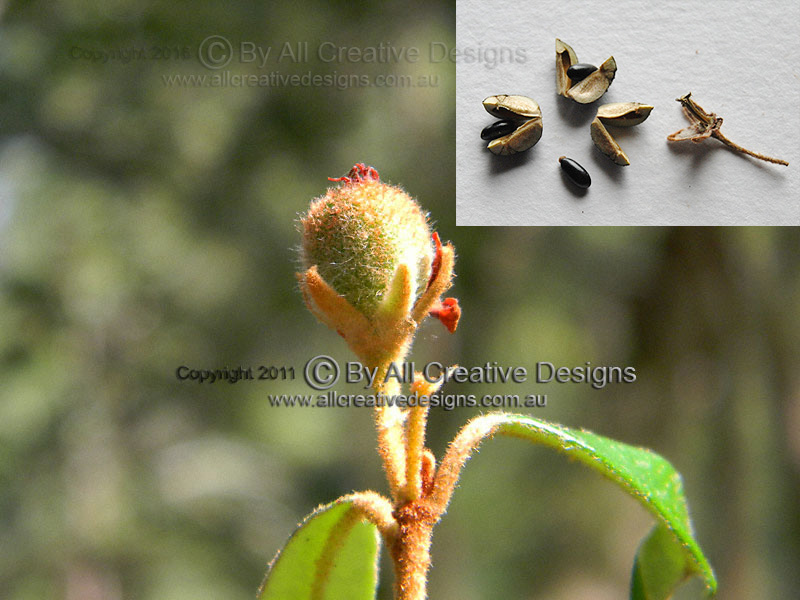
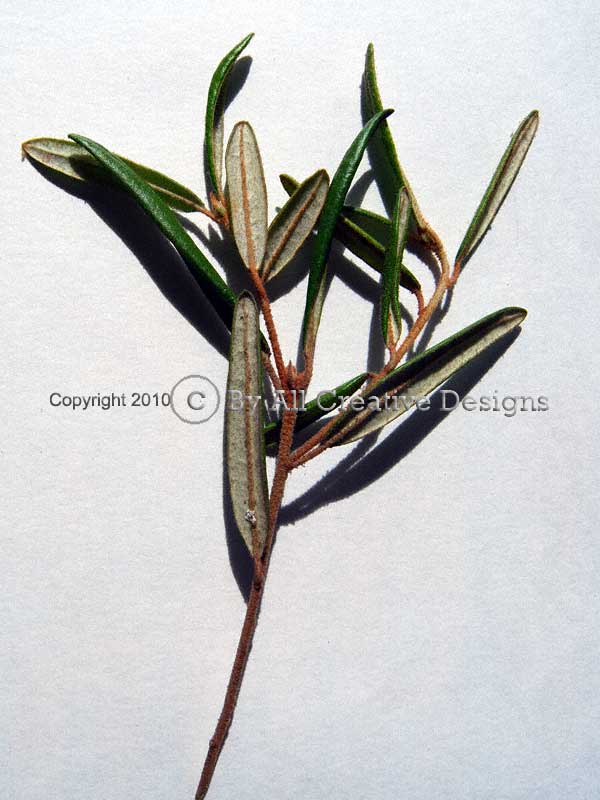
This pretty native shrub up to 3m high occurs on margins of different rainforest types and in more open tall forests. It has become increasingly rare and has been listed as a threatened species (Picture 1). Bark is brown to grey in colour and features fine longitudinal fissures. It is hard and slightly rough in texture (2). Gorgeous flowers are up to 20mm in diameter and bloom over winter into early spring. A tightly packed bundle of stamens identifies a male flower (3a top), whereas the female (3b bottom) has an ovary with a pink style in the centre. The style splits into 3 parts at the base, with each branch forking again. Botanical sources describe this species as monoecious, meaning different male and female (unisex) flowers appear on the same plant. See comment below (3). The fruit, a small hairy capsule with mostly 3 lobes, is seated on the remaining hairy calyx and about 1cm long. Each lobe (valve) contains an oblong shaped and black coloured seed (inset) (4). Simple leaves with an alternate arrangement are; up to 8cm long, mostly oblong in shape with entire (in-rolled) margins, dark green and nearly hairless on top when fully mature, densely hairy beneath. Long brown hair, with lateral branches at the apex (star hairs), covers young branches, petioles and centre veins on underside of leaves. Venation except for centre vein is otherwise obscure (5). Distribution: NSW mid-north coast to southern Qld.
Comment: Prolonged observation of a local population of more than 50 specimens (growing in a restricted area) has shown an intriguing process of flowering. Shrubs produce either only male or female flowers at first and afterwards, in a secondary flush of flowers, the roles are reversed, i.e. shrubs, which now bear developing fruits, generate only male flowers and female flowers appear on plants that yielded male flowers before. This method avoids self-pollination. Please Contact Us if you like to make a comment on the subject.

(1)

(2)
(3)
(4)
(5)
Bull Kauri Pine Agathis microstachya
Bull Kauri Pine Agathis microstachya Other names: Queensland Kauri Pine, Black Kauri
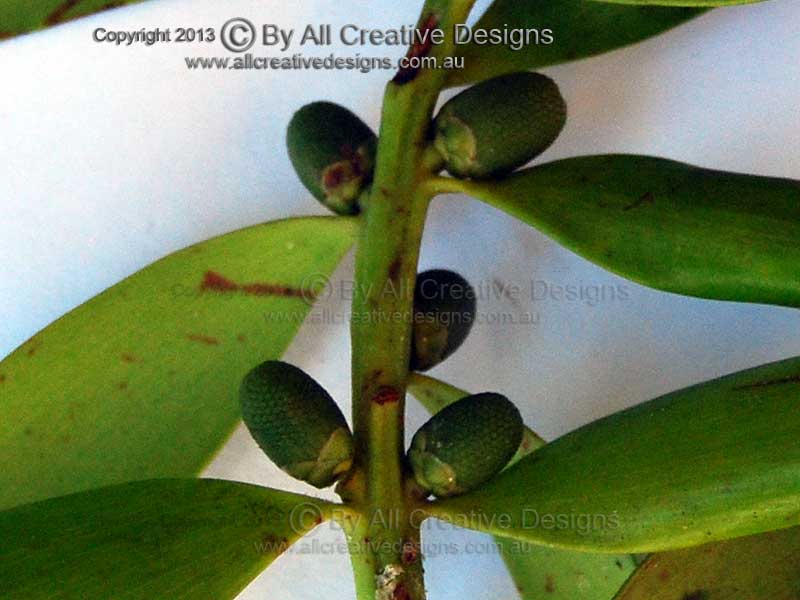
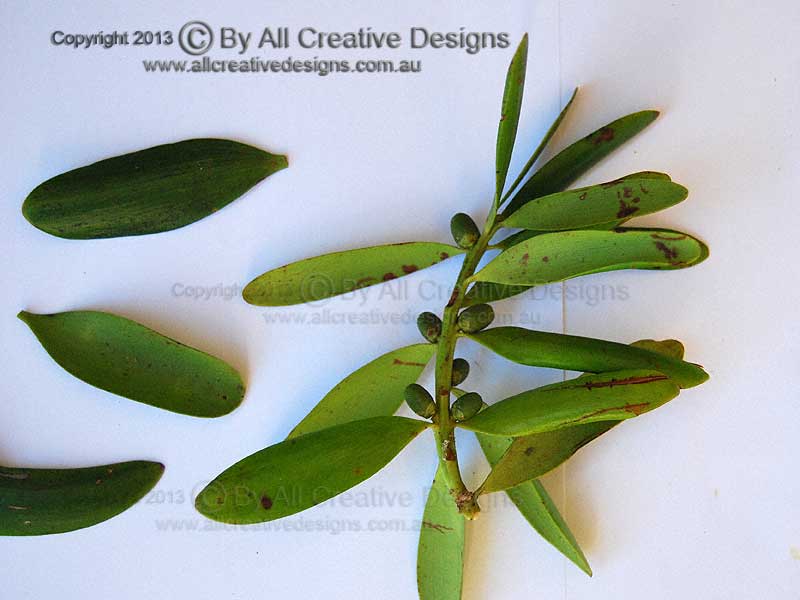
This towering conifer tree is found within upland tropical rainforests and can attain a height of 50m on a straight and column-like trunk (Photo 1). Bark is a greyish brown in colour with a scaly and flaky texture (2). Male cones are produced from axillary buds towards the end of young branchlets. They can measure up to 3cm in length and reach full maturity over spring (3 & 4). Simple leaves with an opposite arrangement are; up to 9cm long, elliptic or more lanceolate (lance-shaped) with entire margins, dark green on top, paler green beneath, hairless and very firm in texture. Apex shape is rounded to bluntly acute, base shape is cuneate. Fine parallel venation is visible (4 & 5). Distribution: Nearly exclusively on the Atherton tablelands in Northern Qld.

(1)

(2)
(3)
(4)
fs.jpg)
(5)
Bunya Pine Araucaria bidwillii
Bunya Pine Araucaria bidwillii
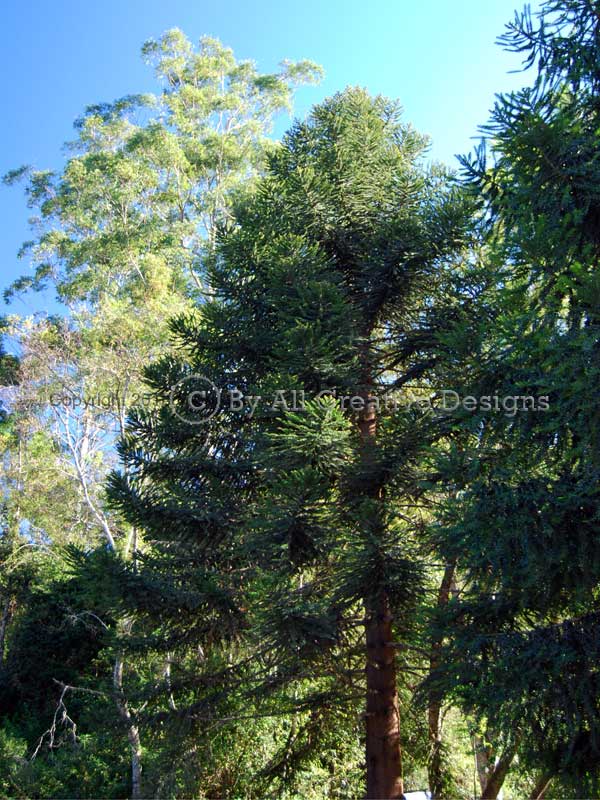
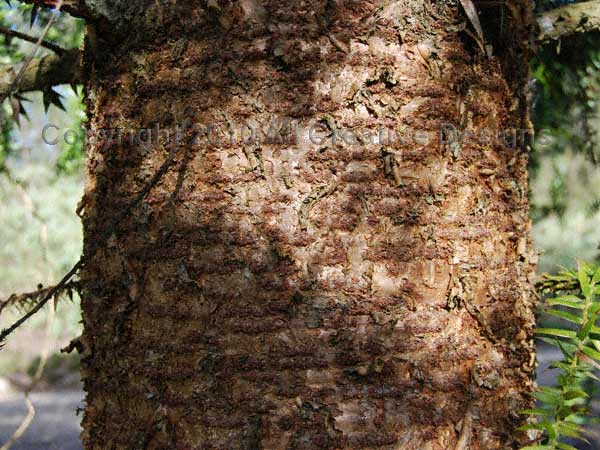
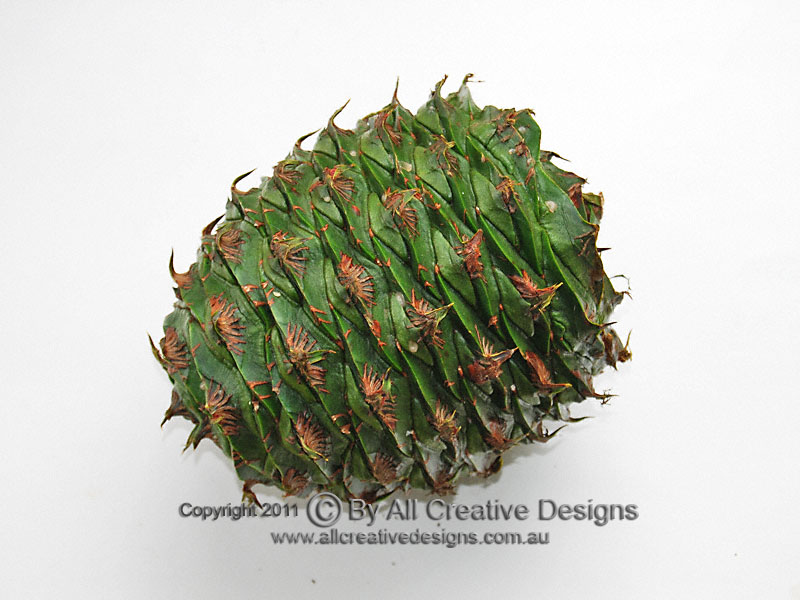
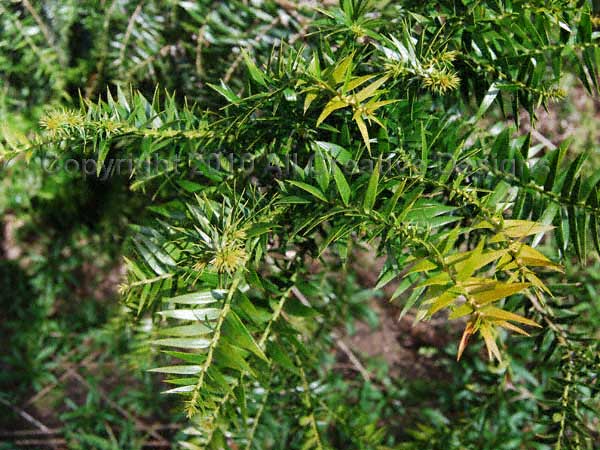
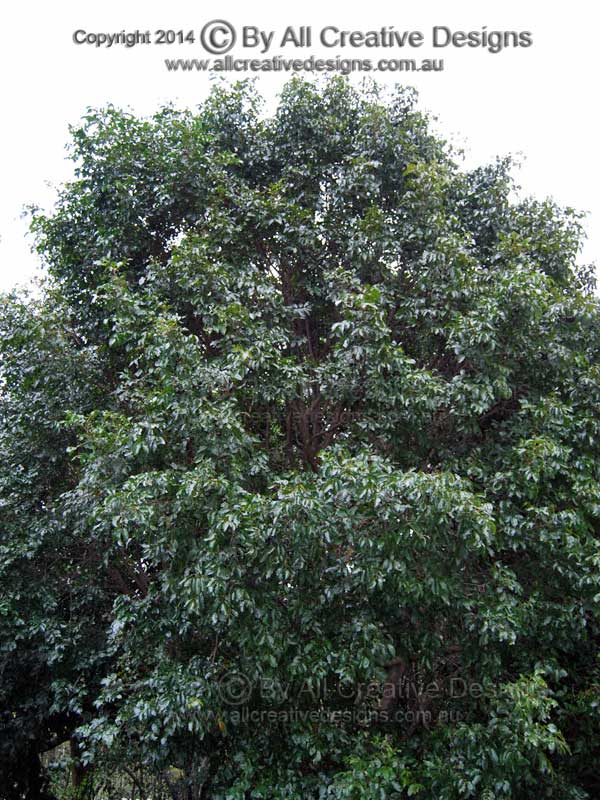
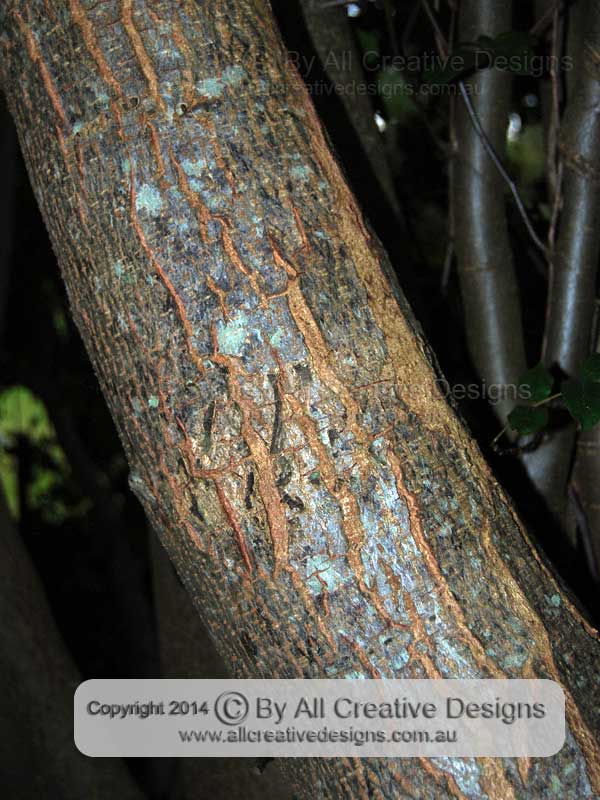
This conifer is a tall rainforests tree species that reaches a height of more than 40m and can be identified by its characteristic rounded canopy shape (Photo 1). Bark is dark brown and very rough in texture with typical horizontal grooves on older trees (2). The fruit is a large heavy cone up to 35cm long and contains numerous edible brown seeds covered in separate cone scales (3). Leaves with an alternate arrangement (spiral) feature a sharp spiny tip. They are; up to 5cm long, lanceolate (lance-shaped) with entire margins, glossy, thick and rigid in texture. New growth is a vibrant light green compared to the dark green and glossy colour of adult foliage (Pictures 4 & 5). Distribution: Central and northern Qld. Often seen planted as an ornamental tree outside its natural range.
(1)
(2)
(3)
(4)
fs.jpg)
(5)
Burdekin Plum Pleiogynium timorense
Burdekin Plum Pleiogynium timorense
This medium sized tree is found in subtropical and tropical rainforests in proximity to the coast, but also occurs in drier environments at higher altitudes. It is cultivated for its edible fruit and attractive appearance, and has been planted outside its natural distribution range (Photo 1). Bark on older trunks becomes rough, fissured and scaly in texture, whereas younger branches and stems have a smooth texture (2). The shiny, dark purple coloured fruit (a drupe) measure up to 4cm in diameter and ripens from late summer into autumn. A plum-like fleshy layer surrounds the single, very hard, woody and unusual shaped seed (3 & 4). The pinnate compound leaf consist of 7 to 11 leaflets, which are; up to 10cm long, elliptic or more ovate (egg-shaped) with entire margins, hairless to sparsely hairy, dark green, glossy on top, paler green beneath, smooth and strong in texture. Leaflet apex shape is rounded or broadly pointed, base shape is asymmetric. Domatia running along the centre vein are clearly visible on the lower leaflet surface (5). Distribution: From southern to northern Qld.
(1)
(2)

(3)
(4)

(5)
Burrflower Tree Neolamarckia cadamba
Burrflower Tree Neolamarckia cadamba Other names: Leichhardt Pine
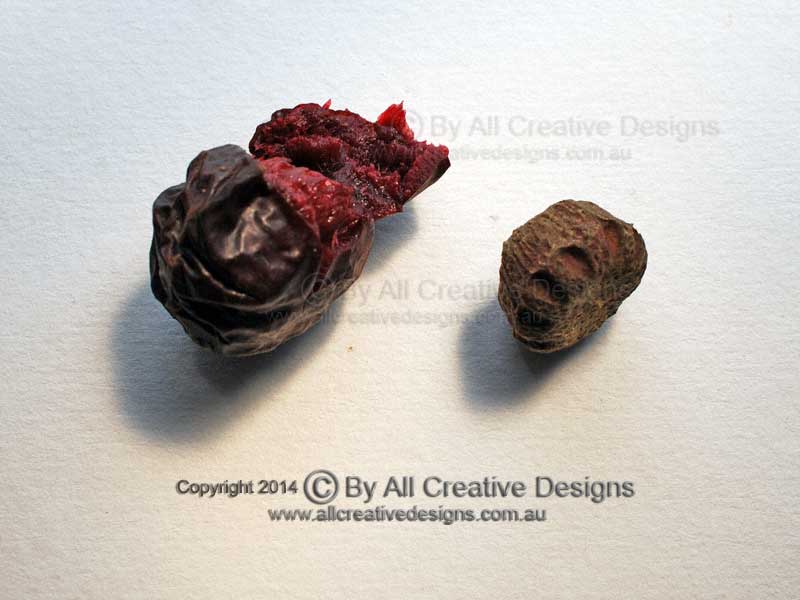
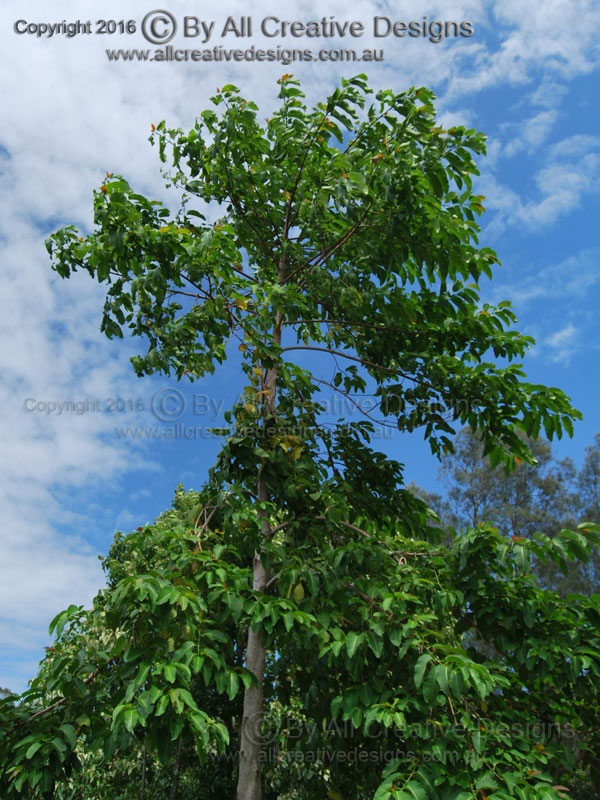
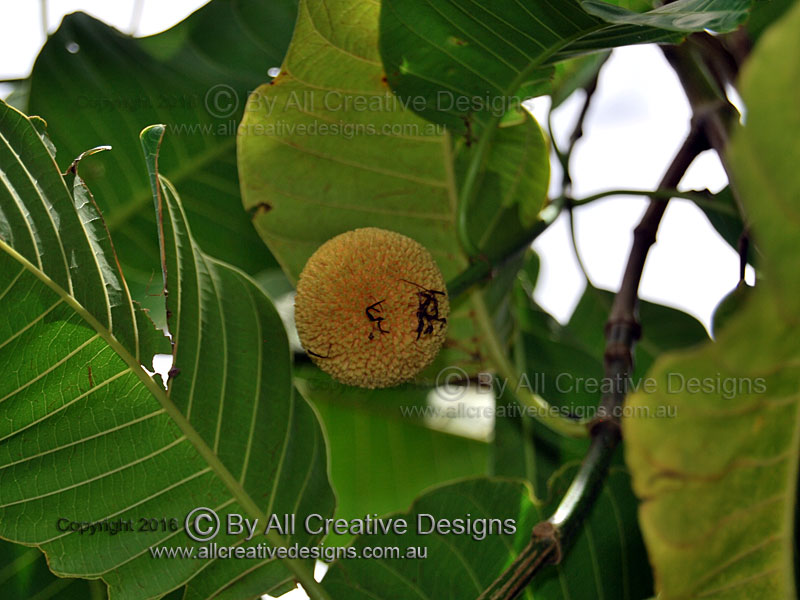
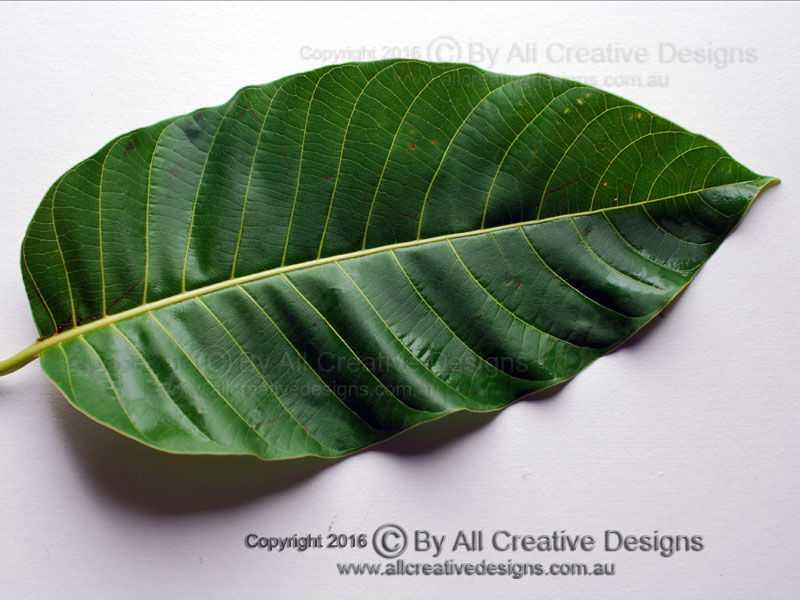
In Australia this medium sized tree is found in dry lowland tropical rainforests and in vegetation fringing watercourses (1). Bark is shades of grey in colour and rough in texture, due to fine fissures and blisters covering the surface (2). Yellow to orange coloured flower heads are perfectly rounded and measure approximately 4cm in diameter. The image shows the tightly packed flower buds before opening (3). Newly emerging leaves are salmon coloured and stipule scars on young branches at leaf nodes are clearly visible (4). Large simple leaves with an opposite arrangement are; more than 30cm long, broadly oblong or obovate (reverse egg-shaped) with entire or broadly undulating margins, hairless, dark green on top, paler green beneath, thick and firm in texture. Leaf apex is acute ending in a fine tip; base shape is broadly rounded. Venation is very prominent with laterals being strongly raised on lower leaf surface (5). Distribution: Northern Qld.
(1)

(2)
(3)

(4)
(5)
Bushy Tamarind Toechima pterocarpum
Bushy Tamarind Toechima pterocarpum Other names: Orange Tamarind
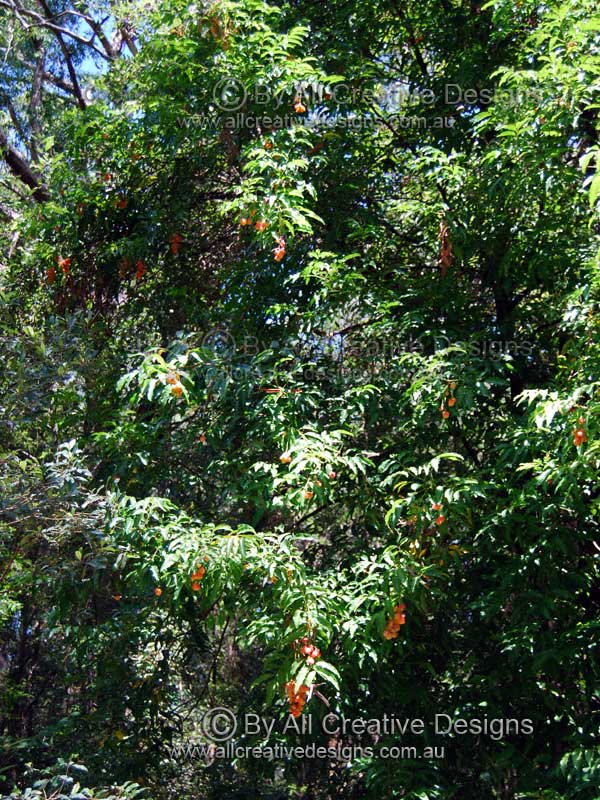
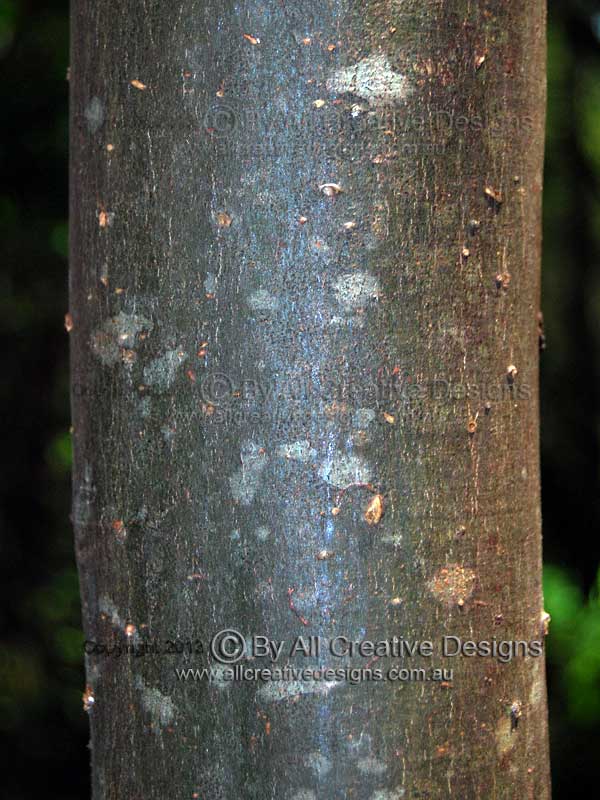
This densely foliated small tree or tall shrub is an understorey species and naturally occurs in tropical rainforests, where it can reach a height of 6m. Due to extensive clearing it now listed as an endangered species (1). Bark is a dark olive grey colour and has a firm, slightly rough texture (2).
The orange coloured fruit (a capsule) features three flattened lobes (wings) and is up to 3cm long. It contains 3 shiny black seeds, which are partly covered by a yellow aril at the apex (3).
Pinnate compound leaves consist of up to 8 leaflets, which are; up to 12cm long, elliptic in shape with broadly undulating (wavy) margins, hairless, dark green, glossy on top, firm and smooth in texture. Leaf apex is acute, ending in a fine point; base shape is cuneate. The petiolule (leaflet stalk) is about 1cm long and shows a swelling at the base (4). Reticulate leaf venation is very noticeable as mid rib, lateral and net veins are raised (5). Distribution: Rare in lowland tropical rainforests of northern Qld.
(1)
(2)

(3)

(4)

(5)
View: Green Guide to Trees of Australia
View: Species List by Botanical Name
View: Species List by Common Name
View: Invasive Trees and Shrubs
 VISIT US ON FACEBOOK and if you like leave a comment. A like on Facebook will notify you when new species or pages have been added.
 We try our best to properly name any tree species shown on our web pages and used these Resources to cross reference our material to make sure botanical identification is correct. All images and the information in accompanying descriptions have been accumulated through a personal interest in our native rainforests for more than twenty five years. Information on distribution range of tree species has been collected from a range of sources including Botanical Gardens (see link above). The aim of these web pages is to show the greater public the beauty and diversity of our remaining rainforests on Australia's east coast in an easy accessible way. We hope to raise the awareness to the high conservation value these remaining areas deserve.
Descriptions and all images copyright ©2023 by www.allcreativedesigns.com.au world wide rights reserved.