
< Expand the Menu to access our Tree Identification Pages
Identification of Eucalyptus Species on Australia's East-Coast
The vast majority of different 'Gum Trees', Eucalyptus species (including Corymbia and Blakella spp.) are endemic to Australia. Eucalypts and species belonging to the closely related genus Corymbia (Bloodwoods) are listed for identification purposes on the web page below. Detailed text descriptions and web-optimised pictures of the full tree, leaf, bark, flower bud or fruit samples are provided. The genus Corymbia is only elevated to a level of subgenus by some botanical sources. Leaves of Eucalypts are often very varied in size and shape throughout the trees development phases. They are classified as; seedling (leaves on young saplings including first emerging leaves called cotyledons), juvenile, intermediate and adult leaves. Except for seedling leaves, even mature trees can feature all leaf phases, such as juvenile leaves emerging on new shoots after bush fires or injury. Seedling, juvenile and sometimes intermediate leaves can have an opposite arrangement, a common feature of Bloodwood Trees (Corymbia spp.). Adult leaves found on mature trees typically have an alternate arrangement. Leaves feature mostly entire margins (edges) and are characteristically rather strong, hairless, smooth and leathery in texture. When a leaf is held against a light source oil glands become visible as translucent dots, which produce the aromatic scent when a leaf is crushed. The fruit of most Eucalyptus species becomes hard or woody when mature and seeds are dispersed by opening valves. Fruit greatly varies in size and shape, making it useful in the identification of different species. Many Eucalyptus species have relative small distribution ranges. Refresh the page in your browser to view updated content.
Blackbutt Tree Eucalyptus pilularis
Blackbutt Tree Eucalyptus pilularis
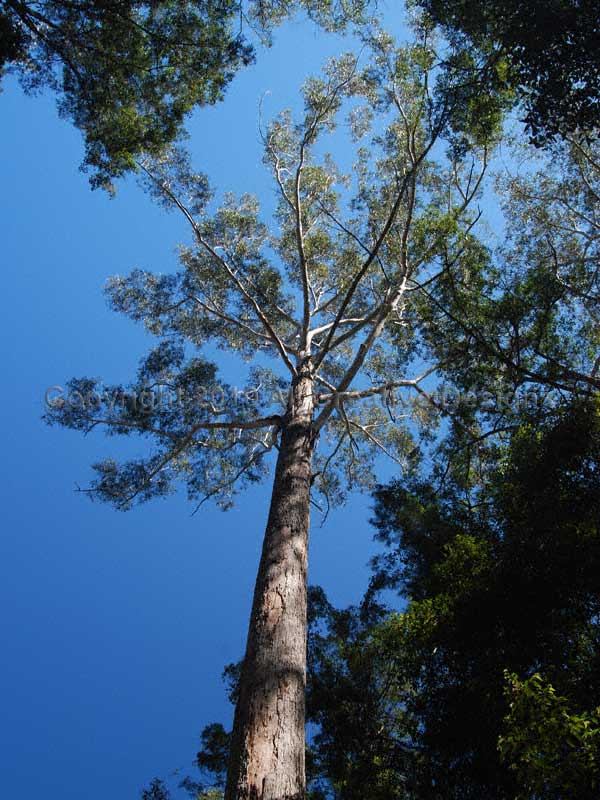
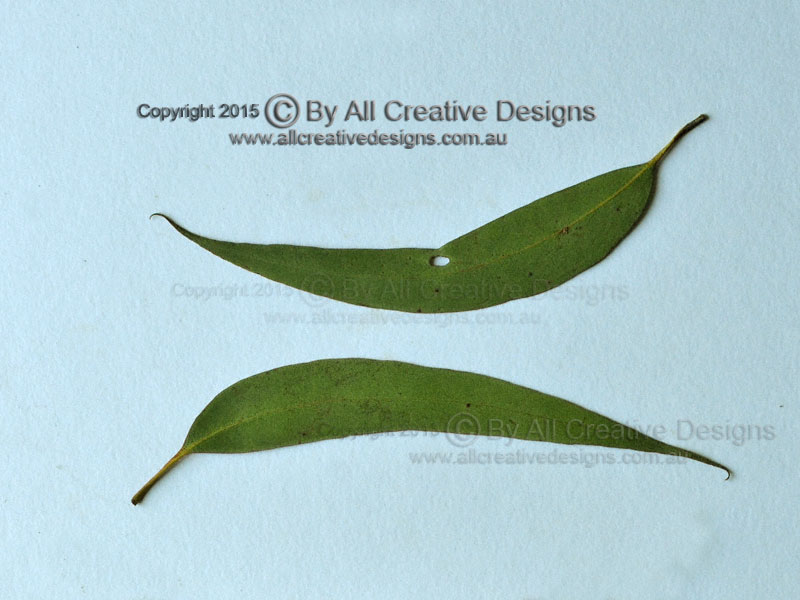
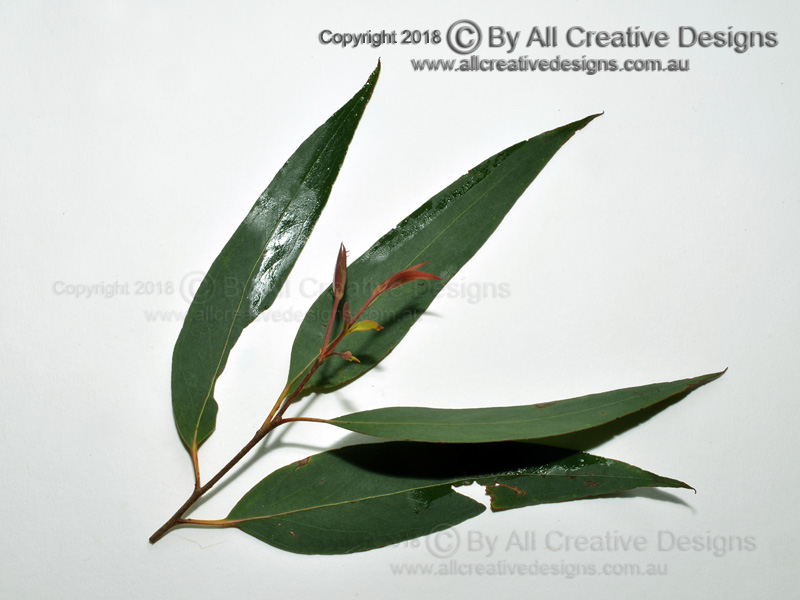
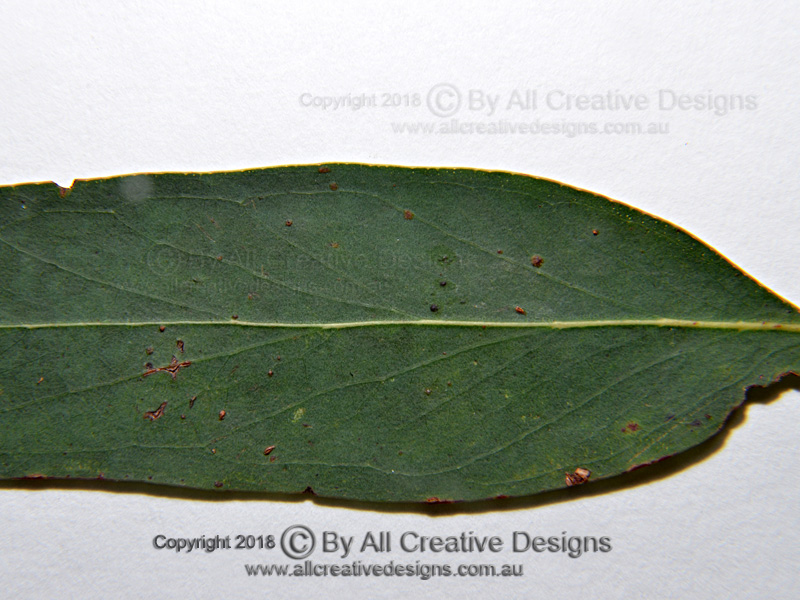
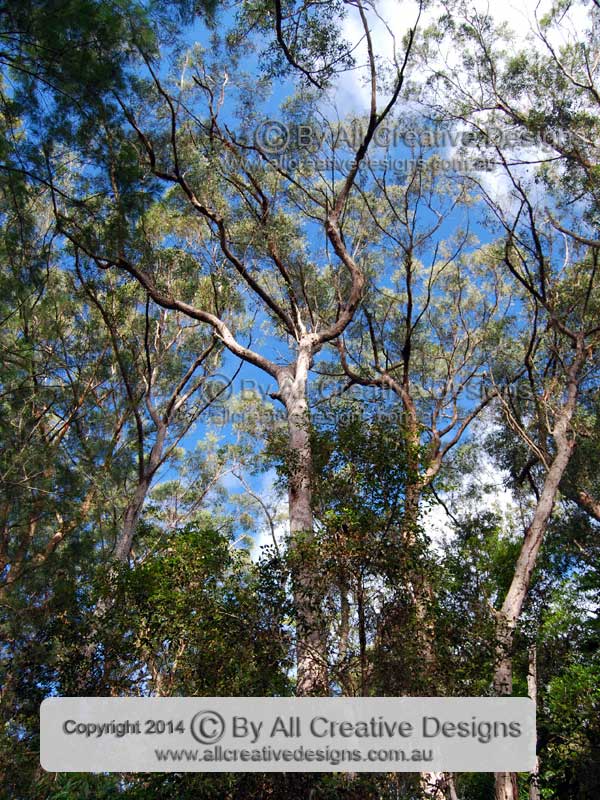
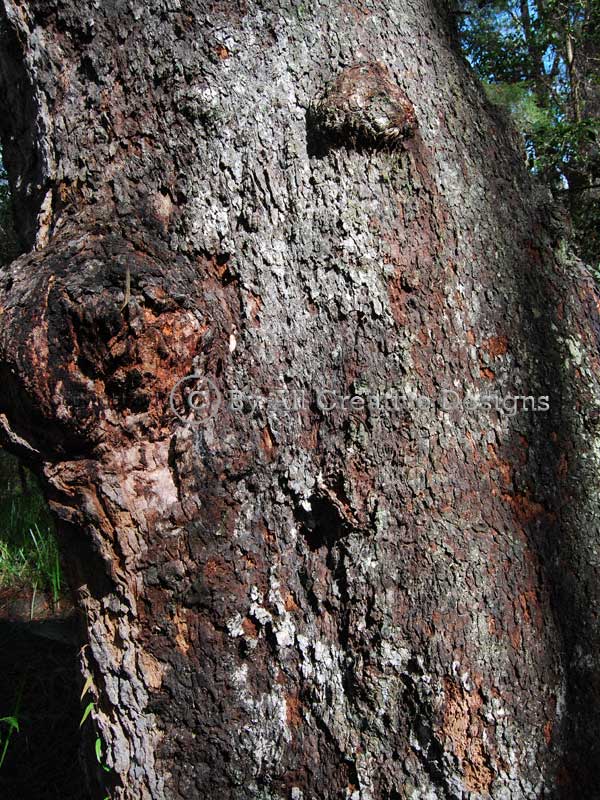
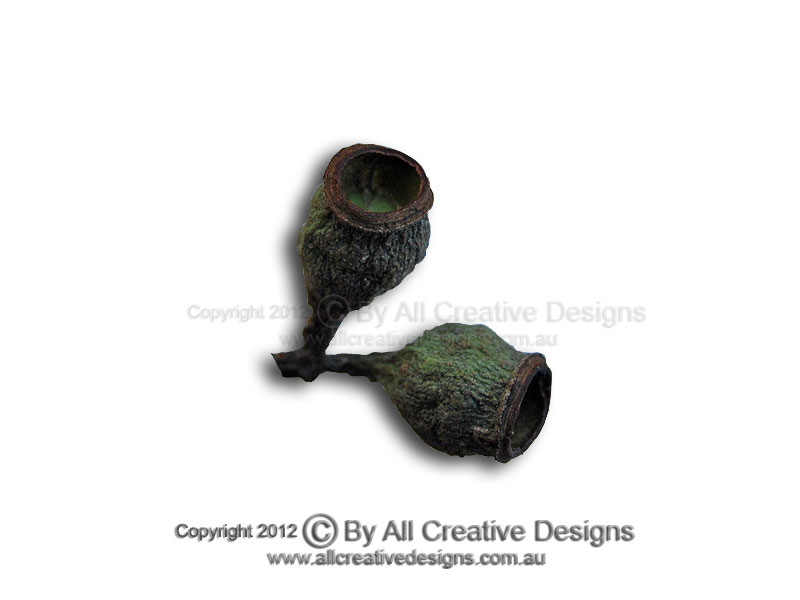
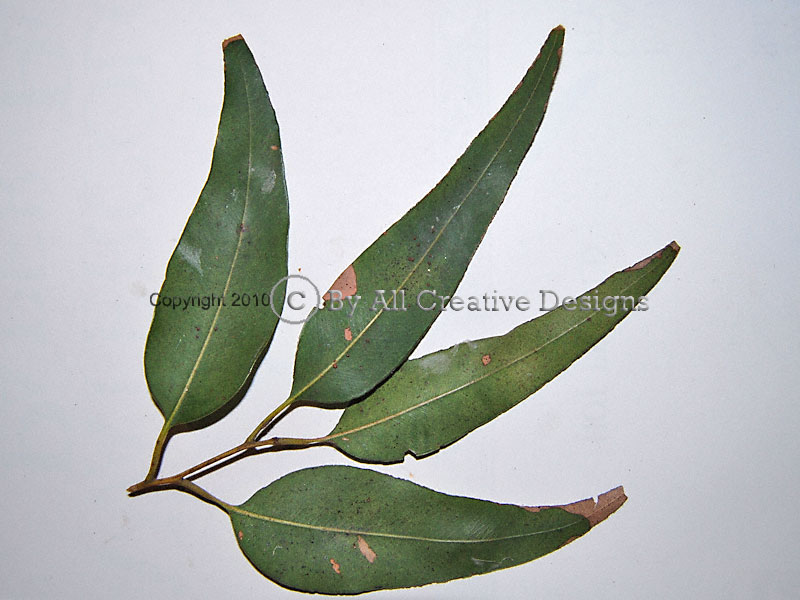
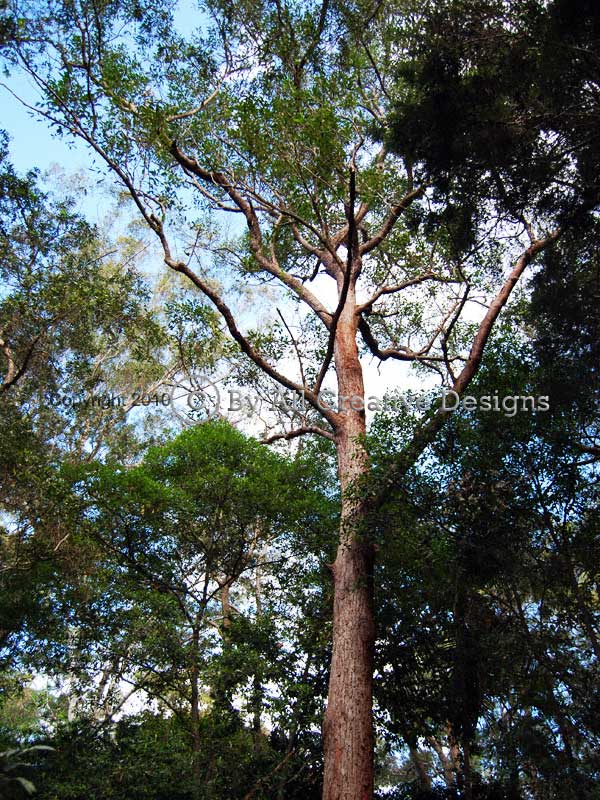
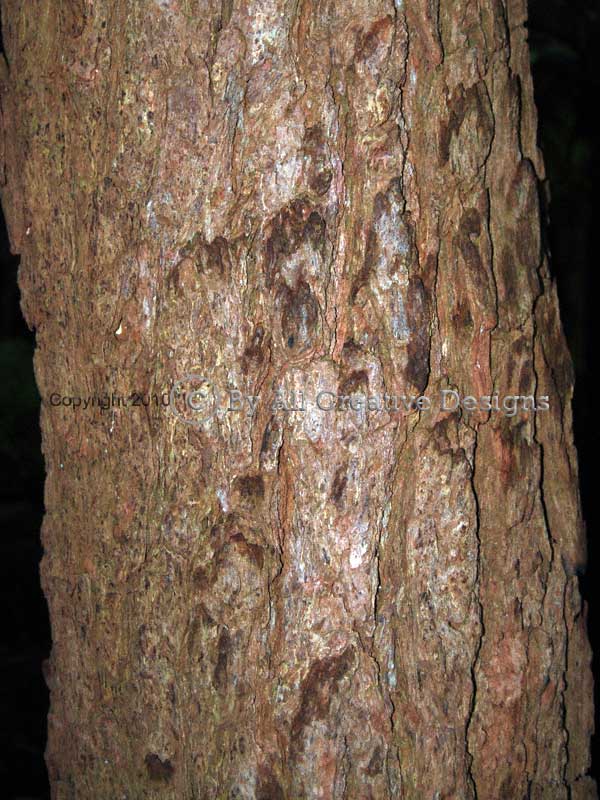
In its natural habitat of tall open forests the Blackbutt tree is able to reach heights of more than 60m. This species is found in coastal to mountainous locations (Picture 1). Fibrous and rough bark covers the lower part of the trunk, which is often blackened at the base due to bush fires, whereas the normal colour is a greyish brown (2 & 3). The woody fruit is either egg- (ovoid) or cup-shaped and measures around 1cm in diameter. It contains 4 sunken valves and produces abundant fine, brown coloured seeds. Adult leaves with an alternate arrangement are; up to 17cm long, mostly lance-shaped or curved (falcate) with entire margins, shiny, mid-green on top, same colour beneath (concolorous), strong, firm in texture and scented when crushed (4 & 5). See Leaf Characteristics Page for explanations of definitions used. Distribution: northern Vic., NSW to southern Qld.
(1)
fs.jpg)
(2)

(3)
fs.jpg)
(4)
fs.jpg)
(5)
Green Guide Trees of Australia
How to recognise Australian tree families and genera.
A practical field guide to the identification of native species. More than 200 full colour photographs and detailed descriptions explaining leaf, bark, flower, fruit and other tree characteristics. The guide was written and illustrated by the author of these web pages.
New Holland Publishers: January 2016
Format: Paperback with PVC
Pages: 128 pp.
Size: 13 cm wide x 18 cm high
First Edition, Hand Signed Copies
CLICK HERE FOR MORE INFORMATION Blue Gum Eucalyptus saligna
Blue Gum Eucalyptus saligna Other names: Sydney Blue Gum
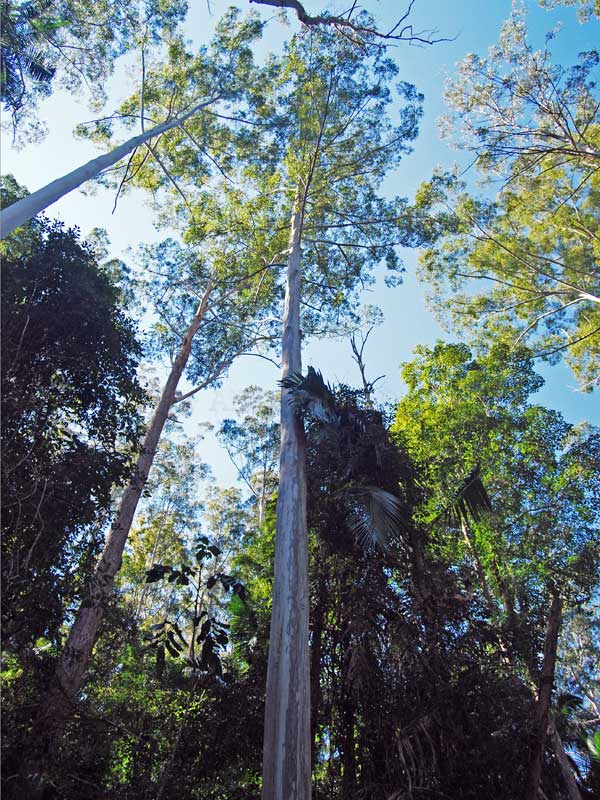
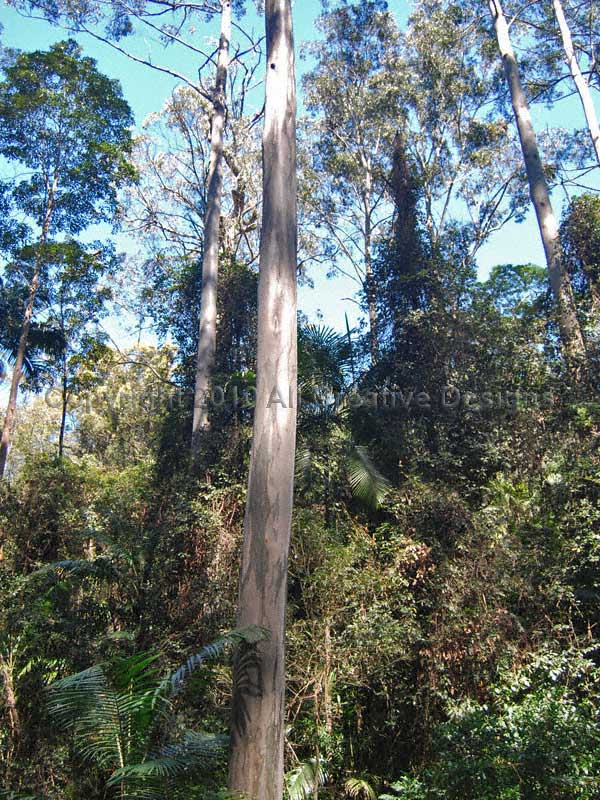
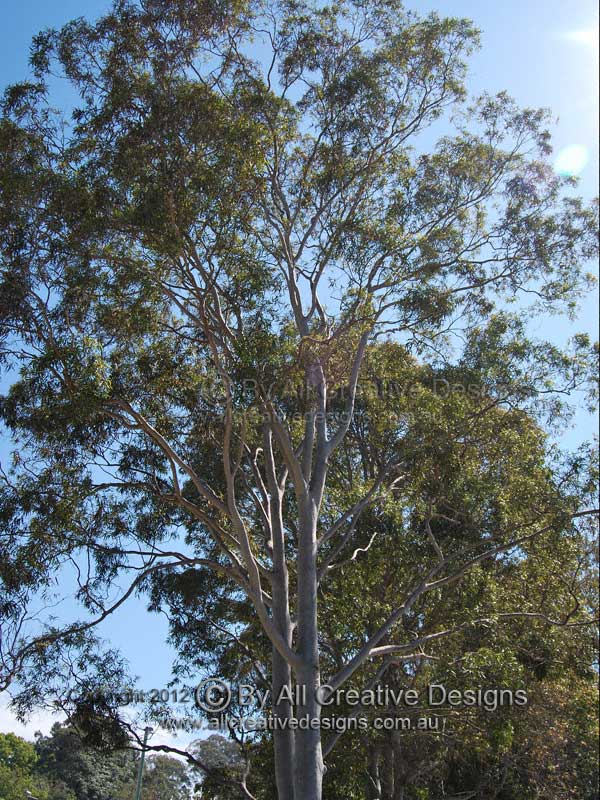
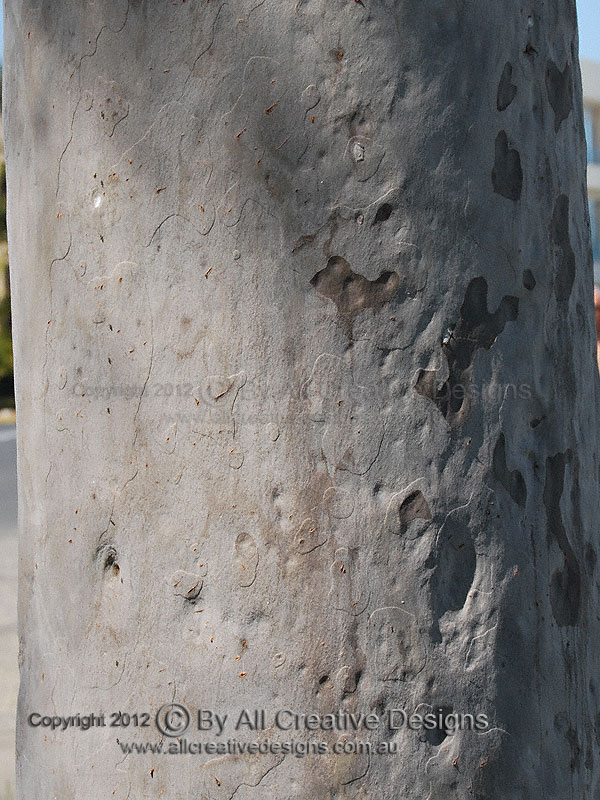
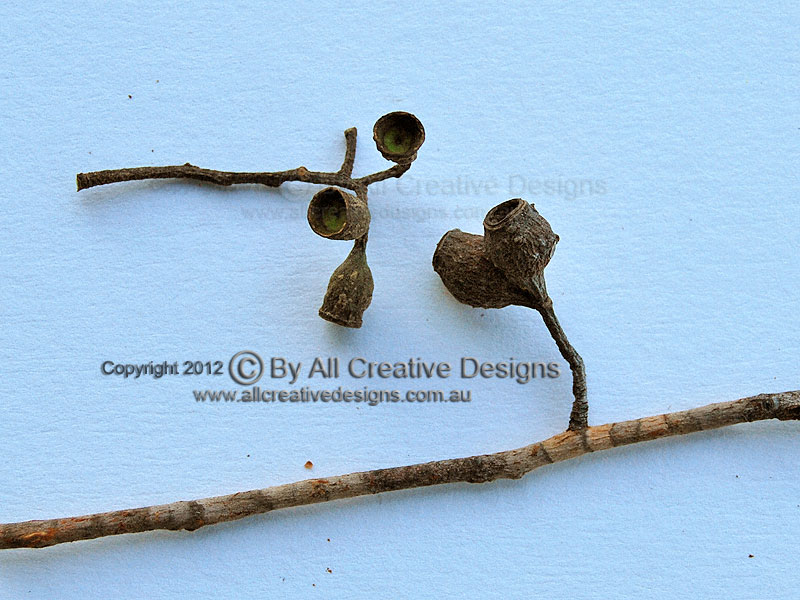
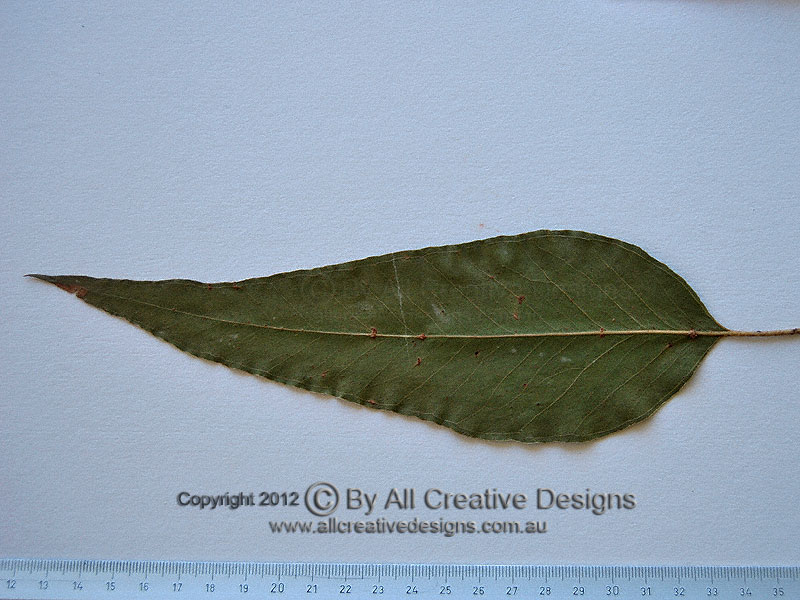
This very tall tree species is found on margins of rainforests and in adjoining wet tall forests, where it grows to a height of more than 60m (Picture 1 & 2). Bark above the short rough barked stocking is very smooth, grey with bluish-grey coloured flecks, streaks and markings, which become more obvious in wet periods. On the mid-north coast of NSW, mature trees lose the rough bark at the base of the trunk nearly entirely (1, 2 & 3). The small woody fruit measures up to 5mm in diameter at the apex and features 3 or 4 valves with exerted tips that are spike-like and point straight up or outwards (4). Adult leaves with an alternate arrangement are; up to 18cm long, narrow elliptic in shape, mostly straight or sometimes curved (falcate) with entire margins, mid-green above, paler green beneath (discolorous), scented, strong and rather stiff in texture. (5). Distribution: NSW south coast to southern Qld.
(1)
(2)
(3)
fs.jpg)
(4)
fs.jpg)
(5)
Blue Mountain Ash Eucalyptus oreades
Blue Mountain Ash Eucalyptus oreades Other names: White Ash, Smooth Barked Mountain Ash
This medium to tall tree is most abundant in the Blue Mountains of NSW, where under favourable conditions it can attain a height of 40m. Its’ natural habitat are open Eucalypt dominated forests at higher altitudes (Picture 1). At the base of the trunk (up to a height of 3m), bark is rough and grey to brown in colour. Otherwise bark is very smooth in texture and mainly whitish grey, showing longitudinal streaks of darker grey, and areas with yellow to brownish tones (2). The woody fruit is cup or more urn-shaped and up to 1cm in diameter. In the centre 4 or 5 small valve tips extend to rim level or slightly above after opening (3). Juvenile leaves, found on sapling trees, are ovate (egg-shaped) and only up to 10cm long (4). Simple adult leaves with an alternate arrangement are; up to 17cm long, straight lanceolate (lance-shaped) or curved (falcate), mid-green on both surfaces (concolorous), strongly scented when crushed, rather thick and firm in texture. Leaf apex gradually narrows into a fine point; base shape is asymmetric (oblique). Distribution: In widely separated regions along the Great Dividing Range, from NSW to southern Qld.
(1)
(2)
(3)

(4)
(5)
Carbeen Corymbia tessellaris [Eucalyptus tessellaris]
Carbeen Corymbia tessellaris Other names: Moreton Bay Ash
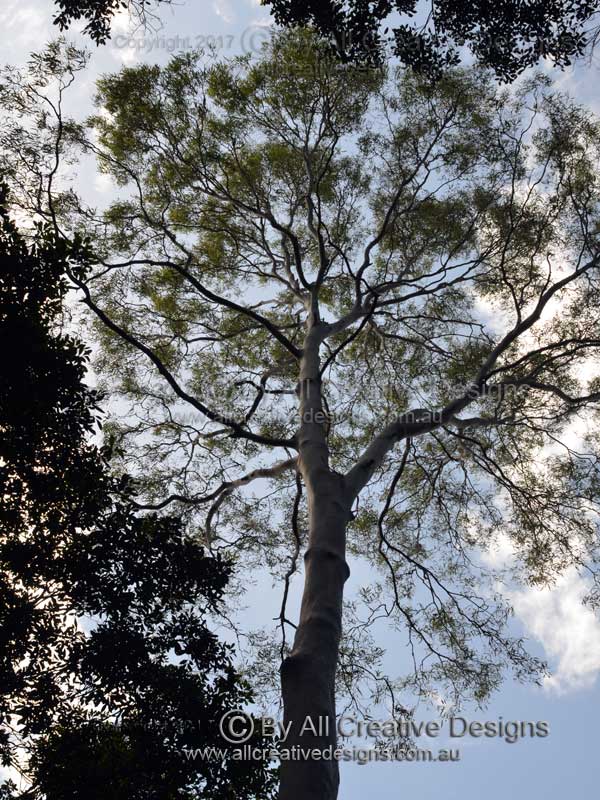
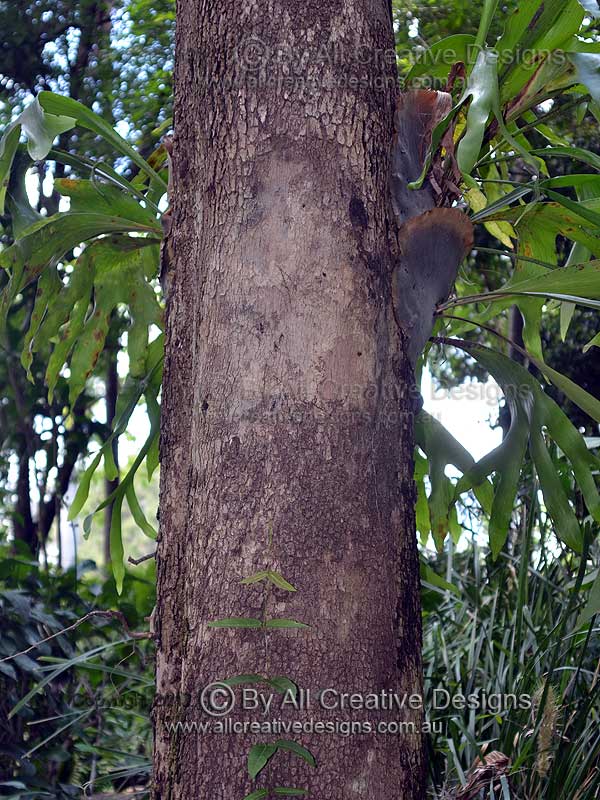
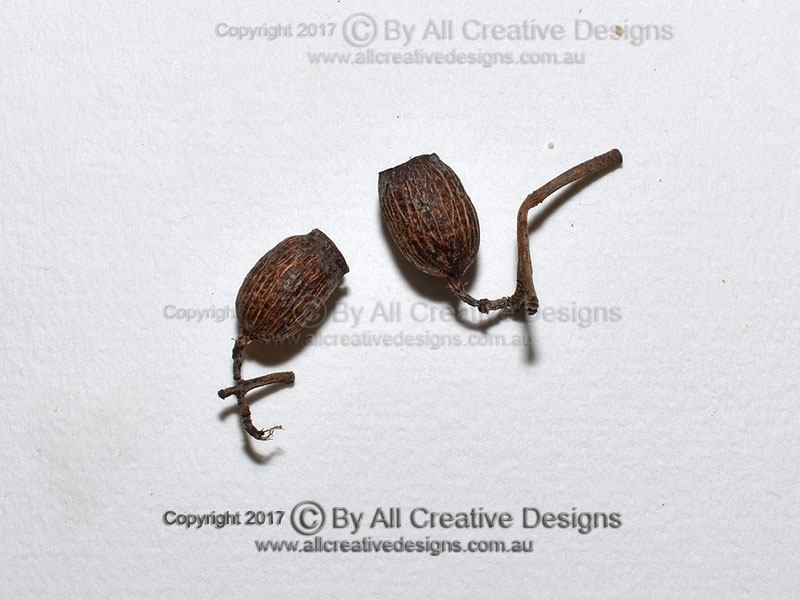
Under ideal conditions this species can reach a height of 40m. The relatively thin branches are held at steep angles from the upright trunk. The Carbeen occurs in various habitats ranging from dry woodlands to the margins of littoral rainforests (1). The two-type bark is very characteristic feature for this tree. A dark stocking of rough and scaly texture is abruptly replaced by very smooth and light grey coloured bark higher up the trunk. On younger specimens the stocking is more deeply furrowed and paler in colour (2 & 3). The woody but thin-walled fruit reaches a length of 14mm and a diameter of up to 10mm. It is cylindrical or more urn-shaped and shows small longitudinal ridges on its surface. It is supported by an individual stalk up to 5mm long (4). Simple adult leaves with an alternate arrangement are; up to 20cm long, narrowly lanceolate (lance-shaped) with entire margins, straight or slightly curved, hairless, leathery, greyish green and dull on both surfaces (concolorous) (5). Distribution: From northern NSW to the tip of Cape York, Qld.
(1)
(2)

(3)
(4)

(5)
Cadaghi Corymbia torelliana [Eucalyptus torelliana]
Cadaghi Corymbia torelliana Other names: Cadaga
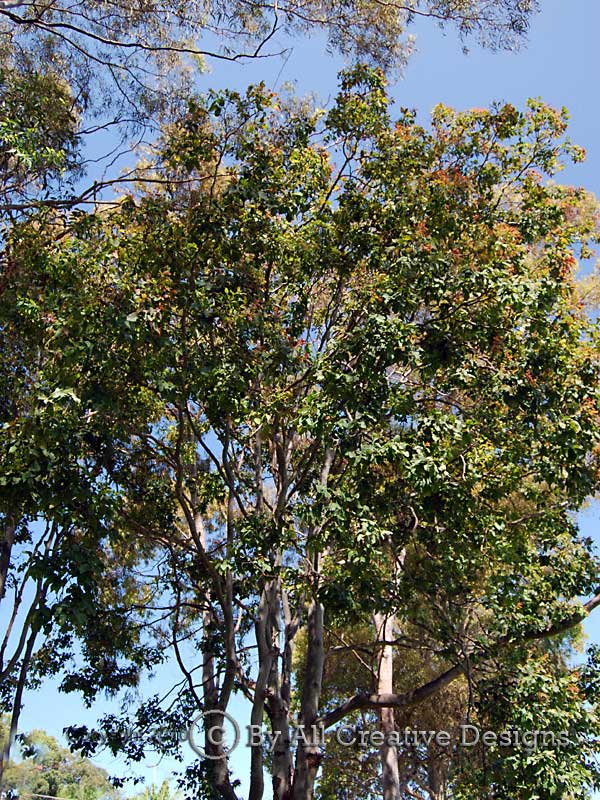
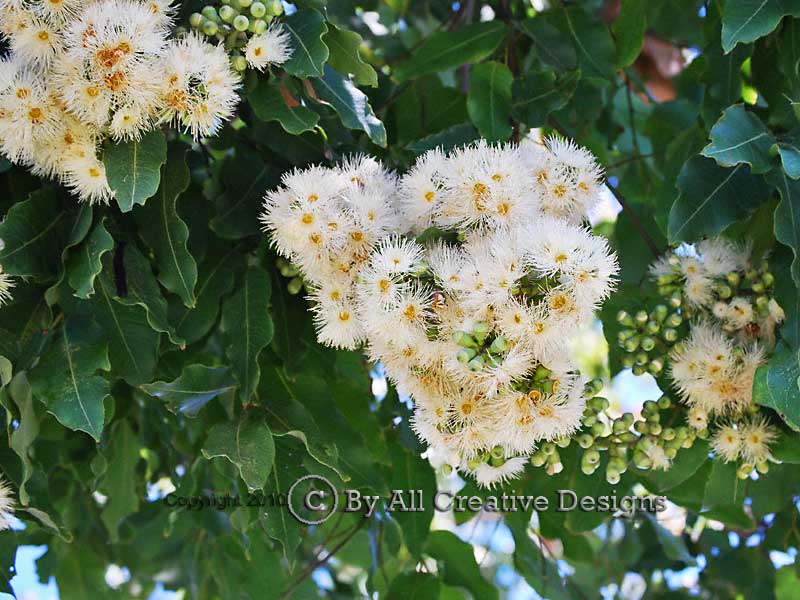
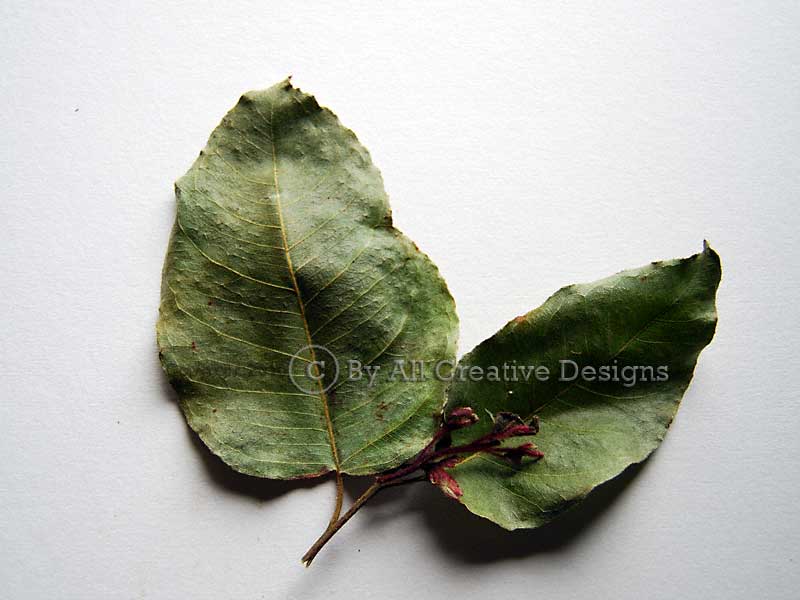
The Cadaghi or Cadaga can reach a height of 30m or more and is naturally found on margins of tropical rainforests and adjoining tall open forests. It also has been extensively planted as an ornamental tree outside its natural habitat (Picture 1). The bark on the lower half of the trunk is brown in colour with a rough and flaky texture, whereas the top half of the trunk and upper branches feature a smooth greyish green bark (2). Clusters (panicles) of white flowers, borne at the end of branches, measure 2 to 3cm in diameter and blossom over late spring and early summer (3). Juvenile leaves have an alternate arrangement and are; up to 20cm long, hairy and ovate (egg-shaped) (4). Adult leaves are; up to 15cm long, lanceolate in shape with entire margins, hairless, dark green and rather dull on upper surface, lighter green below with a firm texture. Leaf apex is acute, base shape is cuneate to rounded. Mid vein is raised on both surfaces and numerous straight lateral veins are obvious. Distribution: Restricted habitat of wet coastal areas and adjacent ranges in tropical Qld (Cairns and surrounding areas). Note: This tree is listed as an invasive species in a number of shires along the NSW north coast. See Flower Characteristics Page and Leaf Characteristics Page for information on terms used.
(1)

(2)
(3)
(4)

(5)
Coastal Ironbark Eucalyptus siderophloia
Coastal Ironbark Eucalyptus siderophloia
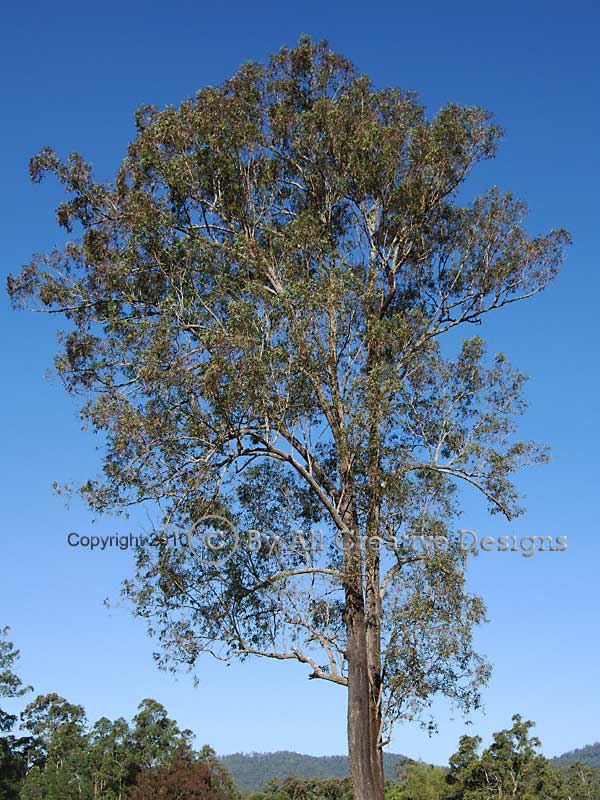
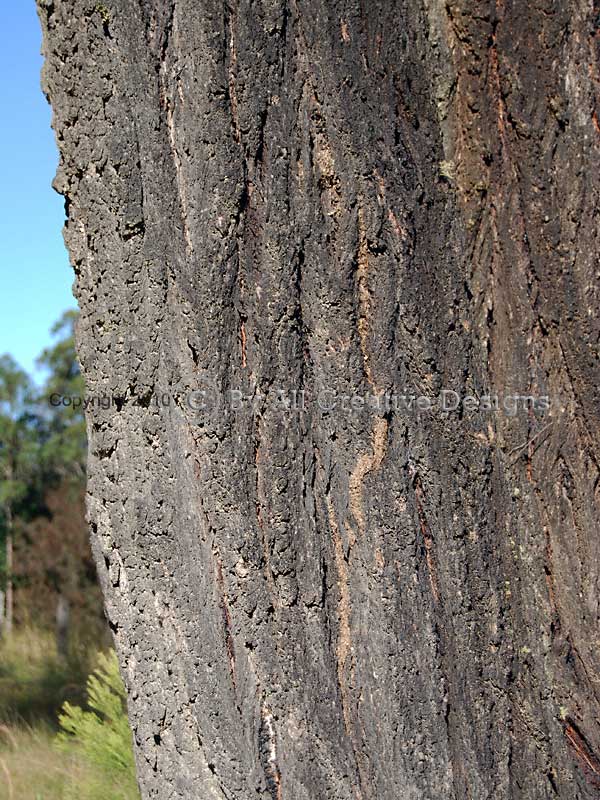
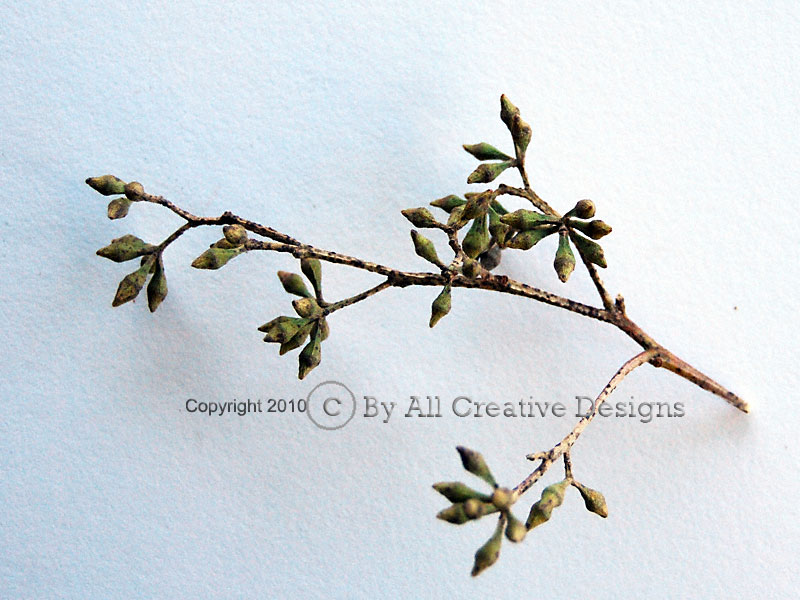
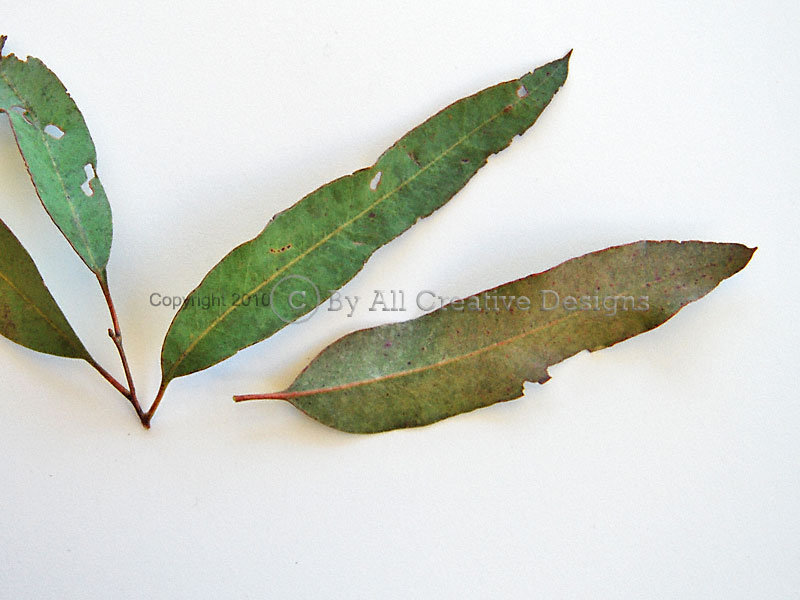
Under favourable conditions the Coastal Ironbark can reach a height of more than 40m. As the common name suggests, it is found in coastal areas and the lower escarpment (Picture 1). Bark is dark grey, very hard and deeply furrowed. On adult specimens the rough bark continues to the smallest branches in a fairly open canopy (2). Flower buds are a diamond-shaped and up to 10mm long (3). The woody fruit is obconical (reverse cone-shaped), about 8mm long and 6mm wide at the apex. When fully opened, valve tips are exerted above rim level (4). Simple alternate adult leaves are; up to 14cm long, lanceolate (lance-shaped) with entire margins, mid green on top, a lighter grey green beneath, fairly thin, papery but strong in texture. Leaf apex is acute and terminates in a fine pointed tip (5). Distribution: NSW central coast to subtropical Qld.
(1)
(2)
(3)

(4)
(5)
Descriptions and all images copyright ©2023 by www.allcreativedesigns.com.au world wide rights reserved.
Click Images for Full Size View
Flooded Gum Eucalyptus grandis
Flooded Gum Eucalyptus grandis Other names: Rose Gum
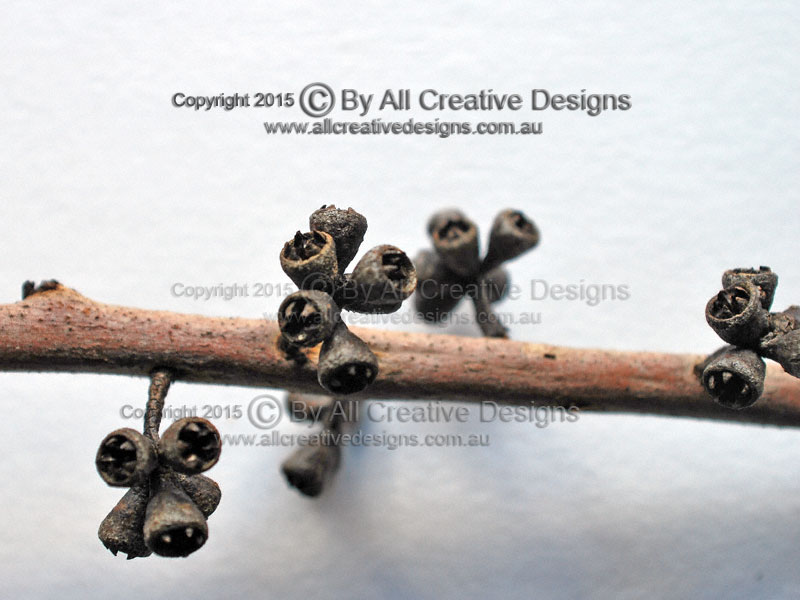
The Flooded Gum is very tall forest tree up to 70m in height and prefers moist fertile soils in higher rainfall areas. The specimen shown (Picture 1) resides within the outer margins of subtropical rainforest and is surrounded by rainforest species, such as the Black Booyong (Argyrodendron actinophyllum) and the Yellow Carabeen (Sloanea woollsii). A stocking of rough bark is retained at the base of the tree, but recedes with age (2 & 3). The relative small woody fruit measures only about 5mm in diameter and features 4 or 5 valves which are slightly exerted above the rim level after opening. Valve tips are claw-like and point inwards, whereas valves tips of the very similar Blue Gum (E.saligna) are spike-like pointing up or outwards (4). Simple adult leaves (middle) with alternate arrangement are; up to 16cm long, lanceolate (lance-shaped) with entire margins, straight as adult leaves, longer and curved as intermediate leaves, discolorous, strong and scented when crushed. Leaf apex is acute and base shape cuneate. Venation except for mid vein is very faint (5). Distribution: NSW central coast to northern Qld.
fs.jpg)
(1)

(2)

(3)
(4)
(5)
Forest Red Gum Eucalyptus tereticornis
Forest Red Gum Eucalyptus tereticornis Other names: Blue Gum (Qld)
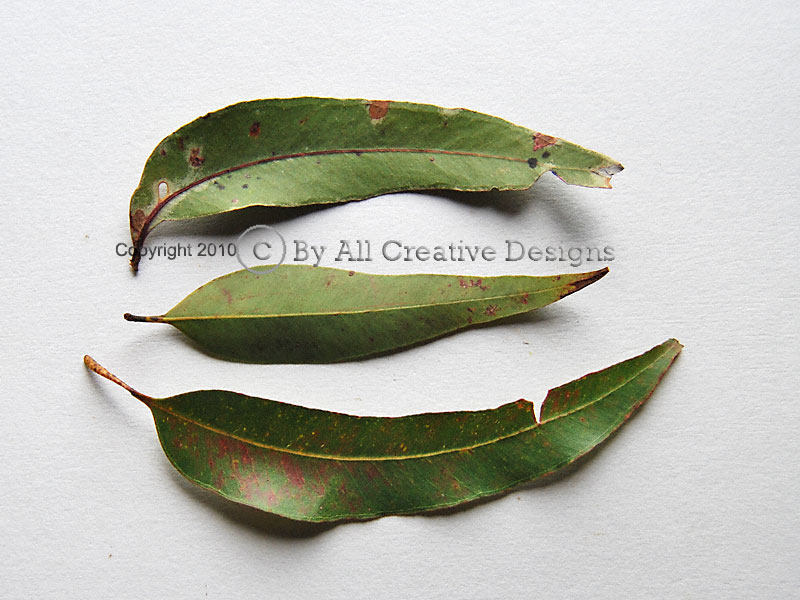
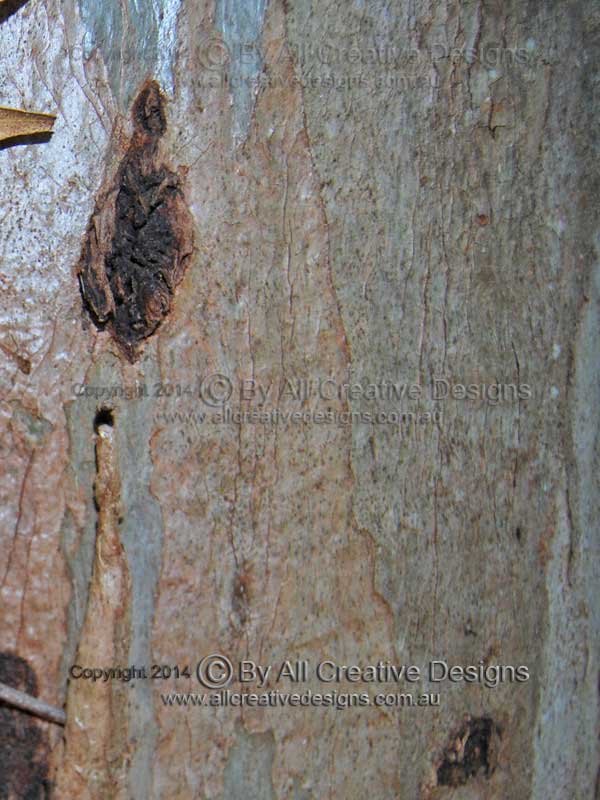
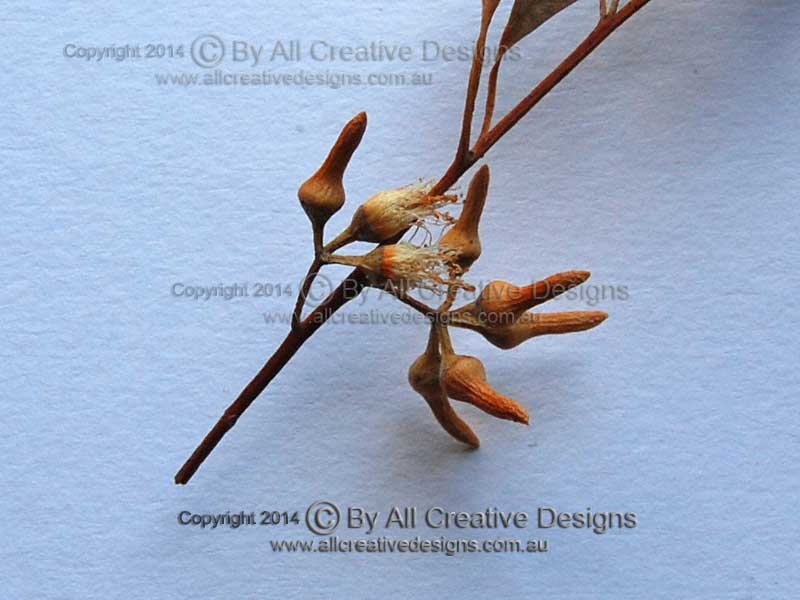
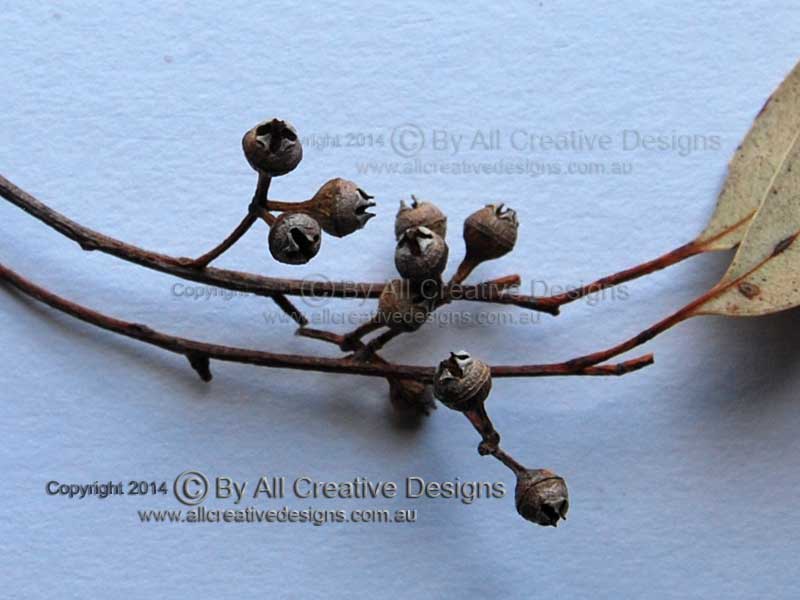
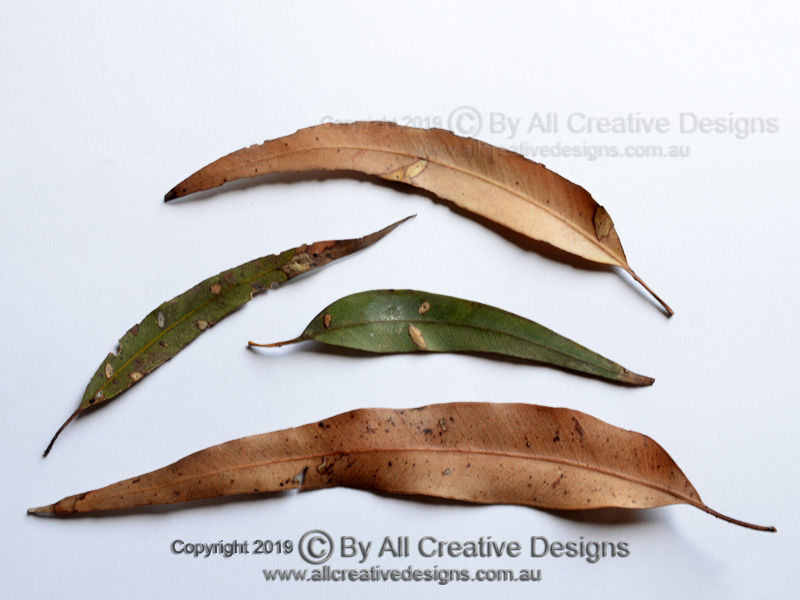
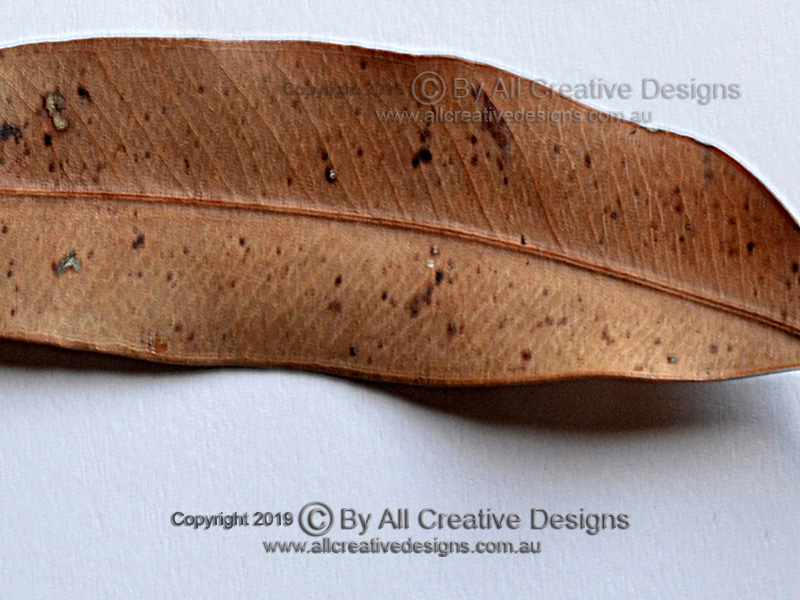
This tall Eucalyptus tree has a wide distribution range along Australia's east coast. It occurs from coastal to mountainous locations and can reach a height of up to 50m under ideal conditions (Picture 1). Newly exposed bark is very smooth and has a glossy surface, whereas older bark becomes finely rough and granular in texture. It is different shades of grey in colour and sheds in irregular sized plates, a short stocking of rough bark can be found at the base of the tree (2). Up to ten separate flowers are held on a common stalk measuring up to 3cm in length. Flower buds are distinctively cone shaped and up to 10mm long (3). The rounded fruit features 4 or 5 stout and strongly exerted valves ending in sharp tips (4). Simple adult leaves with an alternate arrangement are; up to 20cm long, lanceolate (lance-shaped) with entire margins, straight or curved (falcate), dull green (dried specimens shown) on top, paler beneath (discolourous) and scented when crushed. Leaf apex very gradually narrows into a fine tip, base shape is cuneate (wedge-shaped). Distribution: From southern Vic., to northern Qld. Note: This species is a primary koala food source.

(1)
(2)
(3)
(4)

(5)
Grey Gum Eucalyptus punctata
The Grey Gums are a group of six Eucalyptus species (subgenus Symphyomyrtus) that can be recognised by their eye-catching bark, which is orange-coloured when freshly exposed.
Grey Gum Eucalyptus punctata
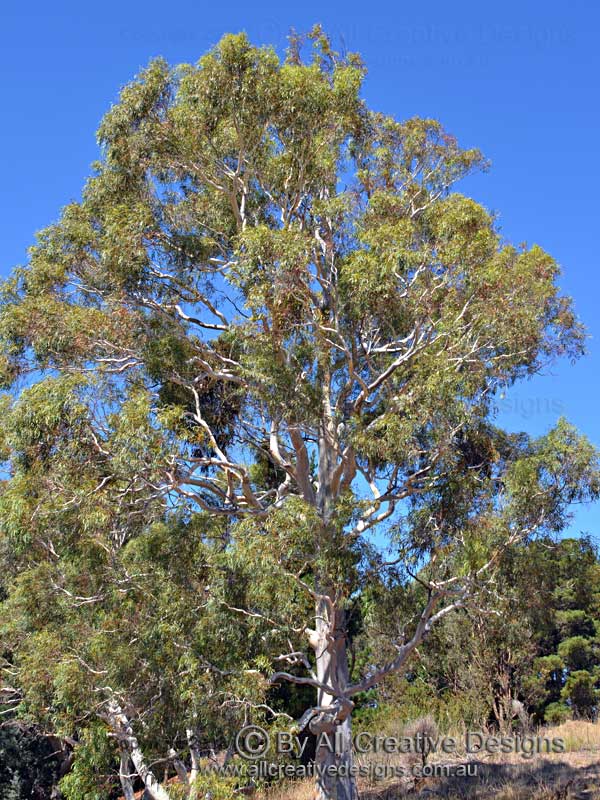
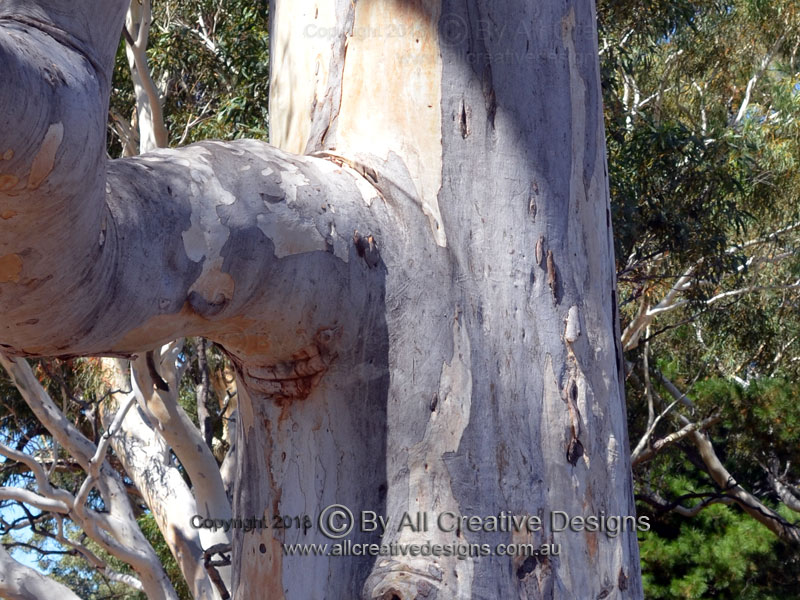
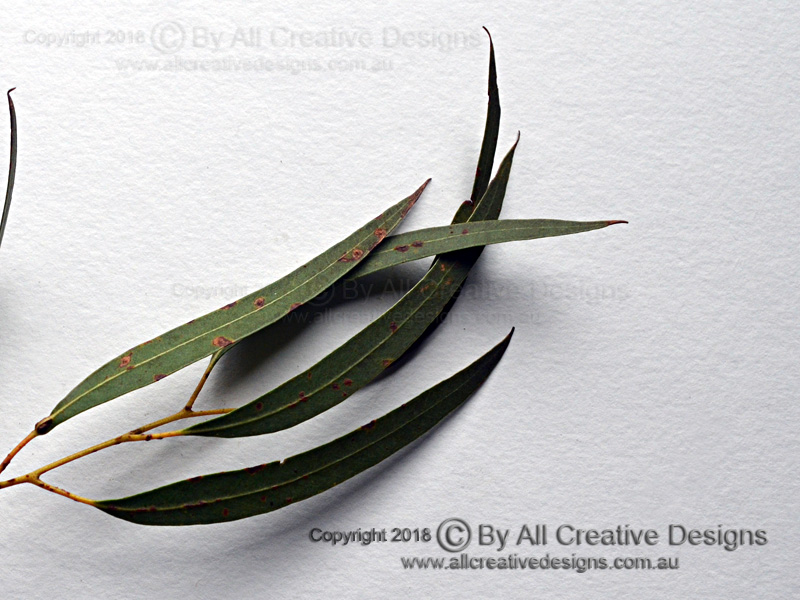
When growing in drier woodlands on poor soils the Grey Gum (E. punctata) is less than 20m tall and branches are held relatively close to the ground. Whereas within wet tall forests it has to compete for light and may reach a height of more than 30m (1). Bark goes through a colour transformation from orange or salmon to a light grey and finally dark grey before shedding in large patches. Texture changes from smooth (all over) to granular with age. Irregular sized and shaped patches of different coloured bark create a mottled appearance (2 & 3). The umbel-shaped inflorescence consists of up to seven flowers that are supported by a primary stalk (peduncle), which is rounded and up to 2cm long. Flower buds are mostly egg-shaped less than 1cm long. The short pedicel (individual flower stalk) is 2mm long (4). Simple (adult) leaves with an alternate arrangement are; up to 15cm long, narrowly to broadly lance-shaped (lanceolate) with entire margins, straight of slightly curved (falcate), dark green above, paler green beneath, firm, leathery and scented when crushed. The petiole (leaf stalk) is up to 3cm long (5). Distribution (E. punctata): Central parts of NSW, coastal to inland regions. Note: This species is a koala food source.
(1)

(2)
(3)

(4)
(5)
Grey Gum Small-fruited Eucalyptus propinqua
Grey Gum Small-fruited Eucalyptus propinqua
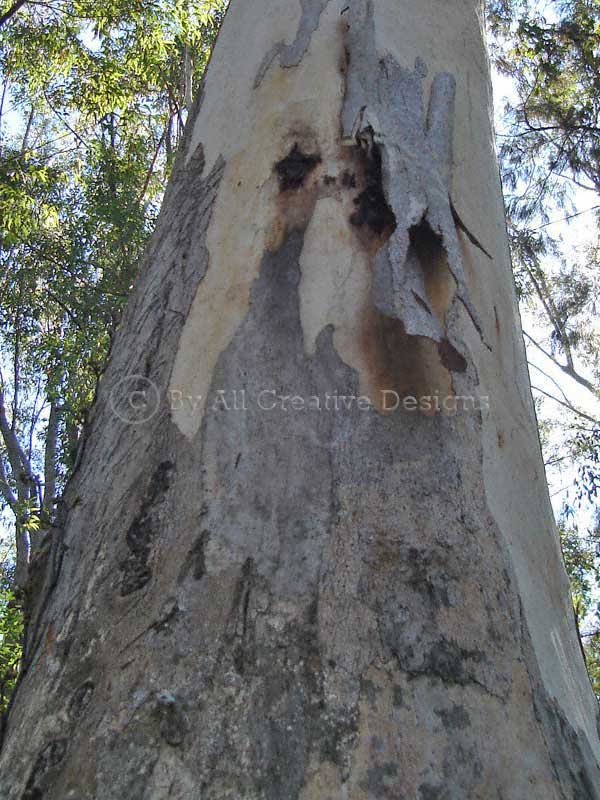
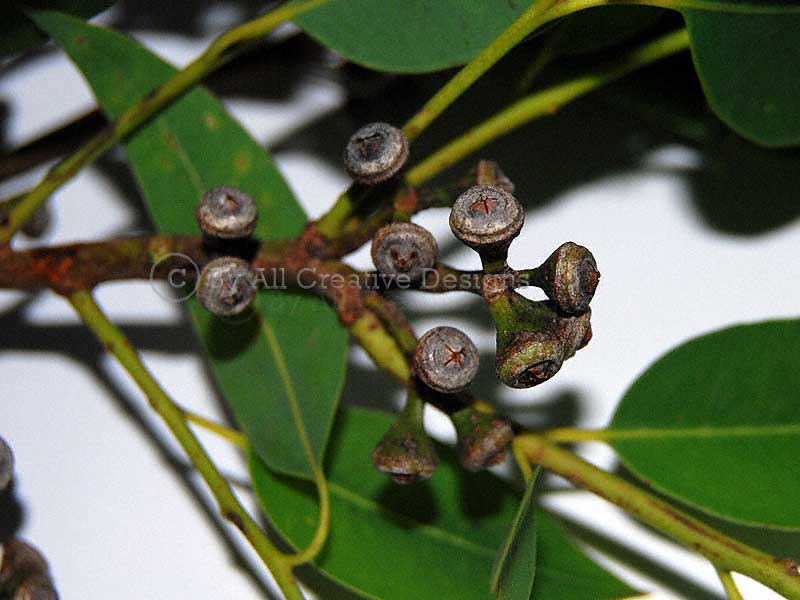
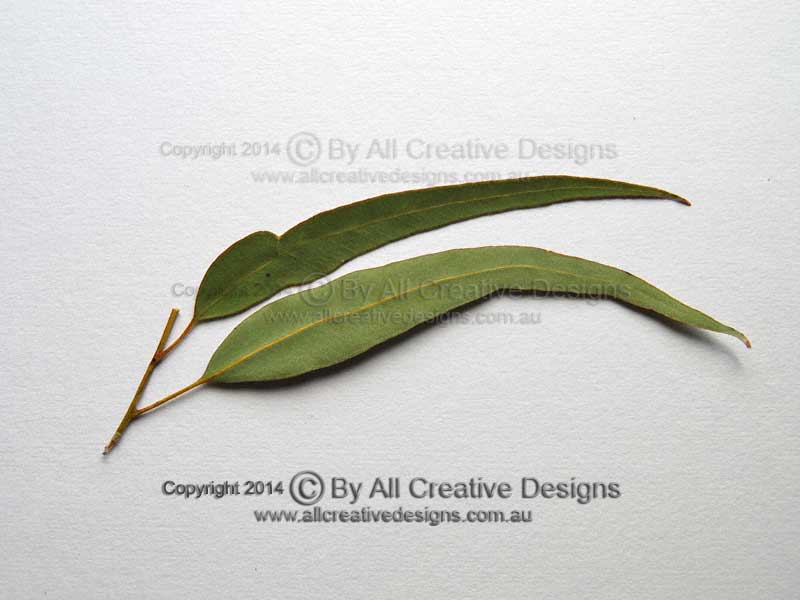
The small-fruited Grey Gum is a tall and erect tree species up to 45m in height, the straight trunk is often branchless to more than half of the tree's height. Its natural habitat are tall open forests from coastal to mountainous locations (Picture 1 & 2). Old slightly rough (granular) bark is shed from the trunk in wide strips or irregular patches exposing new bright orange-coloured bark (3). The woody fruit is reverse cone-shaped (obconical), measures only up to 5mm in diameter and features mostly 4 valves (4). Simple adult leaves have an alternate arrangement and are; up to 15cm long, lanceolate (lance-shaped) with entire margins, dark green above, paler green beneath, firm, leathery in texture and scented when crushed. Leaf apex narrows into a very fine tip, base is broadly wedge-shaped (5). Distribution: NSW central coast to southern Qld. Note: This species is a koala food source.
fs.jpg)
(1)
fs.jpg)
(2)
(3)
(4)
(5)
Grey Gum Eucalyptus major
Grey Gum Eucalyptus major
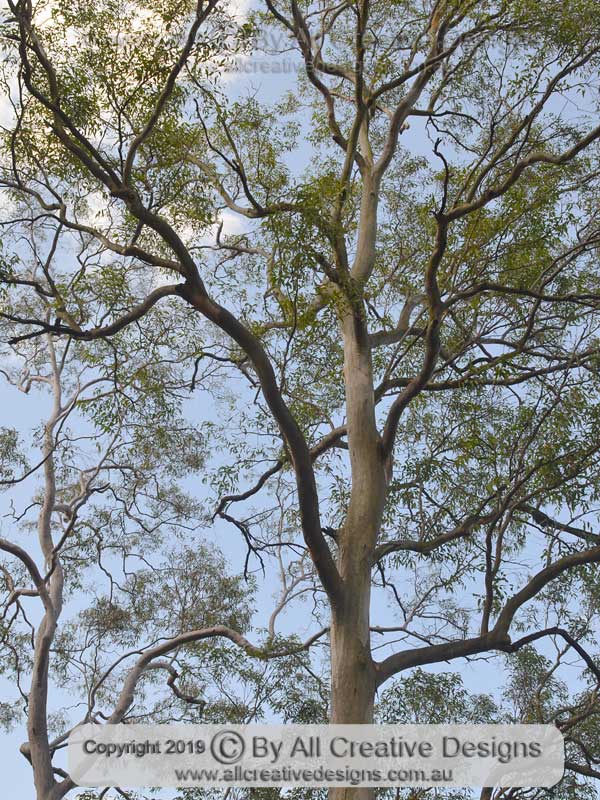
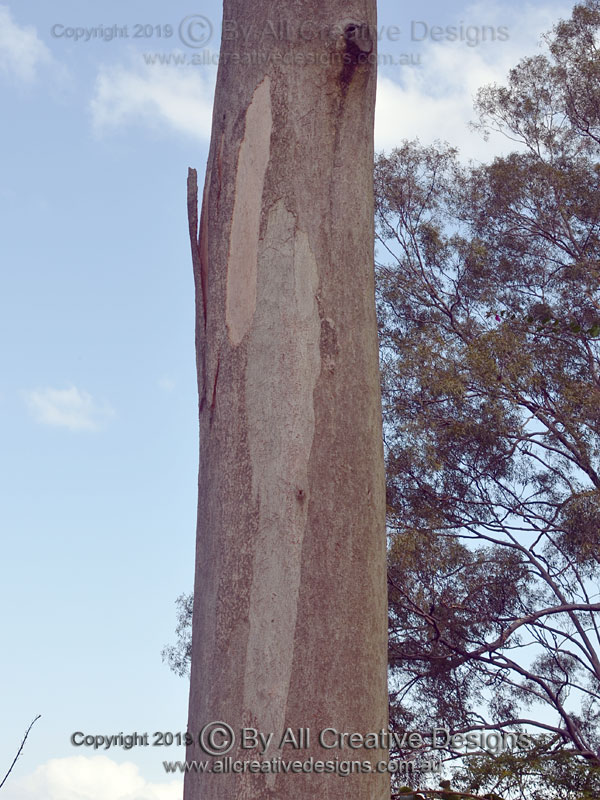
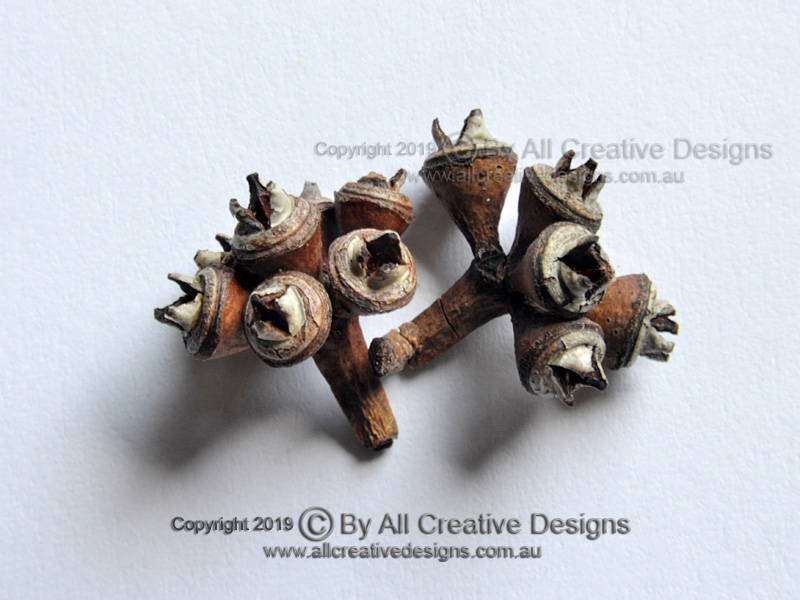
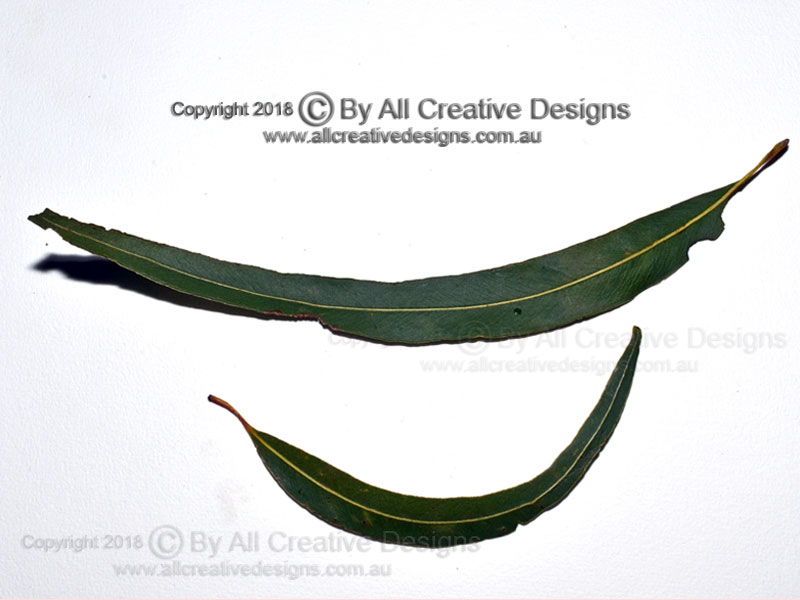
This species of Grey Gum (E. major) reaches a height of up to 25m and is very similar in appearance to the Small-fruited Grey Gum (E. propinqua, listed above), but differs in that the fruit is more cone-shaped and features stout and more strongly exserted valve tips. Open Eucalypt dominated forests are preferred habitats (Image 1). Bark, characteristic for Grey Gums, is smooth and often orange coloured when freshly exposed, changing to dark grey with a granular (finely rough) texture before shedding in large plates (2). The fruit is more obconical (reverse cone-shaped) than cup-shaped, as for E.propinqua, and measures about 8mm in diameter. When fully opened, the 3 or 4 stout valve tips extend prominently above the rim level. The solid primary stalk (peduncle) is rounded and up to 15mm long, whereas individual stalks (pedicels) are non-existent (sessile) or only a few millimetres long (3). Mature simple leaves feature an alternate arrangement and are; varied in length from less than 10 to 20cm long, mostly falcate (sickle-shaped) or sometimes nearly lance-shaped (straight) with entire margins, paler green on lower surface (discolorous), strong and leathery. An intramarginal vein runs very close to the leaf edge and the mid rib is grooved on the upper surface (4 & 5). Distribution: Far northern NSW and southern Qld. Note: This species was classified as a subspecies of E. propinqua and is a Koala food source.
(1)
(2)
(3)
(4)
(5)
Large-leaved Spotted Gum Corymbia henryi [Eucalyptus henryi]
Large-leaved Spotted Gum Corymbia henryi
Depending on conditions, this medium or tall tree reaches a height of 25m to 40m. It inhabits open Eucalypt forests and woodlands at lower elevations. As the common name suggests, leaves of this species can reach an exceptional length of nearly 30cm, but are only about 3cm wide (1). The distinctive mottled appearance of the upright trunk is caused by patches of bark, which change colour from grey to a reddish-brown before detaching in small flakes. Bark has a smooth texture throughout (2). The woody fruit varies in shape from ovoid (egg-shaped) to urceolate (urn-shaped) and is up to 15mm long. The stalk and to some extent the fruit have a finely wrinkled surface texture. Valves are deeply sunken (3). Simple adult leaves with an alternate arrangement are; up to 30cm long, narrowly lance-shaped with entire margins, straight of curved (falcate), dull or semi-glossy and dark green on both surfaces (concolorous), strong and leathery in texture. The leaf apex gradually narrows into a fine tip. Lateral veins have a regular spacing and an intramarginal vein is present (4 & 5). Distribution: northern NSW and southern Qld. The Spotted Gum C. maculata (listed below on this page) has a very similar appearance.

(1)

(2)

(3)
(4)

(5)
Lemon-scented Gum Corymbia citriodora [Eucalyptus citriodora]
Lemon-scented Gum Corymbia citriodora Other names: Lemon-scented Iron Gum, Spotted Iron Gum
The common name refers to the strongly lemon-scented leaves of this tree, which are of great help when identifying this species, as it is of similar appearance to the Spotted Gum E. maculata. Mainly found in open forests along the coastal ranges, it is a medium to tall tree reaching heights of more than 30m with a columnar and upright trunk (Picture 1). Bark is shades of grey to bluish grey in colour, hard and smooth in texture without a stocking of rough bark at the base. It is shed in small irregular plates exposing dark grey (blue grey) coloured patches of fresh bark that cause the mottling effect (more noticeable in wet times) (2). The woody fruit is mostly urn-shaped, up to 15mm long and shows fine ridges and small warts (3). Simple leaves have an alternate arrangement. Juvenile leaves can be more than 20cm long with entire margins, broadly lanceolate to nearly obovate in shape. Venation is more obvious in juvenile leaves, showing raised laterals and a clearly visible intra-marginal vein (4). Adult leaves are up to 20cm long, very narrow lanceolate (lance-shaped), firm and strong in texture. All leaves, even dried specimens on the ground, emit a strong lemon scent when crushed. Distribution: Mid-north coast NSW to northern Qld (2 subspecies; E. citriodora subsp. variegata in NSW/South Qld. E. citriodora subsp. citriodora in North Qld.)
(1)
(2)
(3)
(4)
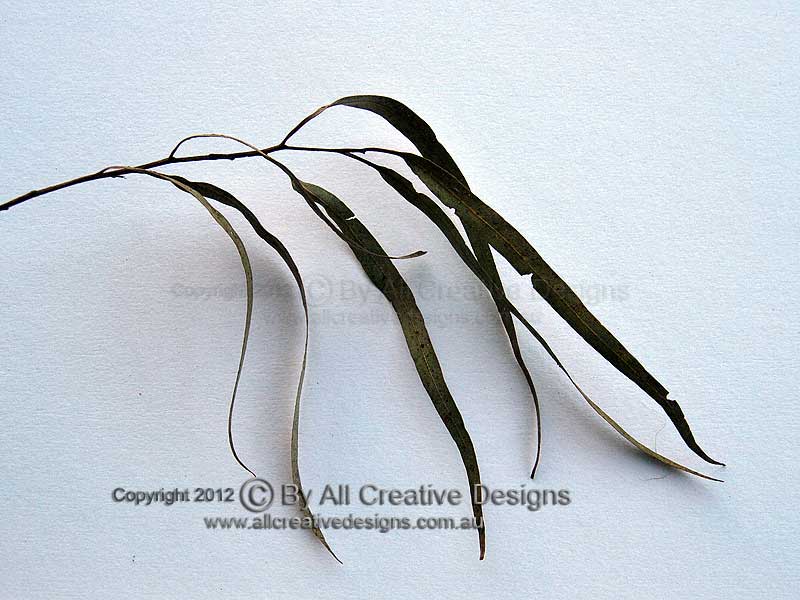
(5)
Messmate Eucalyptus obliqua
Messmate Eucalyptus obliqua Other names: Messmate Stringybark
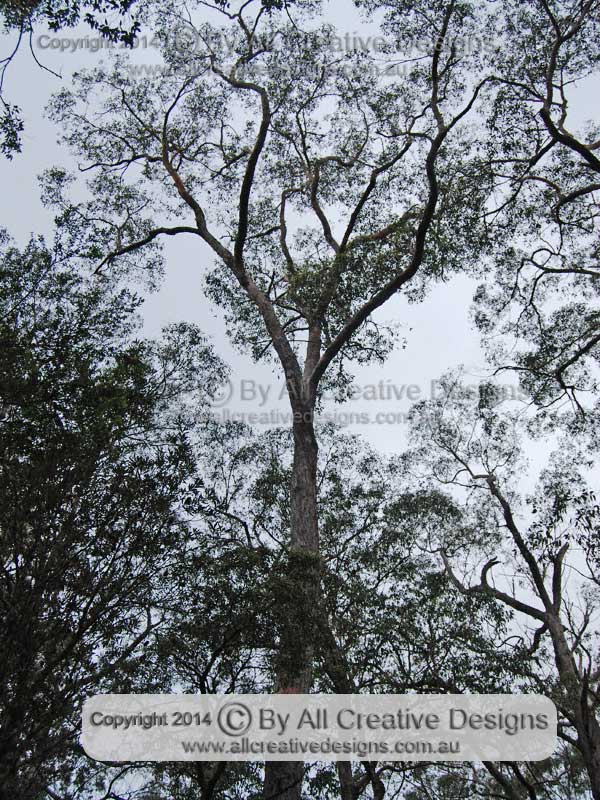
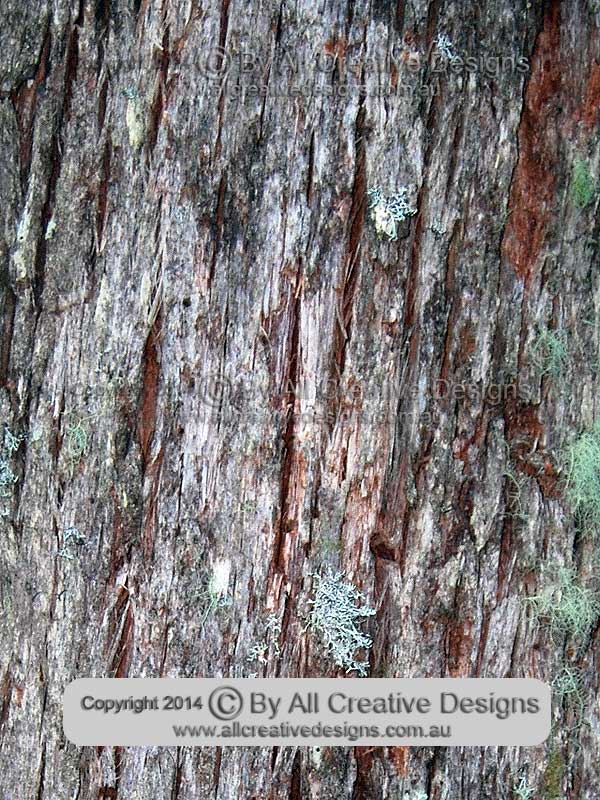
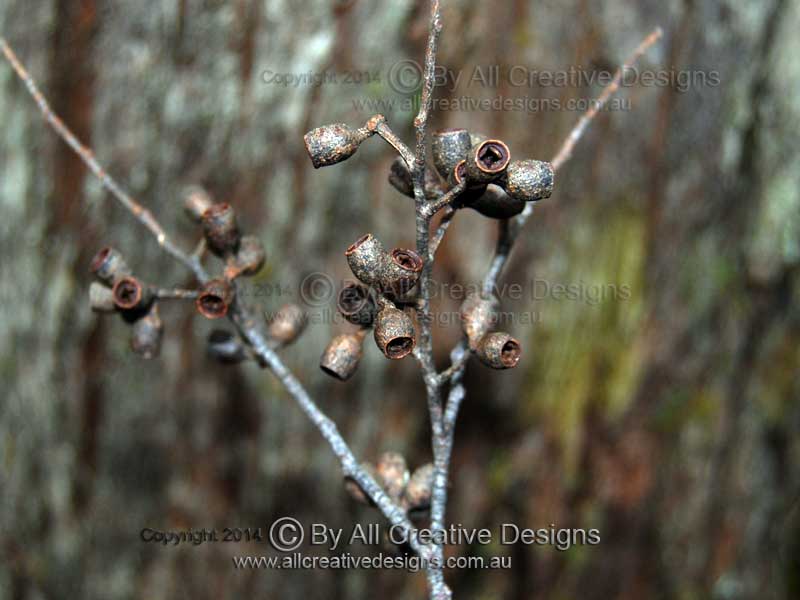
Under favourable conditions this very tall Eucalyptus species can grow to 80m, but heights of under 50m are more common and in exposed costal locations it may only be the size of a tall shrub. It has a wide distribution range and prefers mountainous location for best development (Picture 1). Trunks of tall trees are columnar and branchless to half or more of its height (2). Bark is a reddish brown in colour with older surfaces weathering to grey. It is rough, furrowed and rather soft, fibrous in texture (3). The woody fruit varies from barrel-shaped to more urn-shaped and measures up to 12mm in length. It has a rough surface and features 3 or 4 slightly sunken valves (4). Simple adult leaves with an alternate arrangement are; up to 18cm long, broadly lanceolate or curved (falcate) in shape with entire margins, dark green, semi-glossy on top, similar green beneath (concolorous), firm and leathery in texture. Leaf apex tapers into a fine point, base shape is oblique (asymmetric). Leaf stalk is up to 20mm long (5). Distribution: Tas., SA, Vic., NSW and southern Qld.
(1)

(2)
(3)
(4)
(5)
See
Leaf -
Flower - Fruit - and Bark Identification Web Pages for explanations of botanical definitions and concepts.
Select images for Full Size View. (Opens new browser window).
Use the Key to Species, which is based on leaf characteristics, to identify native trees and shrubs found on Australia's east coast.
Narrow-leaved Peppermint Eucalyptus radiata ssp. sejuncta
Narrow-leaved Peppermint Eucalyptus radiata subspecies sejuncta
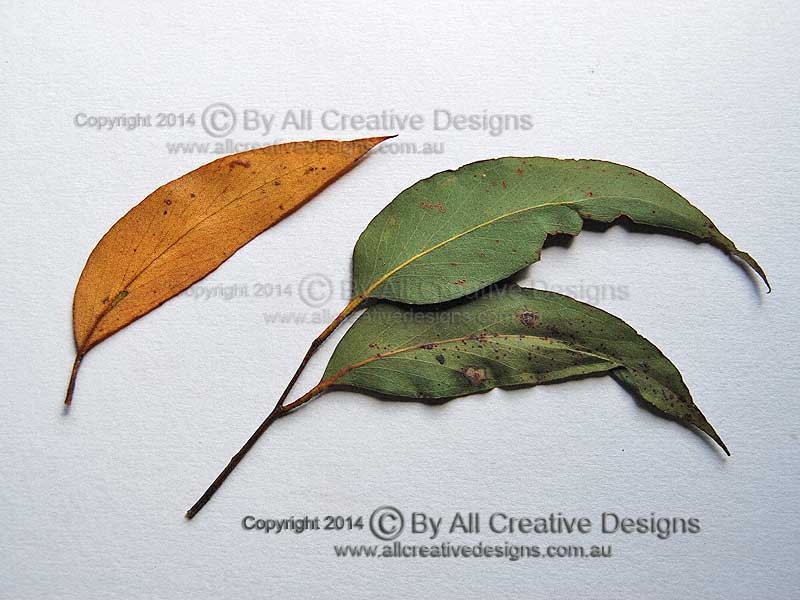
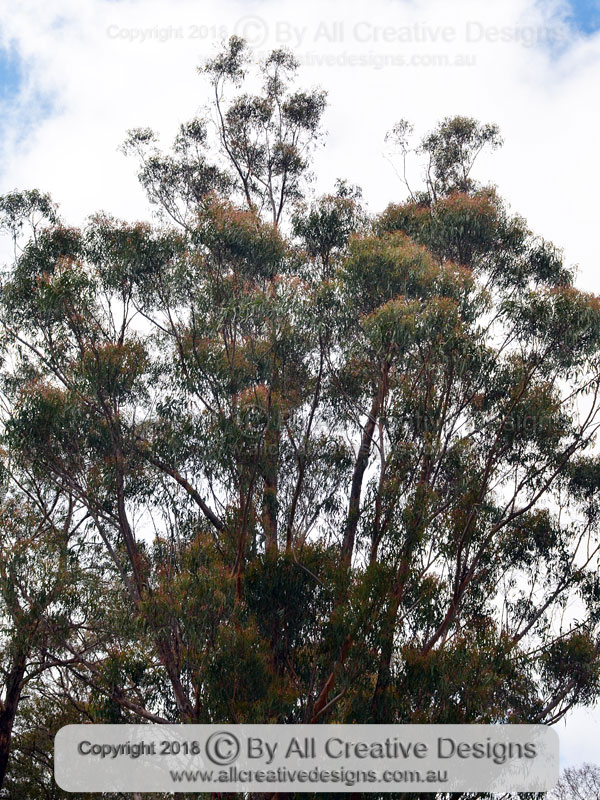
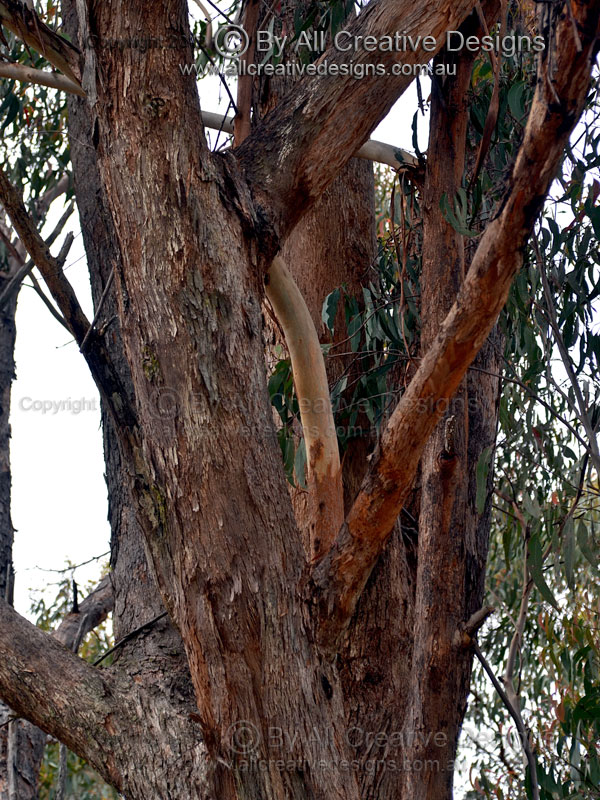
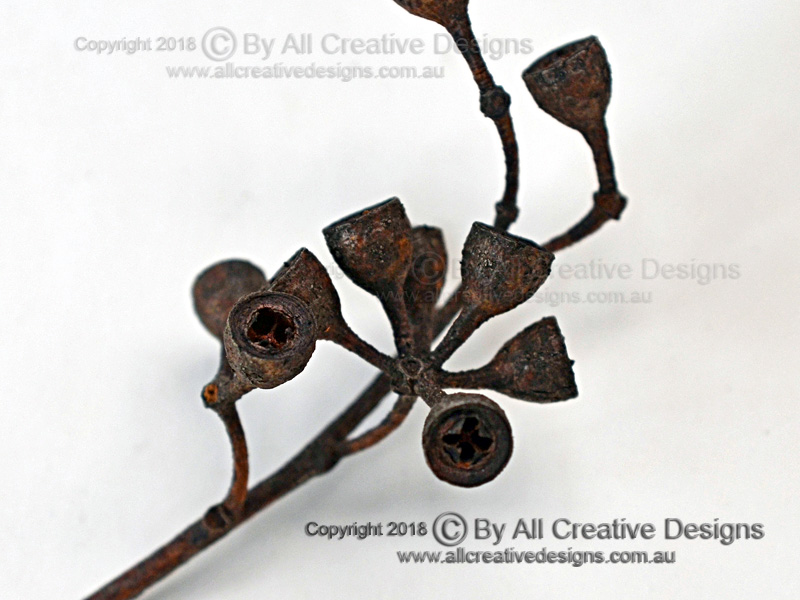
As the common name implies, the Narrow-leaved Peppermint belongs to a group of Eucalyptus trees that are easily recognised by the peppermint scented oil contained in their leaves. Compared to many other Eucalypts, this species has a relatively densely foliated and multi-branching crown. Depending on conditions, it can be up to 50m tall, but a height of 15-30m is more common (Picture 1). Bark on the lower trunk is grey or grey-brown in colour and finely rough, fibrous (stringy) in texture, whereas on older branches it becomes flakier and sheds in strips. Young branches are covered in smooth grey bark (2). The woody fruit measures up to 6mm long, up to 6mm wide, and is supported by rounded stalks 4 to 5mm long. It features a broad flat disc and 3 to 5 valves, with tips that are even height with, or slightly exerted above, the rim level after opening. The shape of the fruit varies from cup-shaped to pyriform (pear-shaped) (3). Adult leaves are up to 15cm long and narrower than the intermediate leaves shown. Intermediate leaves feature an alternate arrangement and are; up to 18cm long, lanceolate (lance-shaped) or slightly curved (falcate), semi-glossy, the same colour green on both surfaces (concolorous), thin leathery in texture and strongly scented when crushed. The leaf venation is distinctive (4 & 5). Three subspecies are recognised subsp. ratiata, subsp. robertsonii and subsp. sejuncta. Distribution: Vic., NSW to the Qld border at higher altitudes. Note: Oil extracted from leaves is used in the production of perfumes and the leaves are a koala food source.
(1)
(2)
(3)
(4)
(5)
New England Blackbutt Eucalyptus andrewsii
New England Blackbutt Eucalyptus andrewsii subspecies andrewsii
This tall Eucalyptus species prefers locations at higher altitudes along the Great Dividing Range, where under good conditions it can reach a height of 40m or more. In tall open forests it develops a straight trunk devoid of major branches up to the height of the relatively open crown (Picture 1). Bark on mature trees shows vertical fissures and is rough and coarsely fibrous in texture. Weathered outer bark is grey in colour, fresh underlying bark is light brown (2). Up to 15 separate flowers buds are grouped on a common stalk (peduncle) measuring up to 2cm in length. Buds are up to 5mm long and start appearing over winter time (3). The woody fruit is half rounded (hemispherical) in shape and measures up to 5mm in diameter, it shows 4 or sometimes 5 valves which are normally level with the very wide rim (4). Simple adult leaves are; up to 18cm long, falcate (sickle shaped) or more lanceolate (lance-shaped) with entire margins, the same mid-green on both surfaces (concolorous), rather dull, strong and leathery in texture. Leaf stalk (petiole) is yellowish in colour and up to 2.5cm long. Leaf apex very gradually narrows into a fine tip, base shape is uneven (oblique). Venation is inconspicuous showing a network of wavy lateral veins under closer inspection (5). Distribution: Higher country from the mid-north coast of NSW to central Qld.
(1)

(2)

(3)

(4)

(5)
Pink Bloodwood Corymbia intermedia [Eucalyptus intermedia]
Pink Bloodwood Corymbia intermedia [Eucalyptus intermedia]
The Pink Bloodwood tree is a medium to tall tree species reaching 35m or more in height and is found in open tall forests (Picture 1). Bark, continuing to small branches, is a pale grey brown colour, rough and scaly in texture with patches of exposed resin (kino) often visible (2). The rather open canopy can spread to a wide margin (3). The woody fruit is urn or more barrel-shaped and measures up to 2cm in length, the outer surface is very rough, covered in small warts and speckles. Four deeply seated valves release reddish brown seeds enclosed in a papery wing (4). Alternately arranged adult leaves are; up to 16cm long, lanceolate or broadly lanceolate (lance-shaped) with entire margins, dark green on top, paler green beneath, only faintly scented when crushed, strong and firm in texture. Older leaves often turn red before falling (5). Distribution: NSW central coast to northern Qld.

(1)
(2)

(3)
(4)
(5)
Red Bloodwood Tree Corymbia gummifera [Eucalyptus gummifera]
Red Bloodwood Tree Corymbia gummifera [Eucalyptus gummifera]
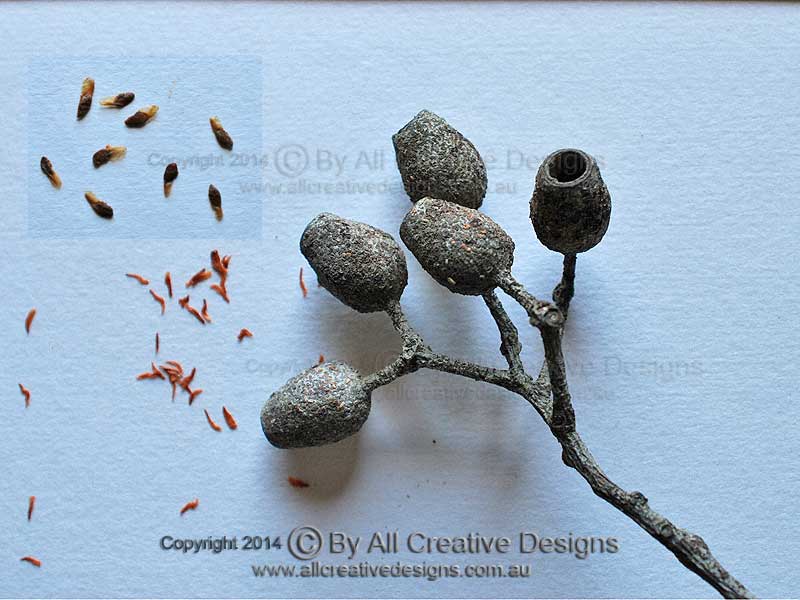
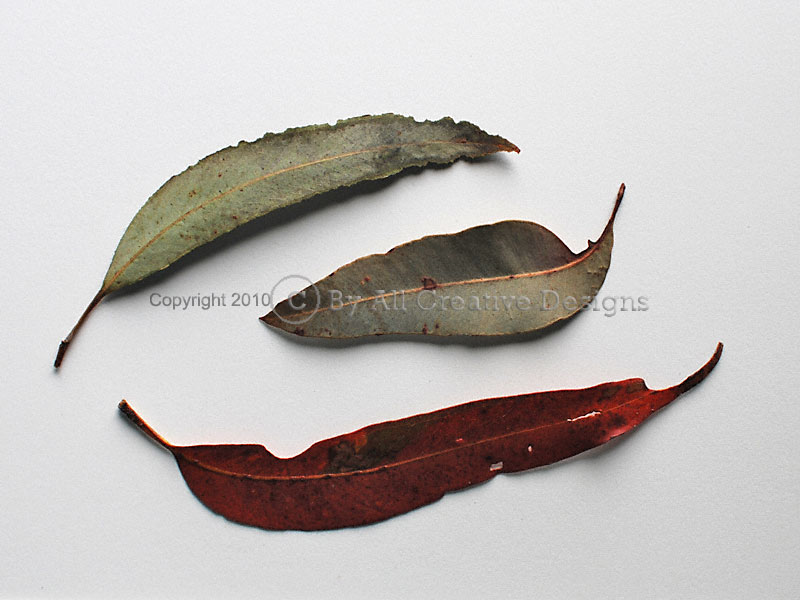
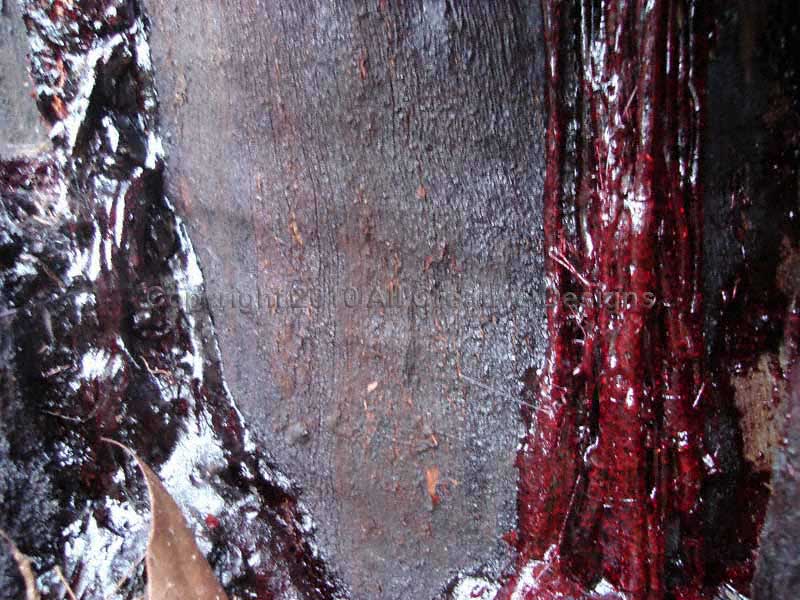
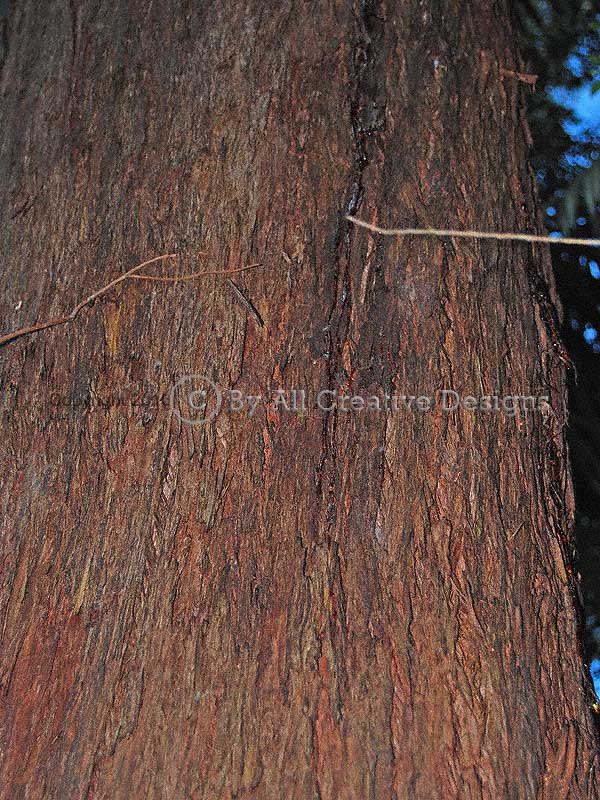
This tall native tree species is found in tall open (Eucalypt dominated) forests growing to a height of 45m (Picture 1). A distinctive feature of this tree is the red sticky resin (kino), produced where an injury occurred or as a protection against termite attack (2). Bark is a reddish brown weathering to grey with a flaky, scaly texture covering the whole tree to the smallest branches (3). The woody fruit is urn-shaped and reaches up to 2cm in length. Four deep seated valves release brown coloured seeds with a small surrounding flange (4). Adult leaves on mature specimens are; alternately arranged, up to 15cm long, lanceolate (lance-shaped) with entire margins, dark green on top, paler green beneath, only faintly scented when crushed. Closely spaced straight lateral veins are visible (5). Distribution: From Vic., to southern Qld.

(1)
(2)

(3)

(4)

(5)
Descriptions and all images copyright ©2023 by www.allcreativedesigns.com.au world wide rights reserved.
Click or Tap Images for Full Size View
Red Mahogany Eucalyptus resinifera
Red Mahogany Eucalyptus resinifera Subspecies: hemilampra Other names: Red Messmate
The Red Mahogany Eucalyptus resinifera is a tall tree reaching heights of more than 40m and occurs mainly in tall open forests (Picture 1). The reddish brown bark is very stringy, fibrous in texture and can exude some resin (2). Flower buds are an elongated cone shape and measure up to 12mm in length (3). The fruit can vary in shape from ovoid to more cup-shaped and reaches up to 12mm in length. 3 or sometimes 4 sharply pointed valve tips extend beyond the flat rim and release numerous fine brown seeds (4). Simple adult leaves with an alternate leaf arrangement are; up to 15cm long, mainly broadly lanceolate (lance-shaped) with entire margins, discolorous, scented when crushed (5). Distribution: South coast of NSW to southern Qld. Note: This species is a koala food source.
fs.jpg)
(1)
(2)

(3)

(4)
(5)
Scribbly Gum Eucalyptus signata
Scribbly Gum Eucalyptus signata
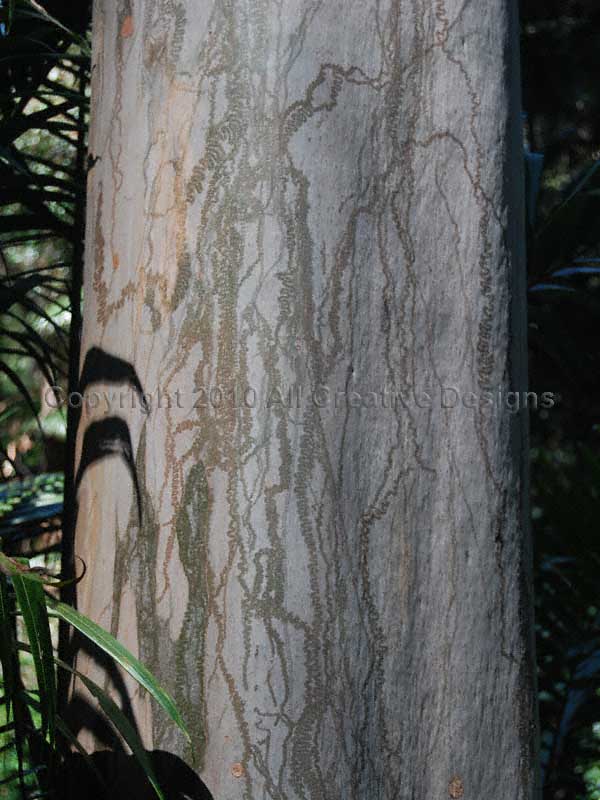
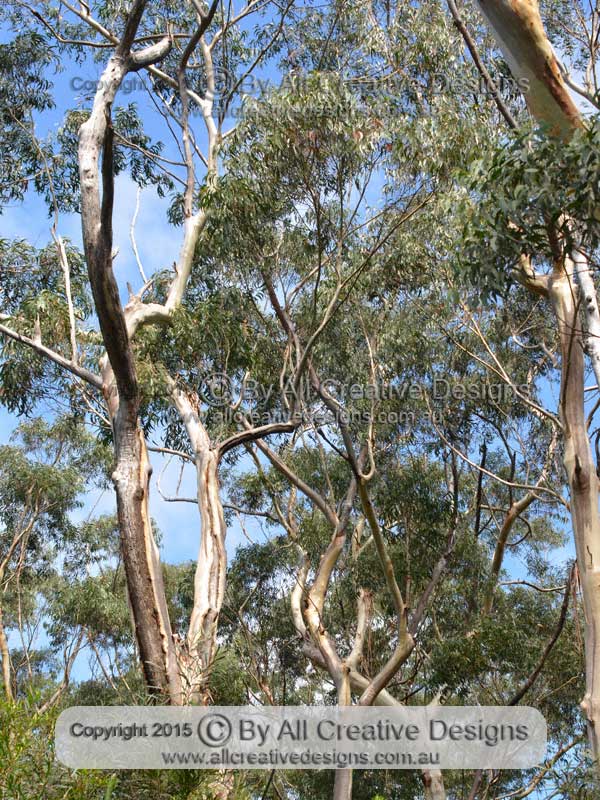
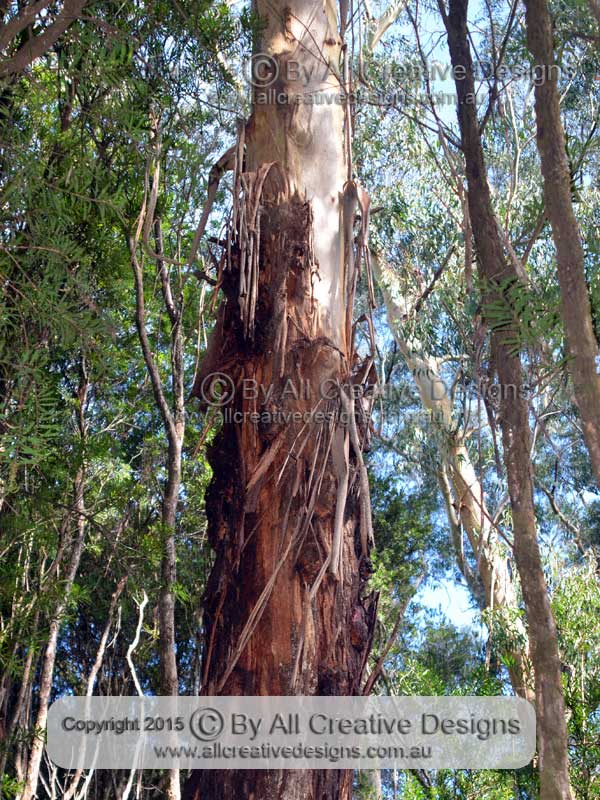
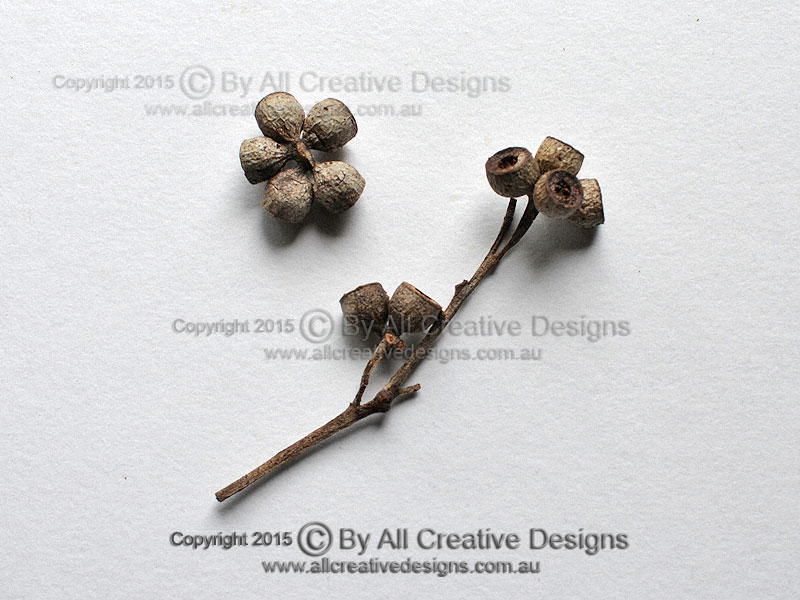
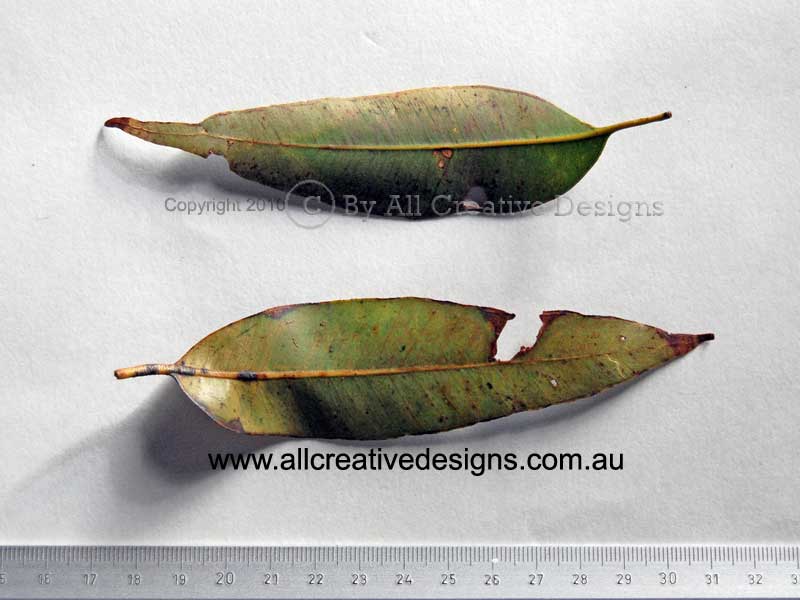
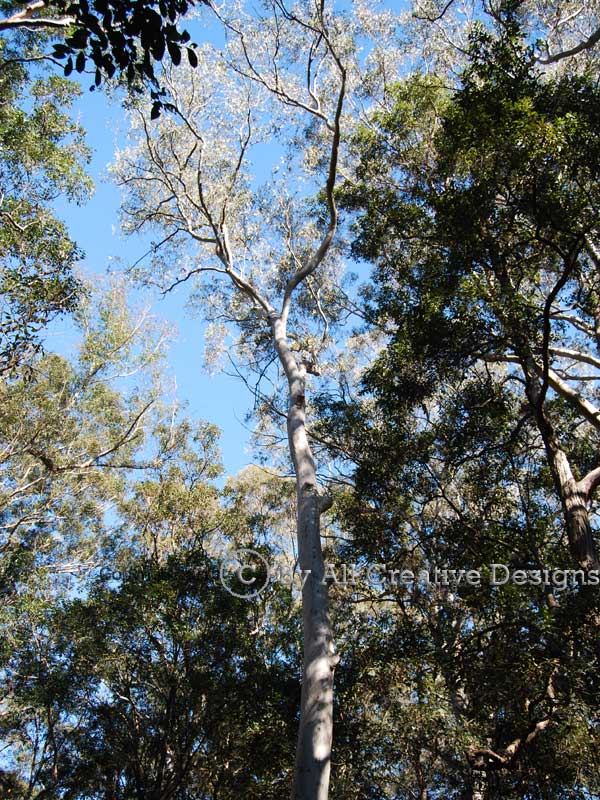
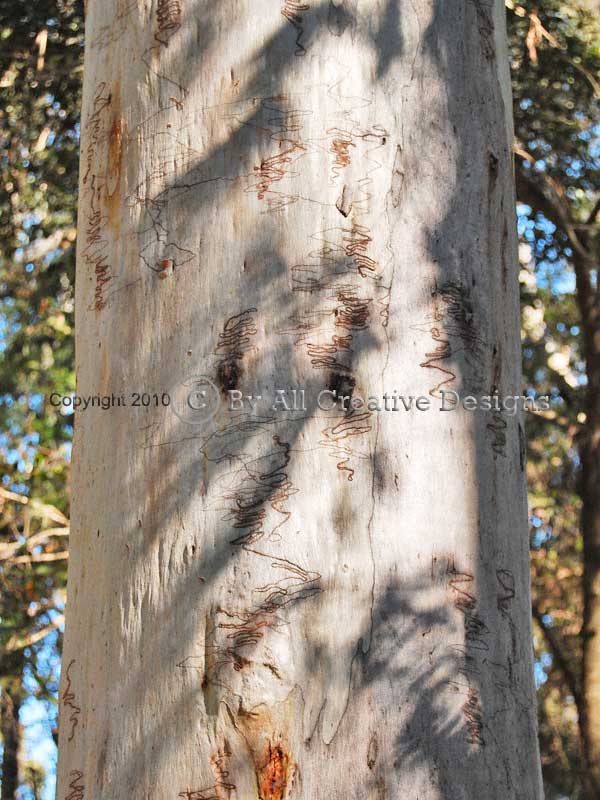
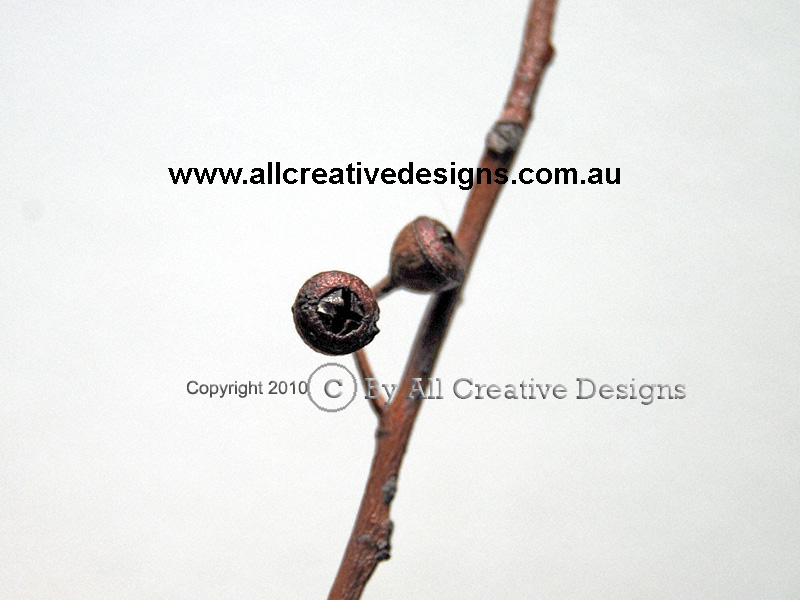
This medium size tree species is mostly found in wetter coastal areas or open forests, where it can attain a height of up to 25m (Picture 1). The bark is smooth and firm, white to light grey in colour showing the distinctive scribbles (2). The crown is limited to a few steep angled main branches supporting a very open canopy (3). Fruit is relatively small at 5 to 7mm in diameter and length. It features 4 exerted valve tips, slightly raised above the rim level (4). The simple leaves (adult) with an alternate arrangement are; up to 15cm long, lanceolate (lance-shaped) with entire margins (deformation are visible), firm and leathery, hairless and scented, semi glossy and mid green in colour on both surfaces. Venation is faint but visible, showing numerous straight lateral veins (5). Distribution: NSW central coast to southern Qld. Note: There are a number of closely related species sharing the same common name.
(1)
(2)

(3)
(4)
(5)
Shining Gum Eucalyptus nitens
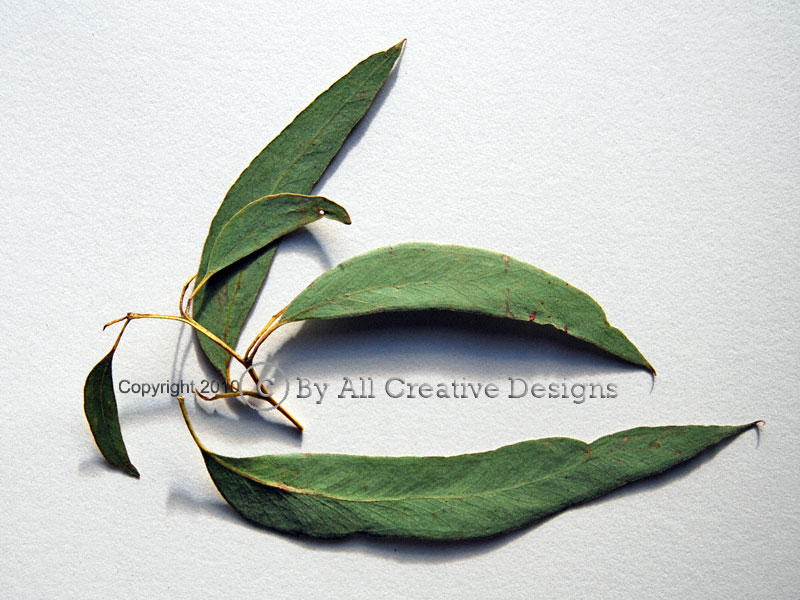
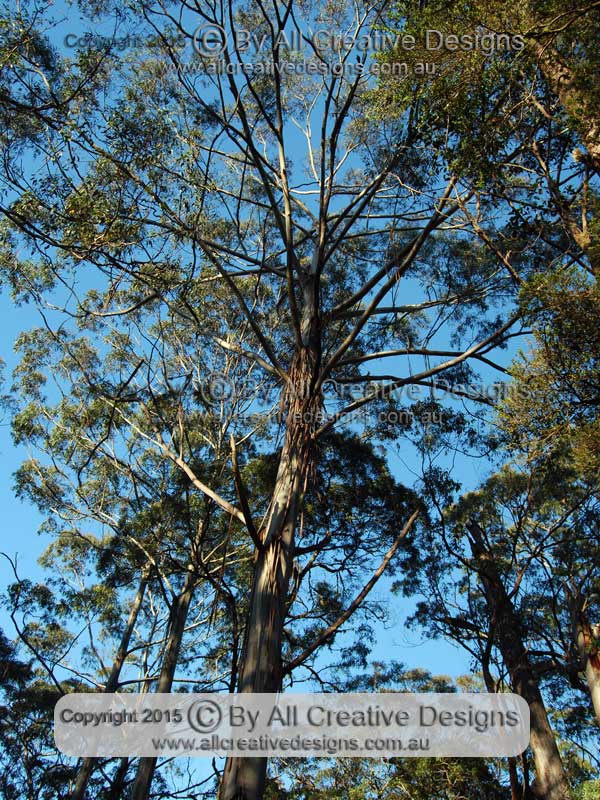
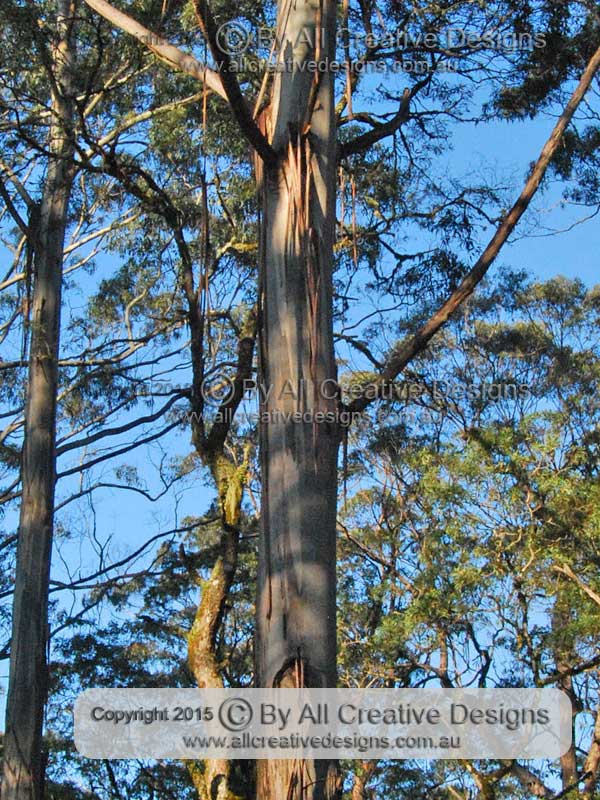
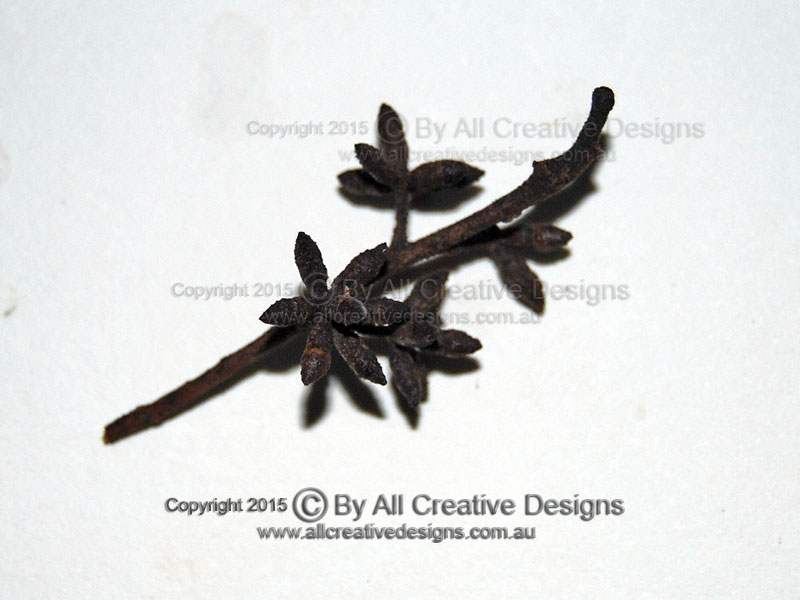
Shining Gum Eucalyptus nitens
Under ideal conditions this very tall tree is able to reach more than 80m in height. It prefers mountainous areas with high rainfall totals along the Great Dividing Range (Picture 1). Bark except for a short stocking at the base is smooth in texture and shades of grey in colour. It sheds in long narrow strips which often decorate the upper branches (2). Groups of up to 7 separate flower buds are borne on a common stalk (peduncle) up to 12mm long (3). The fruit is barrel-shaped and relatively small at only 5 to 6 mm in length. It features mostly 3 valves with pointed tips reaching rim level or slightly above (4). The simple leaves (adult) with an alternate arrangement are; up to 30cm long, narrow lanceolate (lance-shaped) with entire margins, firm and leathery, hairless, glossy when fresh and mid green in colour on both surfaces (concolorous). Leaf apex very gradually narrows into a fine tip, base shape is cuneate. Distribution: Vic., & NSW.
(1)
(2)
(3)

(4)

(5)
Snow Gum Eucalyptus pauciflora
Snow Gum Eucalyptus pauciflora Other names: Cabbage Gum, White Sally
Depending on location the Snow Gum can be a stunted shrub in alpine terrain or under more favourable conditions a medium sized tree. There are 4 recognised subspecies; Eucalyptus pauciflora ssp. pauciflora (shown), ssp. niphophila, ssp. lacrimans and ssp. debeuzevillei (Picture 1). Fresh bark is smooth in texture and colours range from white to dark grey with pink and yellow hues. Bark is shed in irregular patches or in short broad strips (2). Flower buds are club-shaped (clavate) and measure up to 1cm in length. A maximum of 15 buds are borne on a common stalk (peduncle) reaching 15mm in length, pedicels (individual stalks) are absent or only very short (3). The shape of the fruit is varied from cup-shaped (cupular) to more upside down cone-shaped (obconical). It measures up to 15mm in length with mostly 3 rounded valves reaching the height of the broad rim (4). Simple leaves with an alternate arrangement are; up to 16cm long, lance-shaped, straight or slightly curved, glossy, dark green on both surfaces (concolorous), strong and leathery in texture. Longitudinal veins are obvious (5). Distribution: Tas., SA, Vic., NSW and south-eastern Qld. Note: This species is a koala food source.

(1)

(2)
(3)

(4)

(5)
Southern Mahogany Eucalyptus botryoides
Southern Mahogany Eucalyptus botryoides Other names: Bangalay
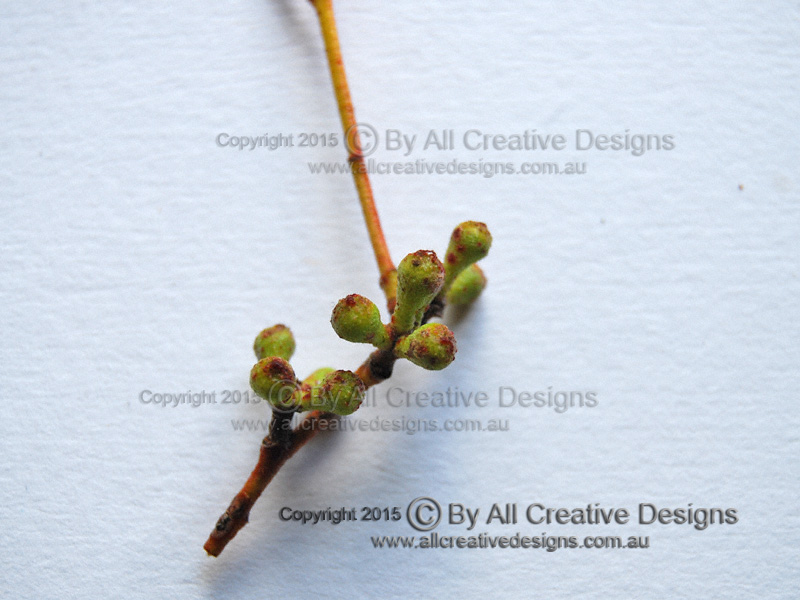
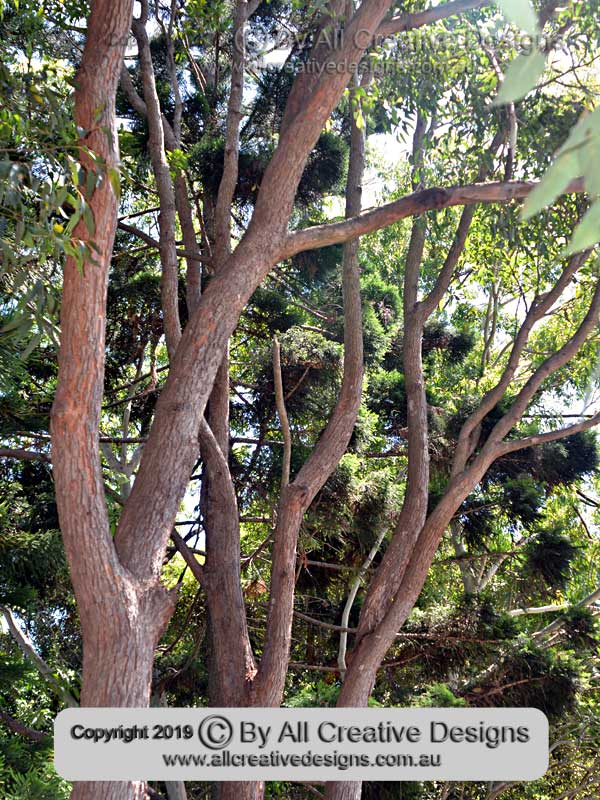
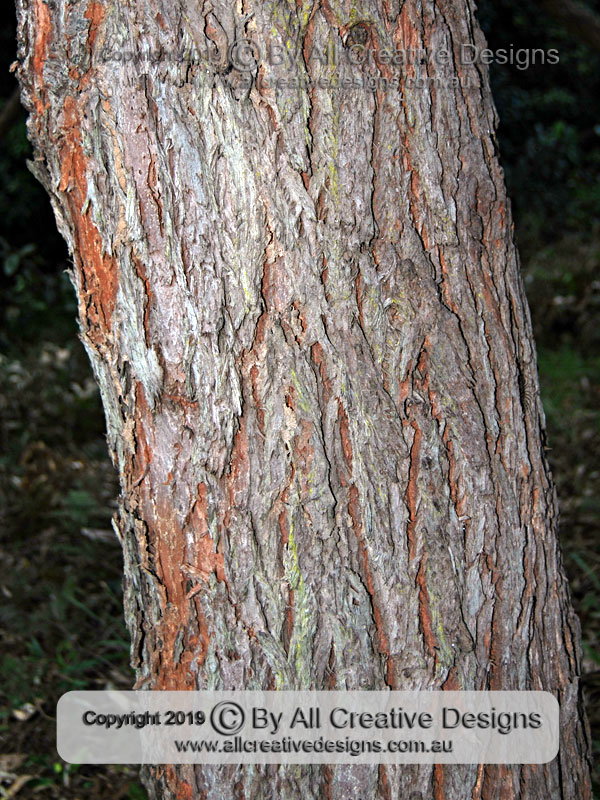
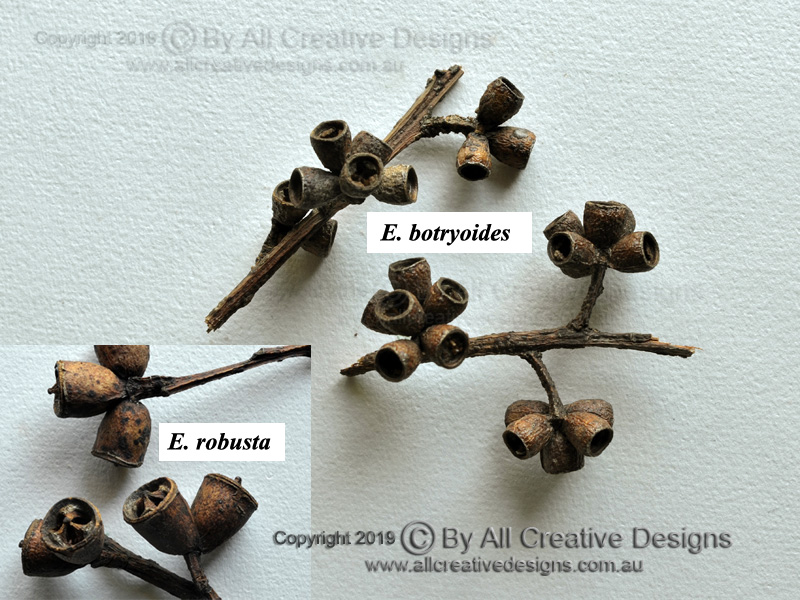
The Southern Mahogany has the potential to reach a height of up to 40m when inhabiting tall Eucalypt forests at lower altitudes along the escarpment. It is more likely to be a smaller multi-branching tree when growing on sandy soils within exposed coastal regions. It is very similar to the Swamp Mahogany (E.robusta listed below) in appearance and often shares a habitat with this species (Image 1). Bark is reddish brown weathering to grey and has a rough fibrous, somewhat flaky texture with longitudinal fissures. Bark on younger branches is greyish white and smooth. Bark of E. robusta is spongier and fissures are more widely spaced (2). The woody fruit is mostly cylindrical or more barrel-shaped, up to 12mm long and features 3 or 4 valves with tips not extending past the rim. The fruit of E. robusta (inset) is considerably larger (18 to 20mm) and valves, reaching above the rim, are conspicuously jointed in the centre. Fruit of the Southern Mahogany (E. botryoides) is attached without individual stalks (sessile) to a primary stalk (peduncle) less than 2cm long. The fruit of E. robusta can be sessile (shown) or feature individual stalks (pedicels) up to 10mm long (3). Simple adult leaves have an alternate arrangement and are; up to 20cm long, broadly lance-shaped (lanceolate) with entire margins, dark green above, considerably paler beneath (strongly discolorous), scented when crushed, strong and leathery in texture. Leaf apex gradually tapers to a fine tip (4 & 5). Distribution: Coastal Vic. to central coast of NSW.
Note: This species is a koala food source.
(1)
(2)
(3)
(4)
(5)
Spotted Gum Corymbia maculata [Eucalyptus maculata]
Spotted Gum Corymbia maculata
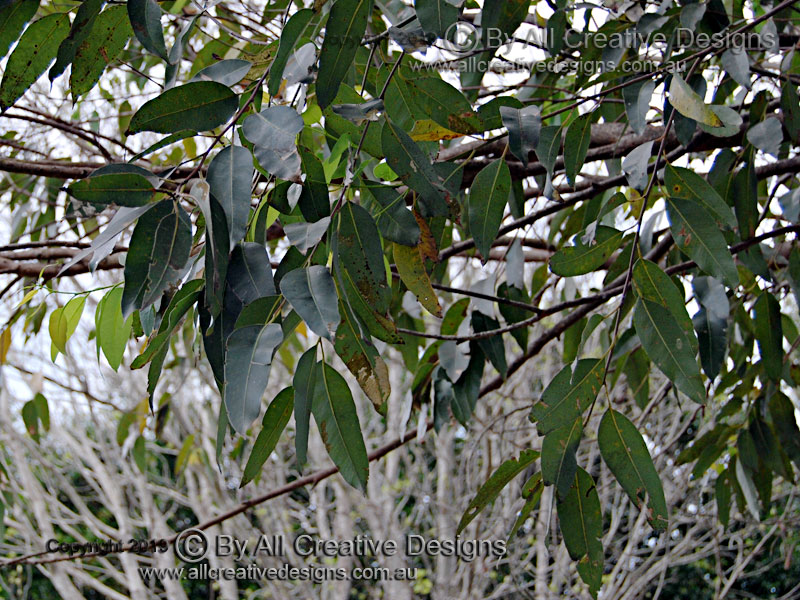
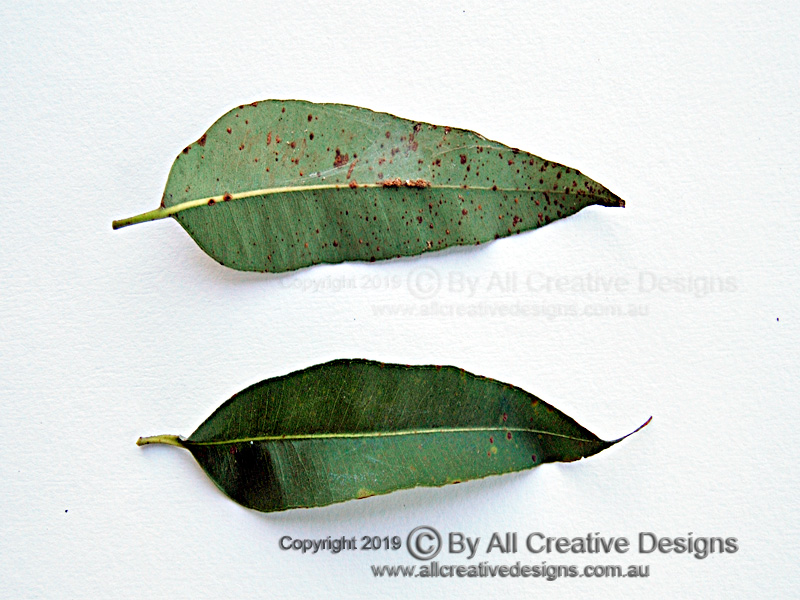
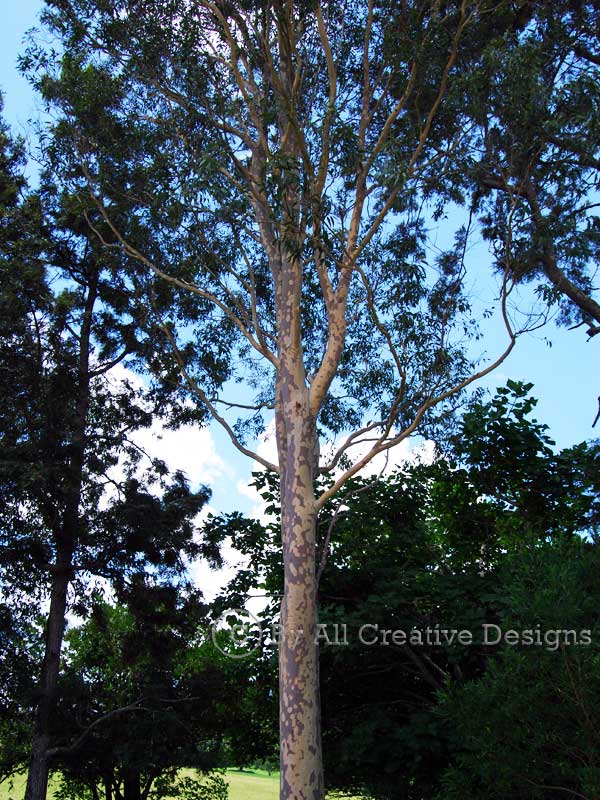
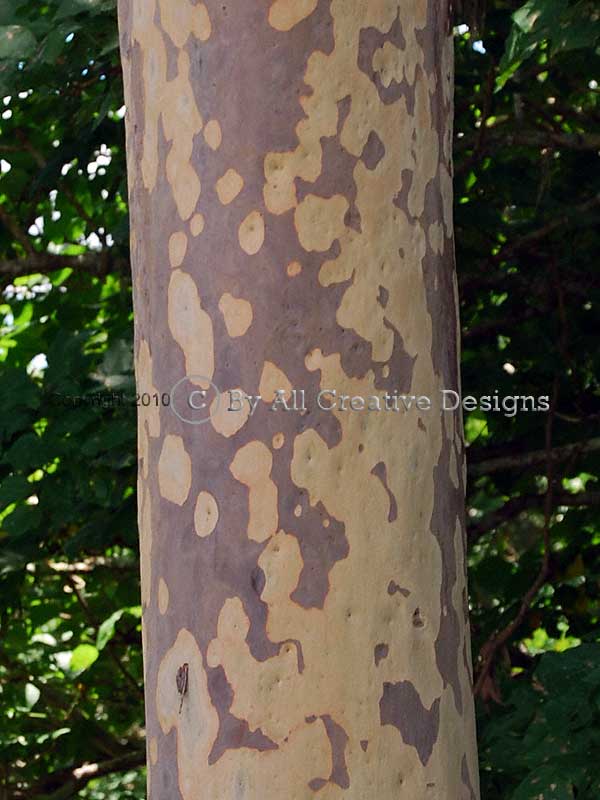
The distinctive bark is one of the first identification feature of the Spotted Gum Corymbia maculata. Under favourable conditions this tall tree species can reach 45m or more in height. Its habitat ranges from close proximity to the coast to open forests along the escarpment (Picture 1). The very smooth bark covers the whole tree (no rough stocking) and is various tones of grey in colour, relating to the maturity of bark after shedding in irregular rounded plates (2). Ovoid shaped flower buds are up to 1cm in length (3). The fruit shown is in its' early development stage, still green in colour turning brown and woody with age. It is up to 15mm long with deeply sunken valves and a thick rim (4). Alternate simple adult leaves are: up to 21cm long with entire margins, lanceolate in shape (image is showing intermediate leaves which are slightly broader), grey green on top and similar coloured below, firm and leathery in texture. Leaf apex is gradually tapering to a fine point (5). Distribution: NSW south coast to NSW mid-north coast. Similar in appearance to C. citriodora, but leaves of this species are not lemon-scented.
See Flower Characteristics Page and Leaf Characteristics Page for information on terms used.
(1)
(2)

(3)
(4)
(5)
Swamp Mahogany Eucalyptus robusta
Swamp Mahogany Eucalyptus robusta Other names: Swamp Messmate
The Swamp Mahogany reaches a height of about 30m with main branches starting at more than half the height of the normally straight trunk (Picture 1). Bark is persistent to the smallest branches; softly fibrous in texture and a light reddish brown in colour (2). Up to 15 individual flowers are held atop a flattened common stalk (peduncle) up to 3cm long. Individual flower stalks are up to 1cm long, but are sometimes absent (sessile). The prominent operculum is beak-shaped (3). The cylindrical shaped fruit is up to 16mm long and 10mm across featuring 3 or 4 valves, which are normally slightly raised above the rim level and conspicuously jointed at the centre (4). Simple alternately arranged leaves (adult) are; up to 16cm long with entire margins, broadly lanceolate (lance-shaped) with entire margins, dark green, glossy above, paler green beneath, firm, leathery and scented when crushed. Mid vein is raised on lower surface with numerous straight lateral veins showing (penniveined) (5). Distribution: Coastal areas from NSW south coast to central Qld. Note: This species is a primary koala food source.
(1)
(2)

(3)

(4)
(5)
Tallowwood Eucalyptus microcorys
Tallowwood Eucalyptus microcorys
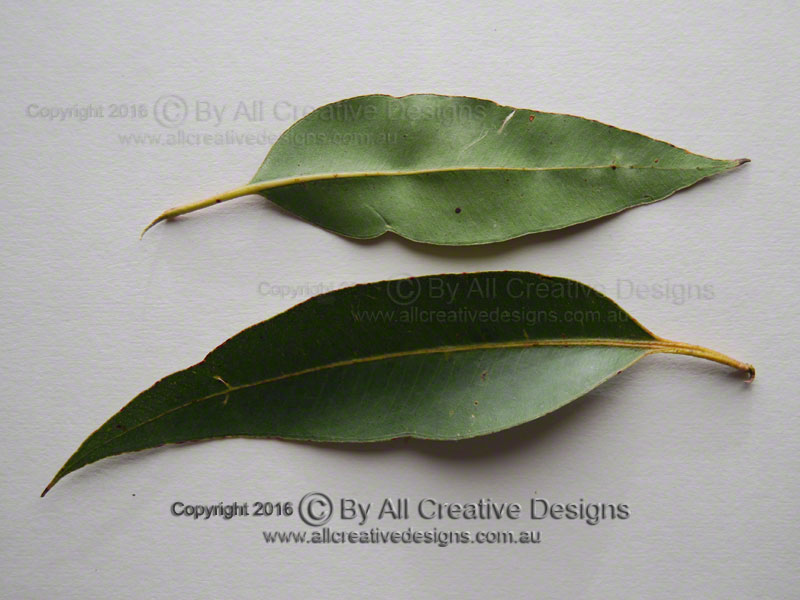
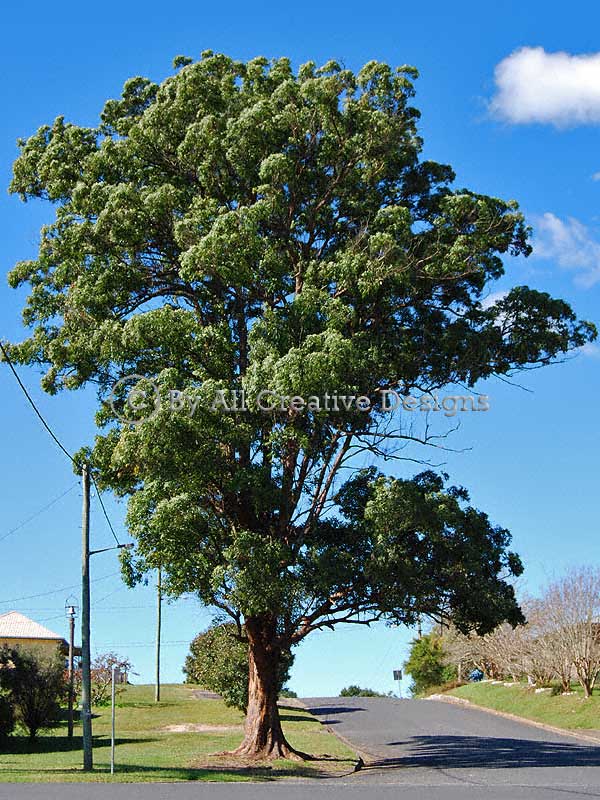
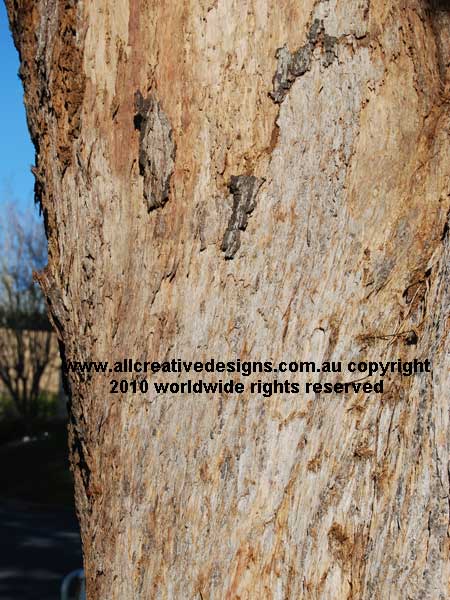
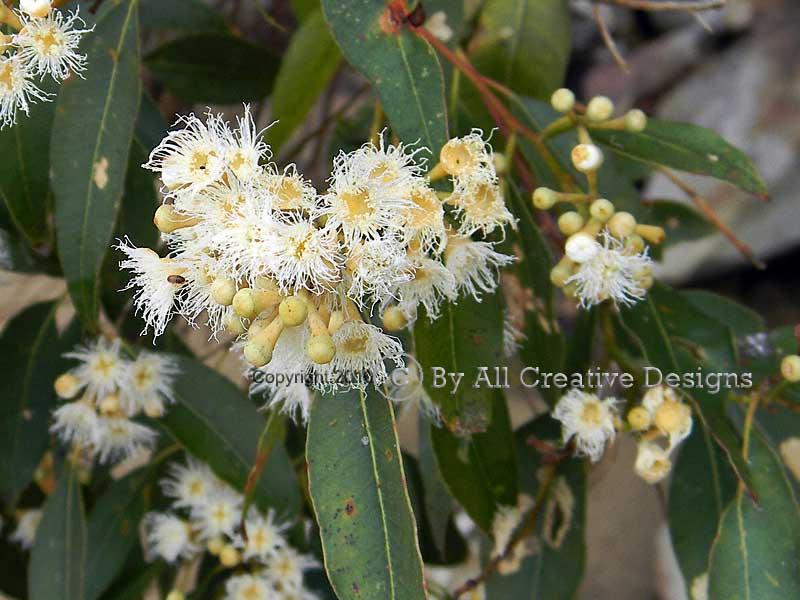
This very tall tree species and can reach more than 60m in height with a trunk diameter of more than 2m (Picture 1). The conspicuous bark is mostly light brown in colour, with a red tinge, and soft fibrous in texture (2). Masses of scented small white flowers appear in winter to early spring (NSW north coast). Flowers are held in groups of up to 9 individuals emerging from axillary joints towards the end of small branches. Flower feature a prominent stalk (pedicel) that tapers towards the base (3).The small fruit measures only up to 5mm across and is less than 10mm long with 3 or sometimes 4 valves that are level with the rim or are slightly exerted (4). Simple adult leaves have an alternate arrangement and are; up to 13cm long, lanceolate (lance-shaped) with rough entire margins, relatively thin but strong in texture. Juvenile leaves are ovate (egg-shaped) and up to 8cm long (5). Distribution: NSW central coast to southern Qld. Note: This species is a primary koala food source.
(1)
(2)
(3)

(4)
fs.jpg)
(5)
Thin-leaved Stringybark Eucalyptus eugenioides
Thin-leaved Stringybark Eucalyptus eugenioides [E.nigra]
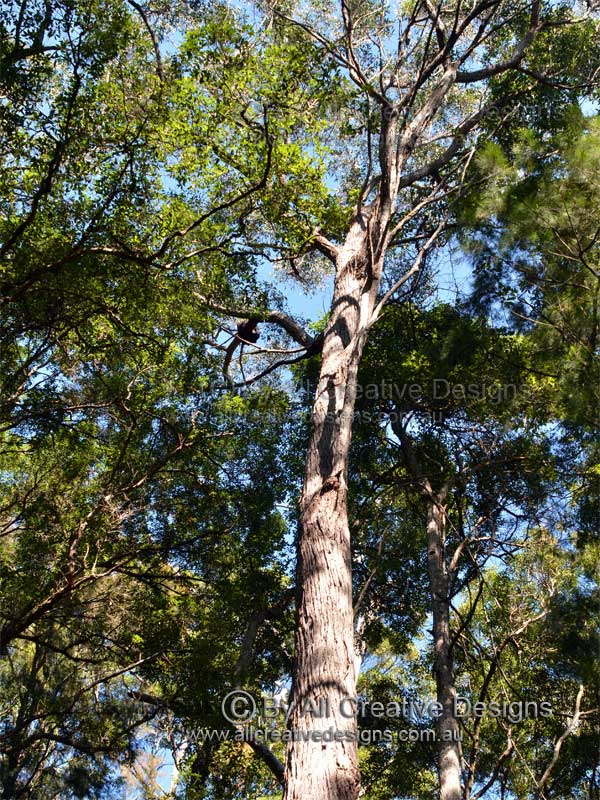
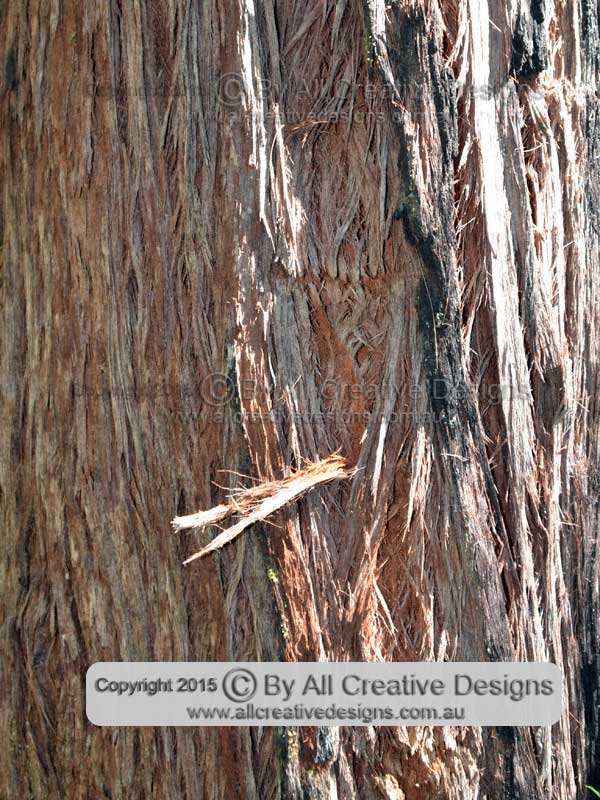
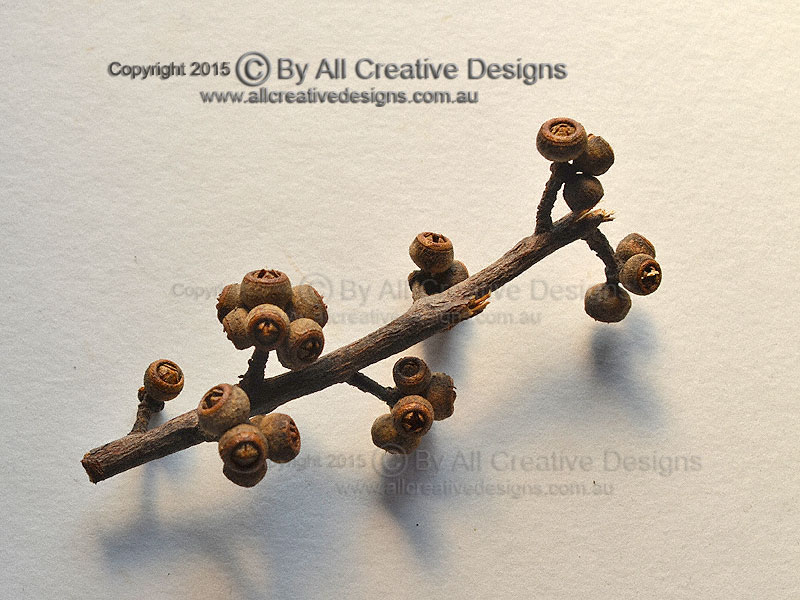
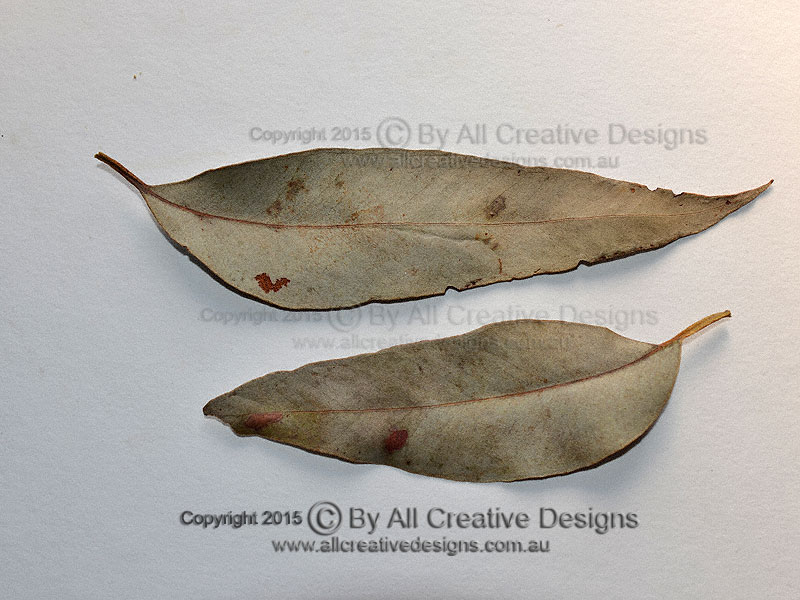
The Thin-leaved Stringybark is an abundant tall tree reaching 35m in height under ideal conditions. It is very similar in appearance to a number of other Stringybarks, such as the White Stringybark (E. globoidea) Tindale's Stringybark (E.tindaliae) (Picture 1). Older bark weathers to grey and fissures on the surface to expose a red brown underlayer of fresh bark, texture is very rough and fibrous (2). The fruit is hemispherical in shape measuring up to 8mm in diameter and can be misshapen when appearing in tight clusters. A broad disc and 4 slightly exerted valve tips are typical (3). The fine seed is roughly pyramid-shaped and brown to dark brown in colour (4). Simple adult leaves with an alternate arrangement are; up to 13cm long, lanceolate (lance-shaped) or falcate (sickle-shaped), glossy green on both surfaces when fresh and scented when crushed. The leaf base shape is noticeable asymmetric (oblique). Juvenile leaves are broader and up to 15cm long (5). Distribution: NSW south coast to southern Qld. Note: This species is a koala food source.
(1)
(2)
(3)

(4)
(5)
White Mahogany Eucalyptus acmenoides
White Mahogany Eucalyptus acmenoides Other names: Yellow Stringybark
Under favourable conditions the White Mahogany can reach a height of 60m with a trunk measuring up to 1.5m in diameter at the base (Picture 1). Bark is greyish light brown, very fibrous and stringy, covering all parts of the tree to the smaller branches (2 & 3). The woody fruit is globe-shaped with a flattened apex or more hemispherical and measures up to 7mm across. It features mostly 4 valves that are slightly sunken or are level with the rim (4). Simple adult leaves with an alternate arrangement are; up to 12cm long, lanceolate (lance-shaped) with entire margins, dark green above, paler beneath (discolorous), relatively thin, but leathery in texture. Juvenile leaves (shown to the right) are broader lance-shaped. Leaf apex terminates in a fine tip (5). Distribution: NSW central coast to central Qld.
fs.jpg)
(1)

(2)
fs.jpg)
(3)

(4)
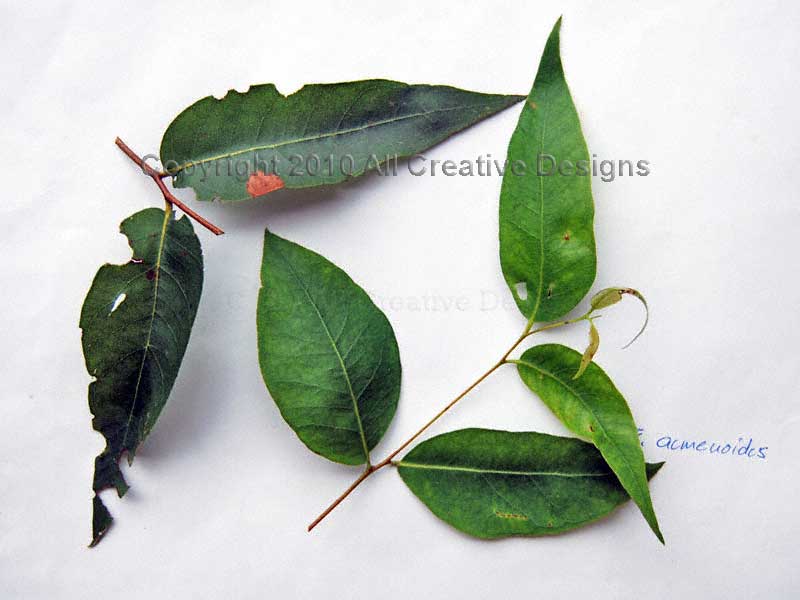
(5)
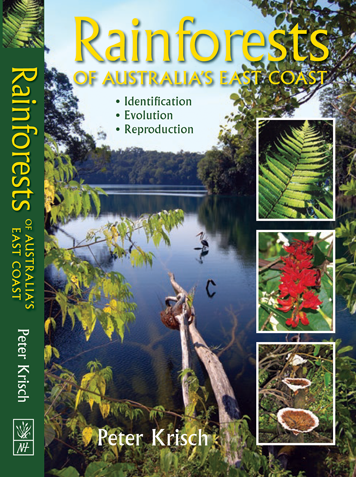
Rainforests of Australia's East Coast, HAND SIGNED BOOKS; (Out of Stock) A practical and informative field guide to the identification of native rainforest species. More than 800 colour photographs, informative graphics, maps and detailed description of more than 300 species.
This book is a valuable information source for bushwalkers, students, gardeners and anyone with an interest in Australia’s native flora.
The book was written and illustrated by the author of the tree identification web pages.
New Holland Publishers: May 2019
ISBN: 9781925546293
Format: Paperback with PVC
Pages: 304 pp.
Size: 23 cm high x 15 cm wide
Full Colour Photography
Rainforests: Identification - Evolution - Reproduction
Dedicated photography of rainforest species including; mosses, mushrooms, lichens, slime moulds, ferns, conifers, flowering trees, climbing plants, orchids and palms enable the reader to identify commonly encountered species.
CLICK HERE FOR MORE INFORMATION